The rapidly evolving commercial space sector has long been shaped by competition, innovation, and geopolitical undercurrents, but the events of December 3, 2025 injected a dramatic jolt into an already tense ecosystem. A groundbreaking Chinese rocket test intended to demonstrate a new era of reusability instead erupted into a fiery breakdown that captured global attention, while, in a separate development, a seasoned Russian cosmonaut was abruptly removed from SpaceX’s next crew mission over serious allegations of espionage. These twin shocks highlight a new era in which commercial technology, national interests, and orbital aspirations collide with unprecedented intensity.
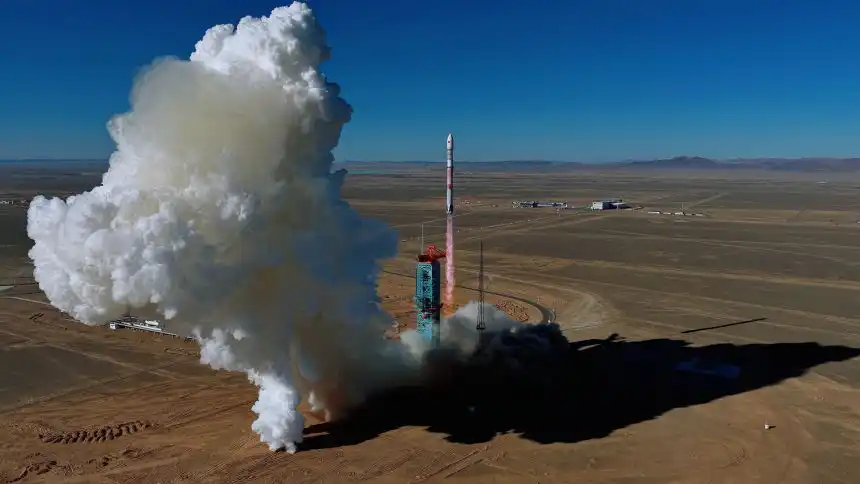
The day had begun with an atmosphere of cautious optimism in Beijing. LandSpace, one of China’s most ambitious private launch firms, was preparing for what it hoped would be a pivotal milestone in its race to challenge SpaceX. Its Zhuque-3 rocket, a sleek stainless-steel liquid methane launcher engineered to be fully reusable, ignited flawlessly at the Jiuquan Satellite Launch Center. After lifting off with thunderous precision, it surged through the morning air toward the promise of low Earth orbit, carrying only a dummy payload but very real national expectations.
The initial flight profile unfolded exactly as LandSpace’s engineers had hoped. The separation between the first and second stages executed on schedule, telemetry remained stable, and the upper stage performed its shutdown and restart as planned before placing the payload into low Earth orbit. For a fleeting moment, observers in China and abroad noted that the mission appeared on track to become the country’s first successful attempt at recovering an orbital-class booster.
Reusability carries profound strategic implications. For China, matching or surpassing the cadence of SpaceX’s Falcon 9 and Starship launch cycles is essential to deploying the vast satellite constellations envisioned under Beijing’s expanding communication and defense initiatives. A reusable Zhuque-3 would have served as a symbol of technological parity—proof that China’s emerging private players could leapfrog conventional state-owned heavyweights and rewrite the industrial hierarchy.
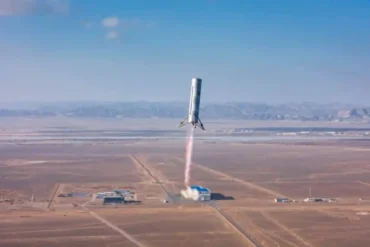
The descent of the first stage, however, quickly unraveled that narrative. As the booster fired its engines to begin the controlled landing sequence, an unexpected anomaly jolted the vehicle. Flames erupted along its engine skirt, consuming critical hardware before the stage could decelerate toward the ground. The booster tumbled and ultimately crashed at the edge of the designated landing zone, startling nearby recovery teams but causing no reported injuries.
LandSpace confirmed the failure in a terse statement that nevertheless attempted to maintain optimism. The company emphasized that the landing point remained close to the predicted trajectory and that the data collected during ascent and re-entry would still serve as a foundation for improving its reusability architecture. The cause of the mishap remains under investigation, but early indications suggest an issue in ignition sequencing or thermal stress affecting one of the landing engines.
Although the setback dealt a temporary blow to China’s ambitions, the historic significance of the attempt cannot be understated. No other Chinese company had ever attempted an orbital-class booster recovery, and only two American firms—SpaceX and Blue Origin—have successfully demonstrated reusability at comparable scale. The test positions LandSpace ahead of its domestic competitors, including China’s state-owned CASC, whose own reusable boosters remain several years from major milestone flights.
The Strategic High Ground of Reusable Launch Systems
As global launch cadence increases and satellite constellations expand into the tens of thousands, reusable rocket systems represent far more than an economic advantage. They form the backbone of national satellite deployment strategies, military communications, rapid-response space logistics, and orbital resilience frameworks. SpaceX’s early mastery of reusability enabled the swift expansion of Starlink, whose constellation now dominates commercial broadband coverage and serves as a dual-use platform for both civilian and military operators worldwide.
Beijing’s aspirations hinge on replicating this capability. China plans to deploy two mega-constellations, a massive undertaking that would be economically prohibitive without reusable systems capable of flying frequently, cheaply, and reliably. For the Chinese government, and for firms like LandSpace integrated into military-civilian cooperation channels, each step toward reusability strengthens Beijing’s long-term positioning in the strategic frontier of orbital competition.
In this context, Zhuque-3’s partial success—combined with its very public failure—serves as a catalyst for accelerated development. LandSpace has already stated its intention to move rapidly toward routine reuse and airline-style operational cadence, a goal that mirrors SpaceX’s philosophy and signals an increasingly intense technological rivalry.
Espionage Allegations Further Strain International Cooperation
The same day China grappled with its launch setback, an entirely different drama unfolded within the walls of SpaceX’s Hawthorne headquarters. Veteran Russian cosmonaut Oleg Artemyev, scheduled to fly aboard the Crew-12 mission to the International Space Station in early 2026, was abruptly removed from the roster. The reason, according to multiple sources and investigative leaks, stemmed from alleged attempts to photograph and transmit sensitive SpaceX documentation—an act that potentially violates U.S. International Traffic in Arms Regulations.
The allegations are severe. During joint training sessions in November 2025, Artemyev purportedly used his personal smartphone to capture images of proprietary SpaceX rocket engine components and classified hardware. Launch analyst Gregory Trishkin, speaking to investigative outlet The Insider, indicated that contacts within the program confirmed the violation, describing the act as too deliberate and too egregious to be accidental.
ITAR regulations exist to prevent foreign access to defense-critical technologies, and SpaceX’s engines—particularly the Raptor series—fall squarely within that domain. The alleged attempt to export or transmit the images triggered an interdepartmental investigation, leading to Artemyev’s removal barely months before launch, a move that almost never occurs unless compelling justification exists.
Roscosmos responded swiftly but vaguely, announcing only that Artemyev had been reassigned and would be replaced by cosmonaut Andrei Fedyayev. The Russian agency neither confirmed nor denied the espionage allegations, instead focusing on continuity and mission readiness. Yet the timing speaks volumes. Artemyev had previously drawn controversy in 2022 when he and two colleagues displayed the flags of Russian-backed separatist regions aboard the ISS, a gesture denounced by NASA and the European Space Agency as inappropriate propaganda.
Space Cooperation at Its Most Fragile State Since the Cold War
For decades, the International Space Station functioned as a beacon of scientific unity, an orbiting testament to international partnership even during strained geopolitical circumstances. However, Russia’s 2022 invasion of Ukraine, combined with its increasingly tense relationship with Western nations, eroded much of that goodwill. The Crew-12 incident deepens that fracture, marking one of the most serious allegations of misconduct involving a partner astronaut in recent memory.
SpaceX, now central to NASA’s commercial crew program, plays an essential operational role in maintaining ISS staffing. Any compromise of its proprietary technology represents not merely a corporate breach but a national security threat, given the dual-use nature of high-performance rocket engines. The removal of a Russian crew member under espionage suspicion risks further isolating Roscosmos and raises questions about the future of cross-agency crew exchanges, which had been revived cautiously after 2022.
A New Era of Competition Marked by Bold Moves and Bigger Risks
The twin crises—China’s rocket explosion and Russia’s espionage scandal—reflect the evolving realities of modern space exploration. Commercial companies are not merely contractors; they are central actors in geopolitical competition. Launch vehicles are no longer simple transportation machines; they are symbols of national prowess and gateways to economic and military influence. Astronauts are no longer only explorers; they are custodians of sensitive technologies and privileged access.
LandSpace’s fiery test and Artemyev’s abrupt removal underscore the wider transformation unfolding in orbit. Nations are accelerating their investments, private companies are taking on roles once reserved for superpowers, and the stakes—economic, technological, and strategic—continuously rise. The next decade promises dazzling breakthroughs, unexpected failures, and a turbulent contest for the heights above Earth. These events signal that the new space race is not slowing; it is intensifying, reshaping alliances and rewriting the rules of engagement as humanity pushes ever deeper into the sky.