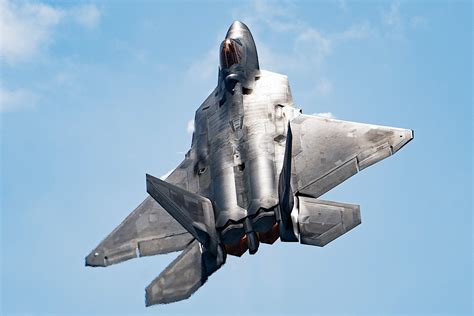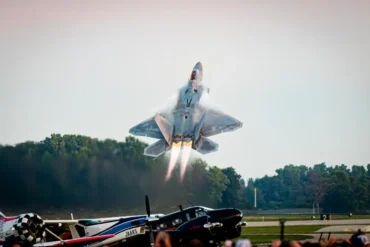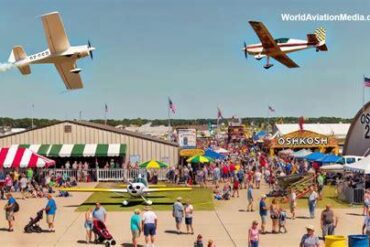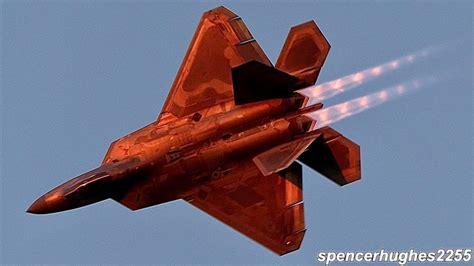
The F-22 Raptor once again proved its aerial dominance with an awe-inspiring “Tactical Pitch” maneuver during the Sunset Airshow at EAA AirVenture Oshkosh 2023. The maneuver, executed at low altitude and framed against a glowing dusk sky, wasn’t just a flex of air superiority—it was a physics-defying demonstration of thrust vectoring and modern aeronautical engineering.
F-22 Raptor “Tactical Pitch” During the Sunset Airshow, Oshkosh 2023
by
u/rdude8 in
aviation
The Tactical Pitch Defined: Defying Physics with Precision Engineering
What onlookers witnessed wasn’t your standard high-speed pass or barrel roll. The “Tactical Pitch” is a maneuver that rapidly pitches the aircraft upward, nearly vertically, while maintaining forward momentum and without stalling. At Oshkosh 2023, the F-22’s performance took this to a dramatic level, with the aircraft practically standing on its tail for a heartbeat—then pivoting with uncanny control.
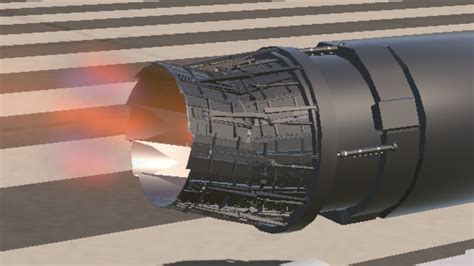
This capability stems from the F-22 Raptor’s revolutionary thrust vectoring system, which directs engine thrust independently of the aircraft’s natural pitch axis. Unlike conventional fighters that rely solely on aerodynamic control surfaces, the F-22’s dual Pratt & Whitney F119-PW-100 engines allow it to “brute force” its way through maneuvers that would stall most aircraft.
Unrivaled Thrust-to-Weight Ratio: The Key to Supremacy
The F-22 has a thrust-to-weight ratio of approximately 1.26, meaning it can accelerate vertically—a characteristic few aircraft in the world can match. When the Raptor performed the Tactical Pitch, this insane ratio, paired with its aerodynamically sleek design, allowed it to instantly bleed airspeed while ascending nose-up, and then recover without losing altitude or control.
According to spectators on the ground and Reddit user Sha77eredSpiri7, even if the Raptor lost part of its wing structure, it could still theoretically fly. This is due to its fuselage acting as a lifting body and its full authority fly-by-wire system that actively stabilizes flight dynamics.
Why the F-22 Raptor’s Control Surfaces Redefine Maneuverability
The F-22’s tailerons—combined elevator and aileron surfaces on the tail—provide both pitch and roll authority. Even without the main wing surfaces, these control elements retain substantial aerodynamic authority, giving the aircraft control even in degraded flight conditions.
Critically, during the Tactical Pitch, the Flight Control Computer automatically compensates for sudden shifts in angle of attack (AoA), center of pressure, and inertia. This results in the smooth nose-up pitch without wobble, sideslip, or visible correction inputs.
Pilot input is interpreted digitally, meaning even if the Raptor behaves like it’s on the verge of breaking the laws of flight, it’s doing exactly what it’s told to—instantly and precisely.
Oshkosh 2023: Crowd Reactions and Context
The reaction from the crowd was a mix of stunned silence, explosive cheers, and disbelief. Seasoned airshow attendees reportedly called the F-22’s performance “the most jaw-dropping maneuver since RIAT 2009.”
Reddit commenters compared it to a space-capable vehicle, jokingly stating, “With enough thrust vectoring, a washing machine could fly.” Others drew parallels to the F-104 Starfighter, noting the Raptor could probably fly with most of its wings missing at supersonic speeds.
Negative G-forces and Pilot Challenges
Pulling off a Tactical Pitch at such low speeds involves brief but intense G-transitions. Though the maneuver is not a sustained high-G event, the abrupt changes in direction subject pilots to negative G-forces, stressing the body and requiring acute awareness of spatial orientation.
As Reddit user moondoggie_00 commented, “That’s gotta be a decent stretch of a few negative Gs.” These G-fluctuations push blood away from the head and require rigorous physical conditioning and flight suit pressure compensation to avoid blackout.
The F-22’s cockpit is equipped with advanced pressure suits and G-LOC mitigation systems, but the human body still faces a limit. It’s not just the aircraft doing the impossible—the pilot is enduring every jolt and stall.
Why It’s Not a Cobra Maneuver—And Why That Matters
Some commentators likened the Tactical Pitch to the Cobra maneuver, popularized by Russian Su-27s and Su-35s. However, this comparison doesn’t hold. While the Cobra relies on induced stall followed by recovery to dramatically decelerate an aircraft, the Tactical Pitch is not a stall maneuver.
The F-22 maintains positive airflow and control throughout, making it not only safer but tactically viable. In a real combat scenario, the Tactical Pitch could be used to bleed speed and force an overshoot—“I’ll hit the brakes, he’ll fly right by,” as one user quipped, invoking Top Gun.
Aerodynamic Sorcery: Lift Without Speed
At its core, the Tactical Pitch demonstrates that aerodynamic lift and control authority are no longer constrained by traditional flight envelopes. The Raptor’s entire airframe—including the wide, flat fuselage and stealthy delta-esque wing planform—generates lift, not just the wings.
Combined with high-angle-of-attack tolerance, the aircraft behaves almost like a helicopter or VTOL-capable fighter, pivoting in mid-air like a gymnast.
The Tactical Use Case—Or Just Airshow Magic?
Critics asked: is there a real-world scenario for a Tactical Pitch? The answer is a qualified yes. In dogfighting, bleeding speed rapidly while maintaining vector control could force an adversary to overshoot, giving the F-22 a chance to reposition or re-engage.
However, such maneuvers are rarely executed in actual combat, where beyond-visual-range (BVR) engagements dominate. Still, in close-range engagements, the ability to perform nose-pointing maneuvers without relying on airspeed is a serious tactical advantage.
The maneuver isn’t about practical application alone—it’s a testament to the Raptor’s overmatch capability, reinforcing its status as a fifth-generation air superiority titan.
Engineering Marvel: Inside the F119 Engines
Powering this aerial wizardry is the Pratt & Whitney F119 engine, a twin-spool, axial-flow turbofan with augmented afterburners. With 35,000 lbf of thrust per engine, the Raptor can fly straight up, decelerate mid-air, or rotate nose-in-place without losing control.
Each nozzle can vector 20 degrees up or down, with independent control, allowing not just pitch authority but also roll influence when paired.
These engines also feature stealth-friendly exhaust systems, reducing IR signature while maintaining performance—a rare blend of traits.
Final Impressions: Oshkosh 2023’s Crown Jewel
The Tactical Pitch maneuver at Oshkosh wasn’t just an airshow stunt. It was an exhibition of what a true fifth-generation multirole fighter can do when piloted by one of the most skilled aviators in the world.
Between the roar of afterburners, the crimson-tinted sky, and the sheer unnatural movement of an aircraft that should’ve stalled out mid-air, the F-22 delivered the most unforgettable moment of the show.
As user Grizzly946 summed it up, “Probably the best display I’ve ever seen.”