France has taken a decisive step to rebuild its ability to move heavy armored forces across rivers under combat conditions, awarding a €697 million framework contract to deliver a new generation of floating bridges capable of carrying modern main battle tanks. The decision reflects a sober reassessment of European terrain, alliance obligations, and the operational lessons drawn from recent high-intensity conflicts, where rivers and canals have once again proven to be strategic obstacles rather than secondary inconveniences.
Confirmed on February 2, 2026, by the French Armament General Directorate, the Syfrall contract activates a ten-year framework agreement with a ceiling value of €697,254,995 excluding tax. The award follows a notification issued at the end of December 2025 and formalizes the selection of a French industrial consortium composed of CNIM Systèmes Industriels, CEFA, and Soframe. Together, the three companies will design, manufacture, and deliver a modular heavy-light crossing system intended to restore autonomous wet-gap crossing capability at brigade level and beyond.
The Syfrall program, short for Système de Franchissement Lourd-Léger, is embedded in France’s 2024–2030 Military Programming Law and is explicitly structured to support both national requirements and acquisitions on behalf of partner nations. In practice, this makes Syfrall not just a domestic engineering project but a tool of defense cooperation, particularly relevant as European armies seek interoperable solutions for collective defense planning.
A Strategic Reset for French Army Mobility
At the heart of the Syfrall program lies a clear operational problem: the mass of modern armored vehicles has increased faster than the capacity of legacy crossing systems. France’s Leclerc XLR main battle tank, upgraded under the Scorpion modernization program, weighs significantly more than earlier variants. When combined with heavier infantry fighting vehicles, armored recovery assets, and logistics trucks, the result is a force that can fight effectively on land but risks being slowed or canalized by rivers if crossing assets are insufficient.
The French Army has long relied on a mix of systems such as the Pont Flottant Motorisé (PFM) and the Engin de Franchissement de l’Avant (EFA). While both remain valuable, they were conceived in an era when vehicle weights, digital integration, and tempo expectations were different. Exercises and operational studies conducted over the past decade revealed a stark reality: available crossing density was too low to support simultaneous maneuvers across multiple wet gaps, especially under contested conditions.
Syfrall is designed to close that gap decisively. It introduces a standardized, modular approach that replaces a patchwork of specialized systems with a single family of crossing assets capable of adapting to different river widths, current speeds, and load requirements. The intent is not merely replacement but consolidation and expansion of capability.
Modular Design Built for Modern Armored Loads
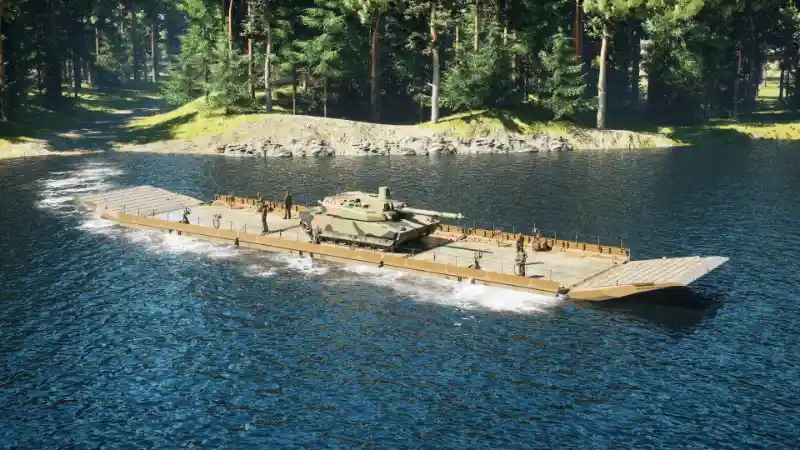
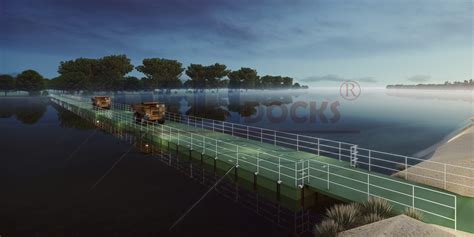
The defining feature of Syfrall is its modular architecture. The system is composed of powered floating modules and loading ramps transported by trucks, which can be assembled into either discontinuous ferries or continuous floating bridges. This flexibility allows engineer units to tailor the crossing configuration to the tactical situation rather than forcing the situation to fit the equipment.
Critically, Syfrall is specified to support Military Load Classification (MLC) thresholds up to MLC 85C and MLC 100R. In practical terms, this means the system can carry all current French Army wheeled and tracked vehicles, including the heaviest combat platforms, as well as equivalent allied equipment. These ratings align Syfrall with NATO planning standards, ensuring that multinational formations can rely on French-provided crossings without restrictive caveats.
The system’s design also accounts for the realities of deployment speed and manpower. Powered modules reduce the need for extensive tug assets, while standardized ramps and interfaces simplify assembly under time pressure. The result is a crossing solution optimized not only for load but for tempo, an increasingly decisive factor in modern maneuver warfare.
Initial Capability and Long-Term Expansion
Under current planning, the French Army’s initial objective is the acquisition of eight Syfrall systems, representing approximately 300 linear meters of crossing capability, with deliveries scheduled before the end of 2030. This quantity is defined as the minimum required to provide a first operational crossing capability for a combined-arms tactical group equipped with Scorpion vehicles and Leclerc tanks.
At brigade level, this restores a degree of autonomy that had eroded over time, allowing commanders to plan maneuvers without assuming external crossing support. At divisional level, multiple Syfrall systems can be combined to support logistics flows or sustain extended operations across major rivers. The framework nature of the contract deliberately leaves room for additional orders, enabling incremental expansion as funding and operational needs evolve.
Equally important is the contract’s openness to partner nations. Through mechanisms such as the European SAFE (Security for Action For Europe) initiative, Syfrall can be procured on behalf of allies, creating economies of scale and promoting a common European approach to heavy bridging.
A Fully French Industrial Effort
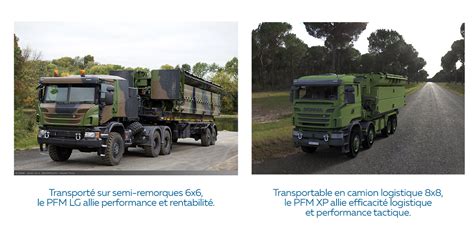
From an industrial perspective, Syfrall is notable for its strictly national production chain. CNIM Systèmes Industriels and CEFA are responsible for the design and manufacture of the floating bridge components, drawing on decades of experience in military bridging systems. Soframe provides the tractor trucks and semi-trailers required to transport and deploy the modules, ensuring that mobility on land is treated as an integral part of the system rather than an afterthought.
This division of labor links the floating elements and the road mobility chain into a single coherent program. In operational terms, a bridge that cannot arrive on time or be sustained is functionally irrelevant. By integrating transport, deployment, and sustainment considerations from the outset, the consortium addresses one of the chronic weaknesses observed in legacy crossing solutions.
The partnership, publicly formalized in 2024, also reflects a broader French defense-industrial strategy aimed at preserving sovereign capabilities in critical enabler domains. Heavy bridging rarely attracts the same attention as combat aircraft or missiles, but without it, armored forces risk becoming strategically brittle.
Lessons from Legacy Systems
The limitations that Syfrall seeks to overcome are best understood in light of existing French Army assets. The Engin de Franchissement de l’Avant (EFA) provides amphibious ferry capability and, when combined in sufficient numbers, can form temporary bridges. Its ability to embark vehicles directly without extensive bank preparation is a major advantage. However, the EFA fleet is small, and the system was designed around earlier generations of armored vehicles, constraining its employment with today’s heavier platforms.
The Pont Flottant Motorisé (PFM), particularly in its modernized PFM F2 configuration, remains the backbone of French floating bridge capability. Composed of powered modules that can form ferries or bridges, the PFM has benefited from upgrades such as improved propulsion, remote control features, and integrated ramps. Depending on configuration and conditions, it supports loads approaching MLC 90T and MLC 100W.
Yet even with these improvements, availability remains the decisive limitation. The total number of PFM modules in service restricts the length and number of crossings that can be established simultaneously. In a high-intensity scenario involving multiple axes of advance, this scarcity becomes a planning constraint rather than a technical one.
Aligning Mobility with High-Intensity Warfare
Syfrall should be understood less as a niche engineering upgrade and more as a structural adjustment to France’s concept of operations. Recent conflicts have underscored how quickly maneuver can stall when forces are funneled toward a handful of predictable crossing points. Rivers, once assumed to be secondary obstacles in expeditionary warfare, have reasserted their role as operational boundaries.
By standardizing and expanding heavy crossing capability, Syfrall enables French and allied commanders to disperse crossings, complicate enemy targeting, and sustain momentum. The system’s NATO-aligned load classifications and modular design further support multinational operations, an increasingly central assumption of European defense planning.
In strategic terms, the €697 million investment is modest compared to the cost of the armored forces it enables. Tanks that cannot cross rivers at speed lose much of their deterrent and combat value. Syfrall ensures that France’s modernized armored brigades remain credible not just on paper, but across the river-dense terrain that defines much of Europe.
As deliveries begin later this decade, Syfrall will quietly reshape how French forces plan and execute maneuver. Heavy floating bridges rarely make headlines, but they decide whether armored power flows—or stops—at the water’s edge.