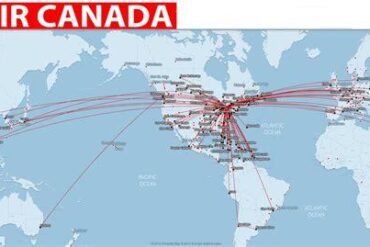
Air Canada has significantly expanded its transatlantic reach this summer, now operating 50 European routes across the month of June. This milestone not only underscores the airline’s strategic emphasis on international growth but also reflects broader shifts in passenger demand, particularly in the wake of a softening transborder market with the United States. With new, returning, and legacy routes now active, Air Canada is positioning itself as a critical connector between Canada and Europe, leveraging both widebody and narrowbody fleets.
A Historic Expansion: Air Canada’s Broad Transatlantic Blueprint
The current transatlantic footprint includes routes from its major Canadian hubs—Toronto Pearson (YYZ), Montréal-Trudeau (YUL), and Vancouver (YVR)—to a diverse array of cities across Europe. According to Cirium’s Diio Mi data, Air Canada now maintains 375 total weekly flights across the Atlantic, an impressive consolidation of both direct and one-stop services that cater to leisure, business, and VFR (visiting friends and relatives) traffic.

Among the most notable additions are services to Prague, Naples, Porto, and Edinburgh, some of which are returning seasonal routes, others entirely new destinations. This expansion reflects Air Canada’s reallocation strategy, as it shifts capacity away from underperforming U.S. routes toward stronger international markets.
Back to Bohemia: Air Canada Returns to Prague
On June 6, Air Canada resumed its seasonal flights to Prague Airport (PRG), operating from Toronto Pearson with a tri-weekly schedule through late September. The route had been suspended since 2019, marking a long-anticipated return to Czechia’s capital. Operated by the Airbus A330-300, this service revives a previously popular link between Central Europe and Eastern Canada.
Mark Galardo, Air Canada’s EVP and Chief Commercial Officer, emphasized the dual significance of this flight: “Our flights connect two countries, facilitating travel, tourism, and trade. We design routes like this to appeal to customers across our North American network.”
New Mediterranean Links: Naples and Porto Now Boarding
Two of Air Canada’s newest additions focus on Southern Europe, catering to growing demand for leisure travel. Naples (NAP), served from Montreal, launched on May 16, marking the airline’s first-ever connection to the Italian city. This route complements existing flights to Rome, Milan, and Venice, bringing Air Canada’s Italian network to four cities and over 13,000 weekly seats.
In Portugal, Montreal has also gained a direct link to Porto (OPO), launched on June 4. This route, too, is a relaunch—last served from Toronto in 2019—and rounds out the airline’s Portuguese offering, which also includes Lisbon, served daily from Toronto and six times per week from Montreal.

These Mediterranean connections reflect Air Canada’s growing interest in providing culturally rich, warm-weather alternatives for Canadian travelers seeking European holidays without lengthy layovers or indirect routing.
The Scottish Frontier: Launching Montreal to Edinburgh
On June 26, Air Canada will inaugurate service to Edinburgh (EDI) from Montreal, operating three times weekly with the Boeing 737 MAX 8. This is a pivotal move, not only because it introduces a new nonstop route but also because it signifies a shift in aircraft utilization strategy.
The MAX 8, typically used for shorter hauls, is part of a narrowbody transatlantic program that includes four routes to three destinations: Edinburgh, Reykjavik (KEF), and London Heathrow (LHR). These routes are managed with 21 weekly departures, leveraging the MAX 8’s fuel efficiency and range while awaiting the arrival of the Airbus A321XLR, which has faced delays.

From Halifax, the airline operates daily flights to Heathrow, while from Montreal and Toronto, Reykjavik is served with five and six weekly departures, respectively. This utilization demonstrates how narrowbody aircraft can successfully bridge the Atlantic on shorter European routes.
Air Canada’s Widebody Backbone: 46 Major Routes
The lion’s share of Air Canada’s transatlantic portfolio—46 out of 50 routes—are operated with twin-aisle widebody aircraft, including the Boeing 787 Dreamliner, 777, and Airbus A330-300. In June, this segment accounts for 329 weekly departures, underscoring the airline’s heavy reliance on high-capacity jets for longer European sectors.
The busiest widebody route remains Toronto to London Heathrow, with 26 weekly flights, often peaking at four daily departures on high-demand days. This is followed closely by major trunk routes from Montreal and Toronto to Paris (CDG) and Frankfurt (FRA), Lufthansa’s hub and a key Star Alliance gateway.

Other strategic destinations in Air Canada’s widebody network include:
- Rome-Fiumicino (FCO) – especially prominent due to Lufthansa Group’s recent stake in ITA Airways.
- Zurich (ZRH), Vienna (VIE), Brussels (BRU), and Munich (MUC) – strengthening the Star Alliance transatlantic corridor.
- Milan-Malpensa (MXP) – served via Montreal on a one-stop basis from Toronto, with the AC894/AC895 loop operated by an A330-300.
Responding to Soft Transborder Demand with Strategic Reallocation
The ramp-up in European service comes amid declining interest in U.S.-Canada transborder routes. Statistics Canada reported a 3.5% drop in weekly departing seats between the two countries in June compared to the previous year. Air Canada has consequently pulled out of multiple U.S. markets, including routes from:
- Montreal to Cincinnati (CVG)
- Vancouver to Nashville (BNA), Raleigh-Durham (RDU), and Tampa (TPA)
- Toronto to Jacksonville (JAX)
According to EVP Mark Galardo, these capacity shifts have been instrumental in enabling the rollout of new European routes. Aircraft originally allocated for low-performing U.S. segments are now powering the airline’s strategic pivot across the Atlantic.
The Bigger Picture: Transatlantic Demand Recovery and Future Outlook
Despite posting a CAD 108 million operating loss in Q1 2025, Air Canada remains bullish on its international prospects. Galardo confirmed during the airline’s earnings call that demand across long-haul markets—particularly Europe, Australia, Japan, and Thailand—remains robust.
This optimism is reflected in capacity planning: Air Canada expects available seat miles (ASM) to grow by 1% to 3% year-on-year through 2025. The transatlantic sector, long known for its high yields, has rebounded sharply following the normalization of post-COVID travel patterns in 2024. This rebound validates the airline’s decision to lean into its international strengths and continue investing in robust long-haul connectivity.

Conclusion: A New Golden Era for Canada-Europe Connectivity
June 2025 marks a defining chapter in Air Canada’s international story. With 50 routes now live between Canada and Europe, the airline has reaffirmed its leadership in the North Atlantic market. The blend of returning favorites like Prague, new ventures such as Naples and Edinburgh, and the operational dexterity to adjust its fleet—from narrowbody MAX 8s to widebody 787s—demonstrates both strategic foresight and agile execution.
As Air Canada continues to monitor and respond to evolving global demand, its ability to pivot aircraft and route planning, especially away from softening U.S. transborder markets, suggests a future where Europe plays an increasingly central role in the airline’s global network. For Canadian travelers, it means more choices, better connections, and a clearer path to the heart of Europe.