Definition
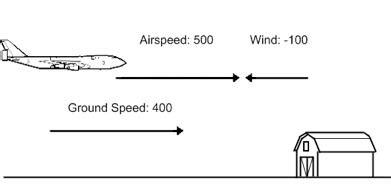
Ground speed refers to the speed of an aircraft relative to the Earth’s surface. This measurement is crucial for understanding how different factors, like wind, affect an aircraft’s performance.
Groundspeed and True Airspeed (TAS)
Groundspeed is the vector sum of True Airspeed (TAS) and wind velocity. When an aircraft climbs while maintaining Indicated Airspeed (IAS), both TAS and groundspeed increase. This happens because air density decreases with altitude, requiring higher speeds to achieve the same dynamic pressure. For instance, if two planes fly at the same IAS but at different altitudes, the one at a higher altitude will have a greater groundspeed due to this effect. As a rough guide, TAS increases by about 7 knots for every 1,000 feet of altitude gain. Therefore, an aircraft flying at 4,000 feet would be approximately 30 knots faster in terms of TAS and groundspeed.
Wind speed also tends to rise with altitude, often peaking at the tropopause. Consequently, in cases of tailwinds, higher-altitude aircraft can gain significant speed. Conversely, during headwinds, planes at different levels may have similar groundspeeds despite maintaining the same IAS.
Groundspeed, TAS, and Mach Number
When an aircraft maintains a specific Mach number, TAS—and thus groundspeed—decreases with altitude. This decrease occurs because both air density and the speed of sound diminish at higher elevations. If two aircraft fly at the same altitude, a difference in Mach number of 0.01 can lead to a 6-knot difference in groundspeed, assuming calm winds. For aircraft flying at different altitudes, a vertical separation of 2,000 to 3,000 feet can also result in a 6-knot speed difference, typically favoring the lower aircraft.
Impact on ATC Operations
Groundspeed plays a vital role in air traffic control (ATC) for two main reasons: estimating arrival times and managing conflicts. For example, if an aircraft travels a distance of 140 nautical miles at 420 knots (with no wind), it will take about 20 minutes. However, with a 60-knot headwind, that time stretches to just over 23 minutes.
Conflict management relies on calculating whether two aircraft will maintain safe separation at their Closest Point of Approach (CPA). This calculation hinges on the moment each aircraft reaches that point, which is influenced by groundspeed. ATC may use speed control and vectoring, but these methods can be affected by wind, either simplifying or complicating the process.
Groundspeed and Wind Direction
Wind direction significantly impacts groundspeed as much as wind speed does. There are two scenarios to consider: when the wind direction changes with altitude or location, and when the wind direction stays constant while the aircraft heading shifts. In a crosswind situation, even a slight change in heading can lead to a considerable change in groundspeed compared to headwind or tailwind conditions.
Speed Control
When ATC employs speed control to resolve conflicts or ensure proper spacing, they assign indicated speeds or Mach numbers that translate to necessary groundspeeds. However, direct use of groundspeed in ATC clearances isn’t feasible due to several reasons. Changes in wind can cause an aircraft to leave its flight envelope, necessitating frequent adjustments to engine power to match wind fluctuations. Additionally, when an aircraft turns, adjustments are needed regardless of whether wind conditions remain stable.
ATC primarily focuses on maintaining appropriate speed differences between aircraft rather than specific groundspeeds. For instance, the first aircraft arriving at a crossing point should be at least 20 knots faster to ensure safe separation. Interestingly, if two aircraft converge at the same point while following different tracks, the influence of wind can differ. An aircraft flying at a lower IAS might achieve the same or even higher groundspeed than one at a higher IAS or Mach number.
The Effect of Wind on Different Aircraft
Consider the A320 flying at Mach 0.78 (around 450 knots TAS) and the B777 cruising at Mach 0.83 (approximately 480 knots TAS). Due to a 60-knot west wind, their groundspeeds adjust such that the B777 cannot overtake the A320 at the crossing point.
Climbing and Descending Aircraft
Wind’s effect on groundspeed is critical when sequencing climbing or descending aircraft. Typically, when two planes descend towards the same point, the first one flies at a lower altitude. Consequently, the higher aircraft trailing behind will usually have a faster groundspeed. This scenario worsens with tailwinds, potentially causing the higher aircraft to overtake the lower one, which is not ideal.
Conversely, in a situation where two aircraft climb shortly after departure and request the same cruising level, the first aircraft (which is higher) is expected to have a higher groundspeed, naturally increasing separation. However, with headwinds that intensify with altitude, the difference in groundspeed—and thus separation—might not change. Even with speed control measures in place (e.g., REK078 assigned 250 knots and EKR040 assigned 290 knots IAS), the second aircraft could still be marginally faster in terms of groundspeed, meaning their separation remains constant despite the IAS difference.
Groundspeed and Vectoring
Vectoring is another technique that ATC uses, and it too can be influenced by groundspeed. If wind isn’t adequately accounted for, the effectiveness of vectoring can diminish or vanish due to changes in groundspeed from the new angle between the wind and the aircraft’s heading. For example, if an aircraft is vectored to increase spacing from the preceding one but ends up with increased groundspeed from a tailwind component, the spacing gained may be lost due to the increased speed. Conversely, when vectoring into the wind, a smaller heading change might suffice compared to a scenario without wind.