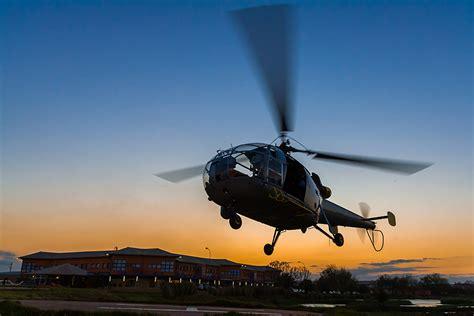
Helicopter night flying is often misunderstood, underutilized, and yet remarkably vital across numerous aviation sectors. While many believe that helicopters are grounded after dark, in reality, they can operate safely at night given the right combination of training, aircraft equipment, and pilot proficiency. Flying a helicopter under the stars is not only a technical achievement but also an experience of breathtaking beauty and intense focus.
The Legality and Possibility of Helicopter Night Flying
Many assume night helicopter operations are exclusive to law enforcement or military aviation, but this isn’t accurate. In several countries, private helicopter pilots are permitted to fly at night, although legal requirements vary widely. Some regions enforce strict training prerequisites and aircraft instrumentation standards, while others, like the United States, are more lenient—allowing night flying with minimal additional certification beyond the private pilot level. However, just because it’s legal doesn’t mean it’s wise without sufficient preparation.
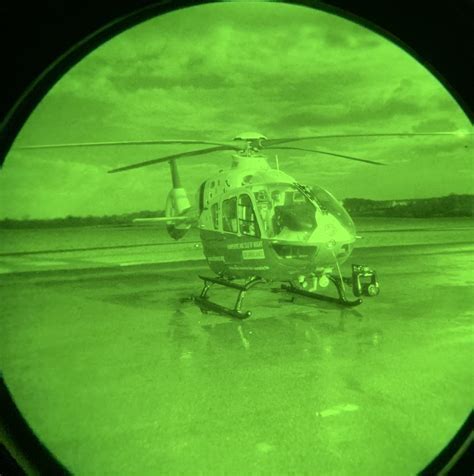
Flying at night introduces layers of complexity that demand high situational awareness, strong instrument flying skills, and sometimes night vision goggle (NVG) proficiency. The visual horizon disappears in unlit areas, making spatial orientation reliant on instruments or advanced avionics. Without the proper training, this situation can become hazardous within minutes.
Training Requirements Around the World
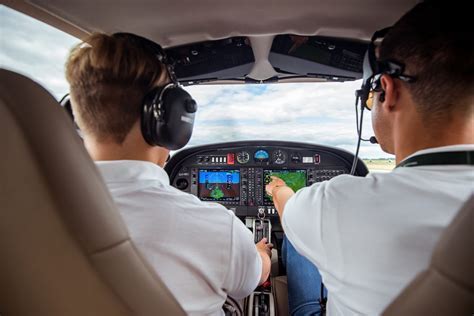
In the United Kingdom, obtaining a night qualification for helicopters involves a significant commitment. Pilots must have logged 100 hours post-PPL(H), including 60 hours as Pilot in Command (PIC) and 20 hours of cross-country flying. The night qualification course itself includes 5 hours of theory, 10 hours of dual instrument instruction, and 5 hours of helicopter night flying.
In Canada, regulations mirror those in the UK, making the qualification both time-intensive and costly. In contrast, the United States adopts a much more accessible approach. The Federal Aviation Administration (FAA) requires only three hours of night training during the Private Pilot Helicopter course. Upon completion, a pilot is legally allowed to operate a helicopter at night. During commercial training, additional night experience is added, but no separate night rating is mandated.
This discrepancy in regulation highlights a critical issue: legal eligibility does not equate to operational safety. While U.S. pilots may legally fly at night, limited exposure to instrument flying and minimal training outside urban areas could prove dangerous. Pilots unaccustomed to navigating without visible ground reference risk spatial disorientation. To mitigate this, experienced pilots or those flying in rural or mountainous terrain should be trained in instrument flight rules (IFR) or proficient with NVGs.
Firsthand Experience: The Challenges of Night Flying Training
Night flying is not only technically demanding but logistically complicated. In many places, coordinating airfield access after sunset can be difficult, especially during summer when daylight lingers. In our own commercial helicopter training, night flying sessions were delayed well into autumn.
Our first dual night sortie took place on October 24, focusing on circuits, hovering, and takeoffs and landings. Hovering in darkness revealed the first major challenge—depth perception deteriorates, and hover-taxying tends to become too fast and too high. Transitions to forward flight involved towering takeoffs, and while the circuit procedures remained similar to daytime, instrument reliance increased.
The second session involved navigation training on a wild, windy night. We were taught to steer toward illuminated zones and recognize that the sudden absence of light likely indicated flying into cloud cover. Estimating distances—even to obvious city landmarks—proved surprisingly difficult.
Subsequent sessions focused on emergency procedures, particularly autorotations. At night, these are conducted using the constant attitude technique at about 40 knots, minimizing the need for a flare. Selecting a safe landing site in darkness is essentially guesswork until the landing light is activated—by then, it’s often too late to change course.
One session stood out: a cross-country flight over a city center in 40-knot winds. Our instructor was indifferent to protests about turbulence, reminding us we were now commercial pilots. Flying an R22 under these conditions was intense, and even caused mild airsickness—a rare occurrence during self-piloted flights.
The final session consisted of five solo night circuits on a calm, clear evening. During the second downwind leg, the serene, illuminated world below finally revealed the aesthetic and emotional magic of night flying. It was peaceful, surreal, and utterly captivating—an unforgettable aviation experience.
Why Choose to Fly at Night?
For private pilots, there is no pressing need to fly at night. However, the added skill set significantly enhances flight safety, especially when delays result in unexpected post-sunset arrivals. Beyond that, night flying deepens pilot competence, builds confidence, and opens up career avenues requiring nocturnal operations.
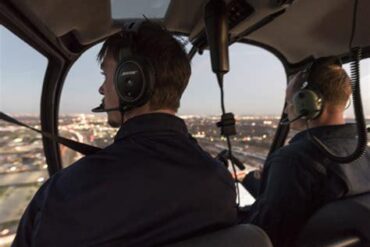
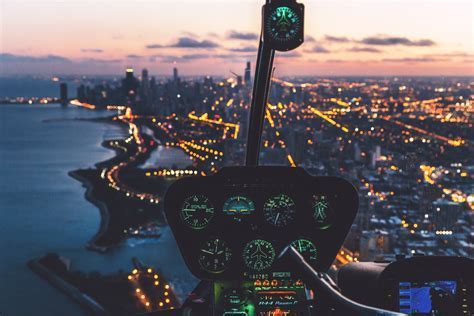
More importantly, the world looks remarkably different from a helicopter at night. Roads glow like arteries; towns sparkle like constellations; the experience is meditative and exhilarating at once. Even seasoned pilots describe night flying as their most memorable airborne moments.
Professional Roles That Require Night Flying
While private flying at night is optional, many helicopter careers demand it as standard. Night proficiency isn’t just a bonus—it’s a fundamental requirement.
Police Helicopter Pilots
Law enforcement helicopters are essential after dark when criminal activity often escalates. These helicopters patrol cities using powerful spotlights, infrared cameras, and night vision goggles. Their aerial perspective allows surveillance over vast neighborhoods without requiring a fixed location. To conserve fuel and minimize noise, pilots typically circle rather than hover.
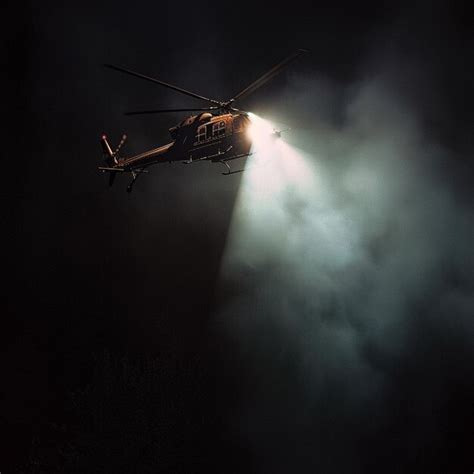
Night flight in urban areas benefits from ambient lighting, but tracking suspects across dim or remote zones requires exceptional coordination between pilots and tactical teams. Often, these operations serve as deterrents as well as active interventions.
Air Ambulance Helicopter Pilots
Emergency Medical Service (EMS) helicopters must be ready 24/7. Speed can make the difference between life and death, and nighttime incidents demand crews that can navigate in zero-visibility terrain. Depending on the region, some air ambulances are restricted to lit airports and helipads, while others land in unprepared zones like fields or highways.
Helicopter types vary: basic single-engine aircraft operate over urban cores; advanced twin-engine, all-weather helicopters serve rural and mountainous regions. Pilots must be intimately familiar with terrain, procedures, and instrument or NVG navigation to maintain safety during these high-pressure missions.
Corporate and VIP Helicopter Pilots
In the world of executive transport, time is paramount. Helicopters offer unmatched flexibility, especially when moving between urban centers and secluded destinations. Night flying is often required during winter months or for late-evening departures and arrivals.
Corporate operations typically involve high-performance helicopters with dual engines, full IFR panels, and experienced two-pilot crews. Departures may occur from rooftop helipads or private airfields, and flights often terminate in similarly discreet locations. The ability to operate at night significantly increases client satisfaction—and company profitability.
Military Helicopter Pilots
The military demands an elite level of night flight proficiency. Operations often involve flying low, fast, and covert, and the use of advanced technologies like synthetic vision systems, NVGs, and radar altimeters is standard. Night flying is practiced routinely in simulated combat scenarios and across varied terrain.
Unlike civil operations, military pilots engage in tactical maneuvers that require flawless coordination, rapid decision-making, and near-constant recalibration to environmental cues. In highly trained forces, night missions become second nature—a testament to the depth of training invested.
Conclusion: The Value of Mastering Night Flying
Helicopter night flying is not a novelty—it is a sophisticated skill set with real-world applications across emergency services, law enforcement, military, and high-end corporate transport. While not a common pursuit among private pilots due to the cost, complexity, and logistical hurdles, those who invest in learning it find the experience both professionally advantageous and deeply fulfilling.
Flying at night demands respect for the limitations of human perception and the need for technical augmentation. It trains a pilot to operate in ambiguity, to trust instruments, and to act decisively. For any pilot seeking to elevate their capabilities or pursue a career where aviation makes a difference after dark, night flying is an indispensable part of their journey.
We advocate for more comprehensive night flight training and awareness, especially in regions where the regulatory barriers are minimal. Whether it’s a moonlit medevac, a city surveillance patrol, or a quiet personal flight above the glowing lights of civilization, night helicopter flying represents the pinnacle of aerial mastery.