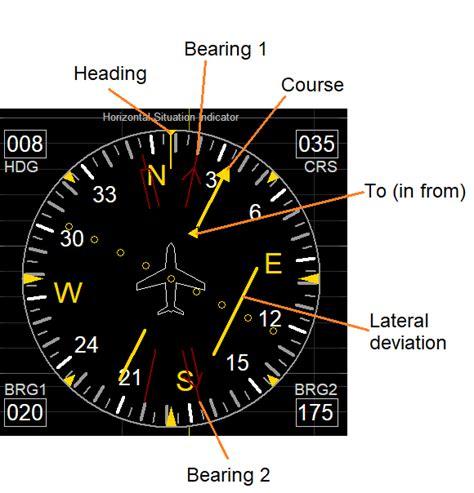
The Horizontal Situation Indicator (HSI) is a crucial flight navigation tool that helps pilots maintain situational awareness. It combines a heading indicator with a Course Deviation Indicator (CDI) to show the aircraft’s position in relation to its intended path. This instrument gathers data from various sources, including the magnetic compass and navigation systems like VOR, ILS, or GNSS.
The HSI displays a visual representation of the aircraft’s location against the chosen course. For instance, when using ILS signals, it also provides information on glideslope deviation, which is essential for landing approaches. In the illustration, the aircraft’s heading points north at 360 degrees. The course arrow is set to 020, while the tail indicates the opposite direction at 200 degrees.
As the course deviation bar functions with a VOR/Localizer or GNSS receiver, it shows any left or right deviation from the selected route. Pilots adjust the desired course by turning the course-indicating arrow relative to the azimuth card using the course select knob. This setup offers a clear picture of the aircraft’s status, resembling a view from above the plane.
The TO/FROM indicator, shaped like a triangle, tells pilots whether they are flying towards or away from their destination. If it points towards the front of the course arrow, it indicates that following the course will lead to the selected facility. Conversely, if it points towards the tail, the aircraft is moving away from it. Additionally, the glideslope deviation pointer indicates the aircraft’s position in relation to the glideslope. A pointer below the center means the aircraft is too high, requiring a steeper descent.
Finally, warning flags like the NAV flag signal unreliable signals, while the HDG flag alerts pilots to compass issues. Some HSIs may also include a GS flag for unreliable glideslope readings.