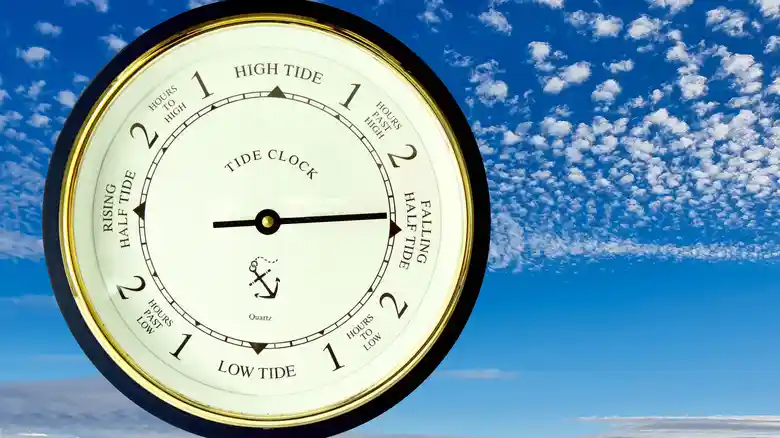
A tide clock is a specialized navigation aid designed to track the natural tidal cycle rather than the 24-hour cycle used by an ordinary clock. For boaters, that difference is crucial because tides influence water depth, currents, harbor access, and the safest time to navigate shallow coastal waters. Unlike a conventional clock, a tide clock completes one full rotation in approximately 12 hours, 25 minutes, and 14 seconds, matching the average interval between successive high tides or low tides in locations with regular semidiurnal tides.
The unusual timing comes from the relationship between the Earth and the Moon. Because the Moon moves along its orbit while the Earth rotates, a lunar day is slightly longer than a solar day. Tides therefore do not occur at exactly the same time each day. A tide clock uses a quartz movement calibrated to this tidal rhythm, allowing its single hand to provide a visual indication of whether the tide is approaching high water, moving toward low water, or somewhere between the two.
However, a tide clock is not a universal tidal predictor. It must be set for a particular coastal location, because the timing and behavior of tides vary significantly between ports and regions. Local geography, coastline shape, seabed contours, and tidal patterns can all influence when high and low water occur. Even after correctly setting a tide clock, its indication remains an approximation because real tidal intervals do not remain perfectly consistent.
How a Tide Clock Works
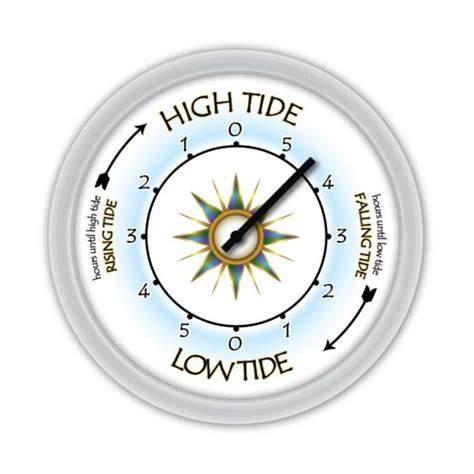
Reading a tide clock is relatively straightforward once its unusual dial is understood. The 12 o’clock position represents high tide, while the 6 o’clock position represents low tide. As the single hand travels clockwise, its position indicates the approximate stage of the tidal cycle. The markings around the dial generally show how many hours remain before the next high or low tide.
Setting the clock normally begins with an official tide table. A boater selects the appropriate reference port and finds the published high-tide time, then adjusts the clock hand to the high-tide position at that moment. In the United States, NOAA Tides and Currents provides tidal information that can be used for this purpose. Once synchronized, the clock provides a convenient visual reference without requiring the user to repeatedly consult a digital device.
Why Tide Clocks Matter for Boating
Tidal information can be especially important when navigating shallow ports, estuaries, intracoastal waterways, and coastal channels. A falling tide can reduce available water beneath a boat, while a rising tide can increase clearance over shoals or other shallow areas. Strong tidal currents can also affect a vessel’s speed over ground, steering, fuel consumption, and approach to docks or narrow passages.
For recreational boaters, the direction and strength of tidal currents can be just as important as water depth. A tide clock can provide a quick indication of where the vessel is within the tidal cycle, helping the operator understand changing conditions at a glance.
Tide Clock Accuracy and Limitations
The biggest limitation is that a tide clock should be treated as a general reference tool, not a replacement for an official tide table or navigation app. Actual high- and low-tide times can differ from the simplified cycle represented by the clock. Weather, atmospheric pressure, local geography, and other factors can further affect observed water levels.
Tide clocks are most suitable for semidiurnal tidal regions, where there are typically two high tides and two low tides during each lunar day. This pattern is common along much of North America’s East Coast. The West Coast more commonly experiences mixed semidiurnal tides, while parts of the Gulf of Mexico experience diurnal tides, with only one high and one low tide per lunar day. In such locations, a standard tide clock may provide unreliable indications.
A tide clock is also not a federally required piece of equipment for U.S. boaters. Its value instead comes from simplicity: when properly configured for a suitable location, it provides an immediate visual reminder that the water is constantly changing. For serious navigation, however, it works best alongside official tidal data, charts, depth information, and sound seamanship.