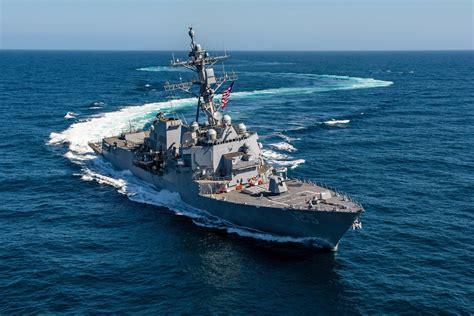
The modern US Navy destroyer is a marvel of engineering, firepower, and precision. Designed to protect carrier strike groups, engage multiple threats, and operate autonomously in blue water and littoral zones, these ships are the lethal edge of American naval supremacy. The key question many military enthusiasts and defense analysts ask is: how far can a US Navy destroyer ship shoot? The answer lies in a complex array of weapons, systems, and mission-specific munitions that allow these vessels to dominate from close quarters to deep strike capability over 1,500 miles away.
The Backbone of Naval Firepower: Arleigh Burke-Class Destroyers
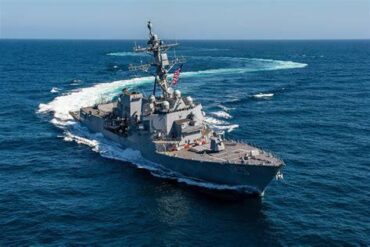
At the heart of the U.S. Navy’s destroyer fleet is the Arleigh Burke-class, a warship that has served with distinction since its introduction in the early 1990s. This class has been continuously upgraded, becoming a floating fortress equipped with multi-layered weapon systems capable of executing anti-air, anti-surface, and anti-submarine warfare simultaneously. The range of its weaponry varies based on the target type and operational mission, but its arsenal includes missiles, naval guns, and torpedoes—each with specific reach and destructive capability.
Close-In Defense: Last-Ditch Shields Against Imminent Threats
In close-quarters combat or when faced with threats that have breached longer-range defenses, the destroyer’s Close-In Weapon System (CIWS) plays a critical role. The Phalanx CIWS, a 20mm Gatling gun, can intercept incoming missiles and aircraft at a range of 1,625 to 6,000 yards (approximately 0.9 to 3.4 miles). This radar-guided system automatically detects and tracks incoming threats, delivering a rapid-fire barrage that serves as the ship’s last line of defense.
Complementing the CIWS is the Rolling Airframe Missile (RAM) system. This short-range, quick-reaction missile is designed to destroy sea-skimming and supersonic anti-ship missiles at a range of 6.2 miles. Its passive radio frequency and infrared guidance allow it to zero in on high-speed threats with deadly accuracy.
Medium-Range Engagements: Tactical Control of the Battlespace
For threats beyond immediate proximity, the Arleigh Burke-class destroyer employs several medium-range missiles and naval guns. The most prominent among these is the Evolved SeaSparrow Missile (ESSM), a radar-guided surface-to-air weapon with a range of 27 nautical miles (31 statute miles). Designed to counter fast-moving aircraft and anti-ship missiles, the ESSM fills the critical mid-tier defense zone.
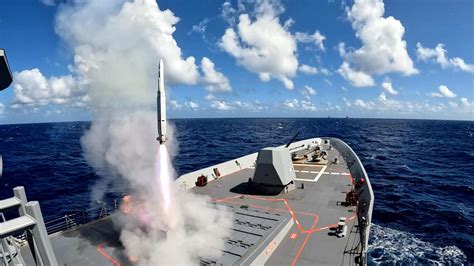
Also featured is the 5-inch/54-caliber Mark 45 gun, capable of striking surface targets, coastal installations, and aerial threats at up to 20 nautical miles (23 statute miles). This gun delivers precision and sustained firepower, often used during amphibious operations or in maritime interdiction roles.
The RUM-139 Vertical Launch Anti-Submarine Rocket (VL-ASROC) is another vital tool. This hybrid rocket-torpedo system has a range of 10 miles and is used to strike enemy submarines detected by the destroyer’s sonar array. It delivers a lightweight torpedo into the water near the suspected target, where it activates and hunts the submarine.
Long-Range Strike Weapons: From Beyond the Horizon
For engagements far beyond visual range, U.S. Navy destroyers deploy a deadly suite of long-range missiles. The RGM-84 Harpoon is an over-the-horizon, anti-ship missile with a range of 67 miles, guided by radar and GPS, and capable of sea-skimming to evade enemy defenses. This missile targets enemy surface vessels with precision, often crippling or sinking them with a single strike.
More formidable still is the RIM-66 Standard Missile 2 (SM-2). Though designed primarily for air defense, its surface attack variant has a range of 90 nautical miles (104 statute miles) and provides an effective counter to enemy aircraft, cruise missiles, and even some ballistic threats.
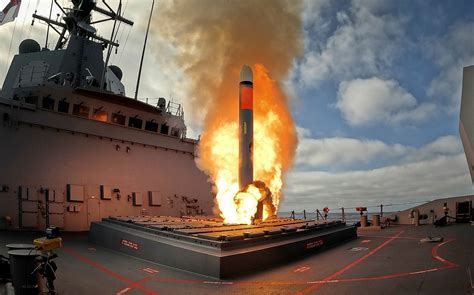
But the true long arm of the Arleigh Burke-class is the Tomahawk Land Attack Missile (TLAM). With an operational range of up to 1,500 miles, this missile allows destroyers to conduct precision strikes deep into enemy territory from international waters. Armed with a 1,000-pound warhead and guided by GPS, terrain contour matching, and satellite data, the Tomahawk enables the Navy to hit strategic targets without risking manned aircraft.
Technological Superiority: Aegis Combat System and Integrated Sensors
What truly multiplies the range and lethality of a U.S. Navy destroyer isn’t just the firepower—it’s the Aegis Combat System. A centerpiece of naval warfare technology, Aegis fuses radar, sonar, and electronic warfare into a single battle management system. Its SPY-1D radar array can track hundreds of targets simultaneously, directing missiles with split-second accuracy.
The system ensures that whether intercepting a hypersonic missile or launching a strike hundreds of miles inland, the destroyer reacts faster and more accurately than potential adversaries. Combined with advanced data-link networks, Aegis allows destroyers to share targeting data with aircraft, submarines, and satellites, vastly extending their engagement envelope.
Beyond the Burke: The Future of Naval Firepower
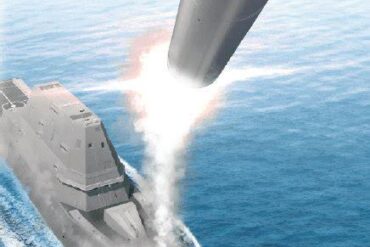
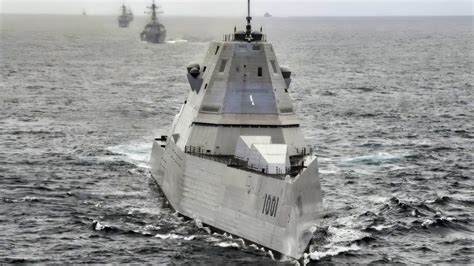
The Zumwalt-class destroyer, the Navy’s latest addition, takes long-range strike capability even further. With a sleek stealth design, electric propulsion, and Advanced Gun Systems (designed for a theoretical range of over 70 miles), Zumwalt aims to push the envelope of what naval firepower can achieve. It also integrates new missile launch technologies and is expected to host hypersonic weapons by the end of the decade.
Meanwhile, the DDG(X) program is under development to eventually replace older Burke-class ships. These next-generation destroyers promise enhanced survivability, modular weapons bays, and even laser-based defense systems, ensuring that the future of American naval warfare remains unmatched.
Versatility in Combat: Multipurpose Mission Profiles
Whether operating independently or as part of a carrier strike group, U.S. Navy destroyers adapt to a variety of mission scenarios. Their combat systems are optimized for:
- Anti-air warfare (AAW): defending against aircraft and missiles using SM-2, ESSM, and CIWS.
- Anti-surface warfare (ASuW): striking enemy ships with Harpoons, naval guns, and Tomahawks.
- Anti-submarine warfare (ASW): detecting and neutralizing subs using sonar, ASROC, and helicopters.
- Land attack: conducting deep strikes with Tomahawk cruise missiles against inland strategic targets.
These ships are the embodiment of multi-domain combat superiority, giving the U.S. Navy the flexibility to respond swiftly to evolving threats across oceans.
Cutting-Edge Upgrades: Staying Ahead in the Tech Race
To remain dominant in a rapidly evolving threat landscape, U.S. Navy destroyers are constantly retrofitted with new technologies. Recent advancements include:
- Augmented Reality (AR) systems for maintenance and rapid repairs during combat.
- Artificial intelligence integration for real-time decision-making and threat prioritization.
- Improved electronic warfare suites to jam enemy sensors and misguide incoming missiles.
Every upgrade ensures that even decades-old destroyers like the Burke-class continue to match or exceed the capabilities of newer adversary warships.
Conclusion: The Reach of Power at Sea
So, how far can a US Navy destroyer shoot? From just over a mile with the Phalanx CIWS to more than 1,500 miles with Tomahawk cruise missiles, these warships control an extensive battlespace. Their layered defense and offense—short, medium, and long-range—allows them to tackle a multitude of threats with precision and speed. With ongoing advancements, including hypersonics, AI-driven targeting, and next-gen platforms, US Navy destroyers remain one of the most powerful symbols of sea-based military might.