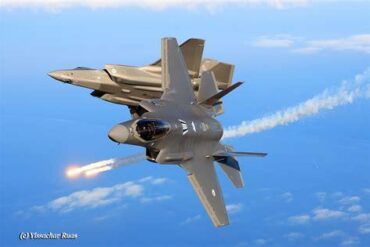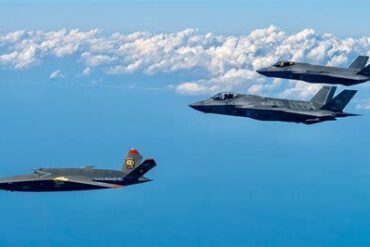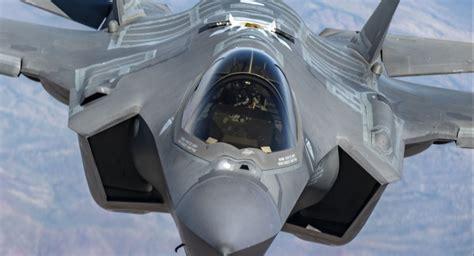
The Lockheed Martin F-35 Lightning II has emerged as the backbone of American air superiority strategy in the 21st century. With its stealth capabilities, network-centric warfare features, and cutting-edge sensor fusion, the F-35 is redefining tactical airpower. While the program has had its share of criticism and delays, especially surrounding procurement costs and software integration challenges, the United States Air Force (USAF) has forged ahead with an aggressive acquisition strategy. As of mid-2025, the number of F-35As in USAF service is approaching 500 units, reflecting its centrality to future air combat doctrine.
Initially declared combat capable in August 2016, the F-35A — the conventional takeoff and landing (CTOL) variant — continues to be integrated across USAF squadrons. With the first production model delivered in 2011, the Air Force has steadily scaled up its fleet. In September 2023, the service had 408 F-35As in its inventory, a figure that includes both active-duty Air Force and Air National Guard (ANG) units. By mid-2025, thanks to steady deliveries and legislative approvals, this number is estimated to be close to or slightly above 480 to 500 aircraft.
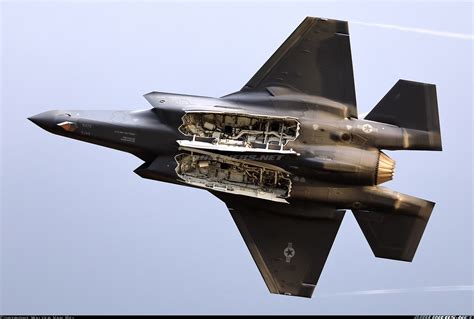
The Role of the F-35A in the USAF’s Future Force Structure
The USAF has long stated its intention to acquire 1,763 F-35As, a figure that represents nearly three times more than the combined planned totals of the US Marine Corps and US Navy. The F-35A is replacing aging F-16 Fighting Falcons and F-15C Eagles, streamlining logistics and maintenance while offering vastly superior capabilities.
Although the F-22 Raptor remains the USAF’s premier air superiority platform, its production was capped early. In contrast, the F-35A is a multi-role workhorse capable of performing deep strike missions, intelligence gathering, and electronic warfare — all while remaining virtually invisible to radar.
Procurement Trends and Congressional Approvals
In 2024, Congress approved the procurement of 48 F-35As for the USAF, continuing the annual pace established in recent years. However, internal budgetary debates have altered this trajectory. While the Air Force initially requested 42 units for 2025, Congress again approved 48, but internal reports from sources like Bloomberg revealed that the Air Force is now seeking to reduce that number to just 24 aircraft for the fiscal year. This shift reflects broader strategic funding pressures, especially as the service balances next-generation fighter development like the F-47 (formerly NGAD) against ongoing F-35 investments.
Lockheed Martin’s Production & Delivery Challenges
The F-35 program’s transition to full-rate production was officially approved in March 2024, marking a major milestone. However, the road was rocky. From 2022 to early 2024, Technology Refresh 3 (TR-3) upgrades — critical to the Block 4 enhancements — created significant disruptions. Lockheed Martin struggled with TR-3 software stability, leading to the buildup of nearly 100 completed but undeliverable aircraft in storage.
A compromise reached in 2024 allowed deliveries to resume, albeit with limitations. The aircraft delivered were cleared for training but not for combat. As of mid-2025, TR-3 problems appear largely resolved. Lockheed now asserts that newly produced and retrofitted F-35s with TR-3 are combat-capable and fully aligned with USAF requirements.
Actual F-35A Inventory Estimates in 2025
The number of F-35As actively in USAF inventory is not an exact science, owing to delays, upgrades, training aircraft, and retirements from accidents. According to FlightGlobal, there were around 385 active F-35As at the end of 2024. This figure likely excluded recently delivered jets awaiting operational clearance.
Reports from the Air & Space Forces Magazine in late 2023 confirmed 408 F-35As in service, broken down as 380 with active USAF units and 28 with the Air National Guard. From late 2023 through mid-2025, Lockheed delivered dozens more aircraft. If the 2024 delivery target of 110 aircraft is assumed, and the Air Force received even half of that number, the total by mid-2025 could exceed 475 aircraft.
Accidents and Losses
Despite high media visibility, F-35A accident rates remain low relative to legacy fighter fleets. Only two or three known crashes have occurred in USAF service, including one in January 2025 at Eielson AFB. The high cost of each F-35, and the program’s visibility, ensures that each incident is heavily reported, sometimes distorting public perception of its reliability. So far, no F-35As have been lost in combat operations.
Other Military Branches and Their F-35 Variants
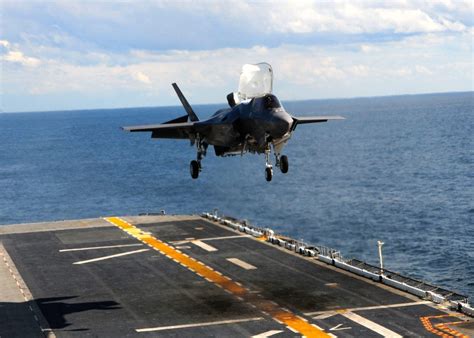
While the F-35A is exclusive to the Air Force, the US Marine Corps and US Navy are investing heavily in the F-35B and F-35C variants, respectively. The Marine Corps originally planned for 420 aircraft, split between 353 F-35Bs and 67 F-35Cs, but this has been revised to 280 F-35Bs and 140 F-35Cs.
As of early 2025, the Marines had received 183 F-35Bs and 52 F-35Cs. These aircraft are replacing AV-8B Harrier IIs and legacy Hornets and are destined for 12 STOVL squadrons and 8 carrier-based units. Meanwhile, the Navy is progressing with its 273-aircraft F-35C program, alongside its final procurement of F/A-18 Super Hornets.
Industrial Production and Global Deliveries
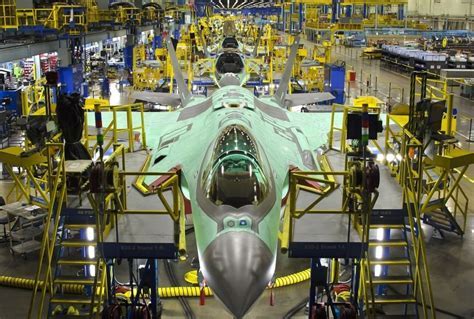
In 2025, Lockheed Martin aims to deliver 170 to 190 F-35s across all variants — a mix of new-build aircraft and those previously delayed due to TR-3 integration. This includes production at Lockheed’s primary Fort Worth facility, as well as partner assembly lines in Italy and Japan.
In contrast, other US fighter programs are producing at far lower volumes:
- Boeing delivered 14 F-15 Eagle IIs and 12 Super Hornets in 2024
- Lockheed Martin delivered 16 F-16 Block 70 fighters, all for export
- Dassault (France) delivered 21 Rafales
- Russia delivered an estimated 24 fighters, across Su-30, Su-34, Su-35, and Su-57 platforms
The F-35 is, by far, the most prolific Western fighter jet being produced today, and potentially second only to China’s J-20 Mighty Dragon in annual production — though Chinese production data remains opaque.
Strategic Positioning: The Tip of the Spear
By mid-2025, the F-35A is not only the most numerous fighter in USAF inventory, but also the strategic tip of the spear. With the F-22 production line closed, the F-35 represents the USAF’s scalable solution to contested airspace dominance, intelligence gathering, and electronic warfare.
Looking ahead, the Air Force is beginning to invest heavily in sixth-generation air superiority, with the F-47 (formerly NGAD) on the horizon. While the eventual F-35A purchase total may be revised downward to accommodate budget realities, there is no doubt the F-35 will form the core of USAF tactical aviation through the 2030s and beyond.
The Future: Ferrari F-35 and Twin-Engine Rumors
In response to Boeing securing the NGAD contract, Lockheed Martin has floated a concept for a ‘Ferrari F-35’ — a higher-performance, lower-cost alternative to sixth-generation fighters. There have also been rumors, partly fueled by statements from former President Donald Trump, about a twin-engine variant dubbed the F-55. These claims, while speculative, indicate the ongoing political and industrial complexity surrounding the F-35 program.
Despite these distractions, the F-35A’s expanding role is certain. With nearly 500 aircraft in service by 2025, full TR-3 integration underway, and expanding global deployment, the Lightning II continues to define the edge of American airpower.