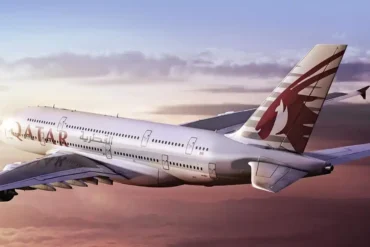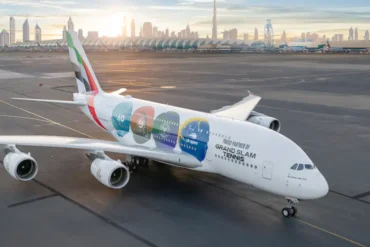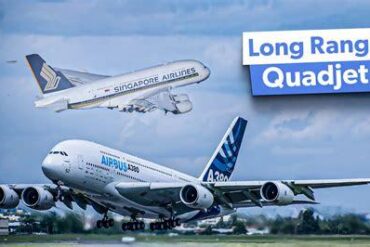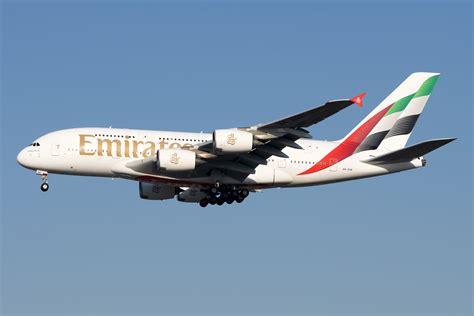
The Airbus A380 represents everything modern airline economics was supposed to move away from. The aircraft is enormous, powered by four engines, requires specialized airport infrastructure, and carries hundreds more passengers than most aircraft flying today. As airlines around the world retire their superjumbos and replace them with efficient twin-engine jets, one carrier continues to operate the A380 at a scale unmatched anywhere else: Emirates.
What makes Emirates particularly unusual is not simply that it operates the world’s largest A380 fleet. The more interesting question is why the airline can successfully deploy this aircraft on routes where competitors often choose much smaller Airbus A320-family aircraft, Boeing 737s, or other narrowbody jets. On paper, a four-engine aircraft flying a short regional sector appears financially irrational. In reality, Emirates has built a network, fleet structure, and business model where the A380 can become the most profitable choice.
The answer lies in a combination of hub economics, passenger connectivity, airport capacity constraints, aircraft ownership strategy, cargo revenue, and network design. Emirates is not treating these short flights as simple city-to-city journeys. Instead, the airline uses them as high-capacity links inside one of the world’s most powerful global aviation networks.
The Emirates A380 Strategy Is Built Around Network Economics
Most airlines evaluate aircraft deployment by looking at individual routes. A short flight between two cities is usually judged by local demand, ticket prices, and operating costs. If a route only requires 150 passengers, operating a 500-seat aircraft would appear wasteful.
However, Emirates operates according to a different philosophy. The airline’s Dubai hub is designed around connecting passengers from multiple continents through a single coordinated network. A flight from Dubai to a nearby destination is not simply carrying passengers traveling between those two cities. It is transporting travelers who may have started their journeys in Europe, North America, Africa, Asia, or Australia.
This distinction completely changes the financial calculation.
A narrowbody aircraft depends heavily on local demand. A large portion of its passengers must originate or terminate at the cities directly connected by that flight. Emirates, however, fills its aircraft with passengers transferring through Dubai. A traveler flying from London to Bangkok, Frankfurt to Johannesburg, or New York to Mumbai may contribute revenue to a regional A380 sector even though they are not traveling between Dubai and that destination alone.
This is the power of the sixth freedom traffic model, where airlines transport passengers between two foreign countries through their own hub. Gulf carriers such as Emirates have mastered this approach because their geographic location allows them to connect major markets across Europe, Asia, Africa, and Oceania efficiently.
The short regional flight becomes an essential piece of a much larger international puzzle.
A Full Airbus A380 Changes The Cost Equation
The biggest challenge facing any airline operating an A380 is simple: the aircraft must be filled.
A typical narrowbody aircraft has lower operating costs because it carries fewer passengers and consumes significantly less fuel. An Airbus A321, for example, may burn around 2.4 tons of fuel per hour, while an Airbus A380 can consume approximately 15 tons per hour depending on operating conditions.
That difference is massive.
If an airline operates an A380 with hundreds of empty seats, the economics quickly collapse. Fuel, maintenance, airport charges, and crew costs must be divided among fewer passengers, creating a high cost per available seat kilometer.
But when Emirates fills its A380 cabins, the situation changes dramatically.
The airline can distribute many of the same fixed costs across more than 500 passengers. Landing fees, navigation charges, cockpit crew expenses, and maintenance costs are spread across a much larger passenger base. The result is a surprisingly competitive seat cost on high-demand flights.
This is why Emirates can sometimes make a superjumbo work on routes where another airline would never consider using one. The aircraft itself is not automatically profitable. The surrounding network creates the conditions where it becomes profitable.
Dubai’s Airport Capacity Makes Larger Aircraft More Valuable
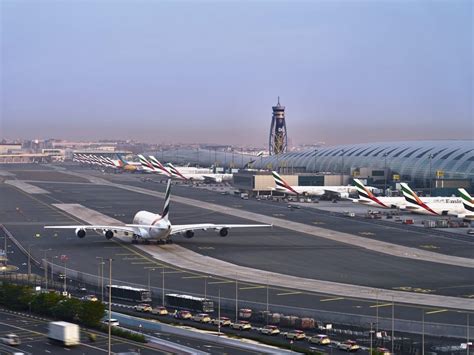
Another major factor is the importance of airport slots at Dubai International Airport (DXB).
Unlike many airlines that operate from airports with room to expand, Emirates operates from one of the world’s busiest international hubs. Dubai’s airport faces significant capacity limitations because demand continues to grow faster than available runway movements.
When an airline has unlimited airport capacity, adding more flights is an easy solution. When slots are scarce, increasing the size of each aircraft becomes much more attractive.
A single Emirates A380 movement can transport hundreds more passengers than a narrowbody aircraft while using only one departure and arrival slot. Instead of adding multiple smaller aircraft movements during peak periods, Emirates can maximize the value of each available slot.
This strategy is particularly important during busy connection waves. Emirates schedules groups of arriving and departing flights so passengers from different regions can transfer efficiently. A larger aircraft allows the airline to move more travelers through the same infrastructure.
The A380 is therefore not only a passenger aircraft. It is also a capacity management tool.
Why Emirates’ Fleet Structure Supports The Superjumbo
Many airlines abandoned the Airbus A380 because the aircraft did not fit their fleet strategies. Operating a small number of superjumbos alongside dozens of other aircraft types created complexity.
Different aircraft require different pilot training programs, maintenance procedures, spare parts inventories, and airport equipment. For airlines with mixed fleets, the A380 often became an expensive specialty aircraft.
Emirates built the opposite model.
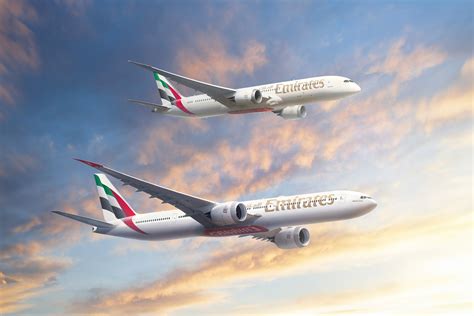
The airline developed one of the largest widebody fleets in aviation history, centered around aircraft such as the Airbus A380 and Boeing 777. This scale allows Emirates to spread operational expertise across thousands of flights.
The A380 is not an isolated experiment. It is a core part of the airline’s identity and operating structure.
Because Emirates has invested heavily in A380 infrastructure, training, and maintenance capabilities, the aircraft becomes less of a burden. The airline already has the facilities and workforce needed to support the aircraft, reducing many of the disadvantages faced by smaller operators.
Aircraft Ownership Gives Emirates More Flexibility
One of the biggest reasons other airlines struggled with the A380 was financial pressure from aircraft leasing.
Large aircraft require significant capital investment. When demand changes, airlines leasing expensive aircraft may still face fixed monthly payments. This makes operating large aircraft on seasonal or unpredictable routes risky.
Emirates has benefited from its strong financial position and long-term approach to fleet management. The airline has been able to acquire aircraft assets and reduce dependence on traditional leasing structures.
Lower ownership costs change the economics of operating the A380.
An aircraft that has already been largely paid for does not face the same financial pressure as a newly leased aircraft requiring high monthly payments. Emirates can therefore evaluate flights based more on operating revenue rather than simply recovering large capital costs.
This flexibility allows the airline to continue using A380s on routes where other carriers might conclude that the aircraft is too expensive.
The Hidden Revenue From Emirates SkyCargo
Passenger revenue is only part of the A380 equation.
One often overlooked advantage of widebody aircraft is their cargo capacity. Beneath the passenger cabin, the A380 has enormous cargo holds capable of carrying substantial amounts of freight.
For Emirates, this creates additional revenue through Emirates SkyCargo.
A narrowbody aircraft operating a short regional route has limited space for freight after passenger baggage is loaded. An A380 can transport significantly more cargo, allowing the airline to move valuable goods between Dubai and regional markets.
This is especially important because Dubai serves as a global logistics hub. Electronics, pharmaceuticals, luxury products, industrial components, and time-sensitive shipments often move through Emirates’ network.
A short regional A380 flight can therefore serve two purposes simultaneously: moving hundreds of passengers and transporting profitable cargo.
The cargo contribution helps offset the aircraft’s higher fuel consumption.
Why Other Airlines Do Not Copy Emirates’ A380 Approach
If Emirates has found a successful formula, why do other airlines not simply copy it?
The answer is that the strategy depends on very specific conditions.
Many international airlines operate from markets with different demand patterns. European, American, and Asian carriers often serve multiple secondary cities where passenger demand is spread across many smaller routes.
For these airlines, narrowbody aircraft provide flexibility. A carrier can adjust schedules, increase frequencies, or reduce capacity depending on demand. A 160-seat aircraft is much easier to manage than a 500-seat superjumbo.
Business travelers also value frequency. An airline offering five daily flights with smaller aircraft may attract more premium passengers than one offering a single large aircraft every day.
Emirates faces a different reality. Its business model is built around concentrating international traffic through Dubai rather than operating extensive domestic or regional networks.
The A380 fits this strategy because the airline is not competing primarily on frequency between neighboring cities. It is maximizing global connectivity through one central hub.
The Passenger Experience Also Supports The Emirates Brand
Beyond pure economics, the A380 provides Emirates with another advantage: brand differentiation.
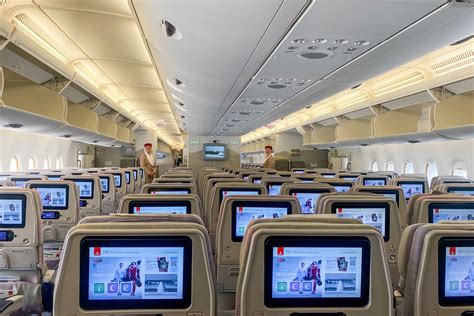
The aircraft has become closely associated with Emirates’ premium image. Features such as spacious cabins, onboard lounges, and first-class suites help create a product experience that smaller aircraft cannot easily replicate.
For long-distance travelers connecting through Dubai, the A380 is part of the overall journey rather than simply transportation between two airports.
This matters because premium passengers often contribute disproportionately high revenue. Business-class and first-class travelers may generate significantly more profit than economy passengers, helping improve the financial performance of high-capacity aircraft.
A full economy cabin is valuable. A full premium cabin is even more valuable.
The A380 Works Only When The Entire System Works
The Emirates A380 story is not about proving that large aircraft are always better. The opposite is true. For most airlines, operating a superjumbo on short routes would create unnecessary financial risk.
The aircraft succeeds because Emirates has built an ecosystem designed around it.
The airline has a massive international hub, strong connecting traffic, high passenger volumes, valuable cargo operations, extensive A380 infrastructure, and a fleet strategy that supports large aircraft.
A smaller airline looking only at fuel consumption would reject the A380. Emirates looks at the entire network.
That difference explains why the same aircraft that became a financial challenge for many carriers remains a powerful tool for one of aviation’s most ambitious airlines.
Why Emirates Can Keep Flying The A380 When Others Cannot
The Airbus A380 was designed for a world where passenger growth would concentrate into mega-hubs and where airlines needed larger aircraft to handle increasing demand. Although aviation moved toward smaller, more flexible aircraft, Emirates proved that the original superjumbo concept can still work under the right conditions.
The airline does not operate the A380 because it ignores economics. It operates the aircraft because it understands economics differently.
Where other airlines see a large aircraft on a short route, Emirates sees a high-capacity connection inside a global transportation network.
Where others calculate fuel burn, Emirates calculates passenger flow.
Where others see an oversized aircraft, Emirates sees a solution to airport congestion, network demand, and premium travel growth.
That is why Emirates remains one of the only airlines capable of profitably operating an Airbus A380 on routes where nearly every competitor chooses a narrowbody aircraft. The secret is not the airplane alone. The secret is the entire system built around it.