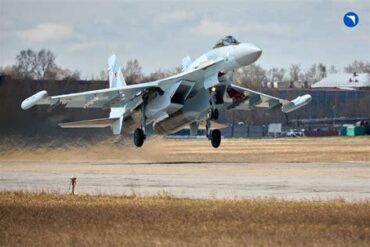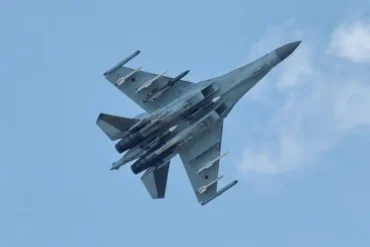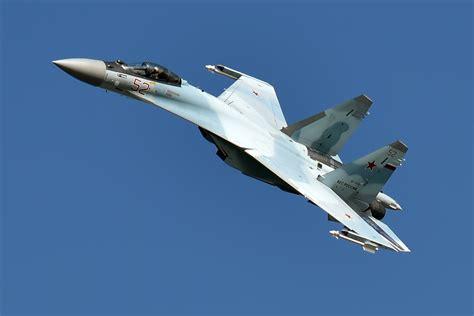
On June 7, the Ukrainian Air Force confirmed the successful downing of a Russian Su-35S Flanker-E fighter jet over the Kursk region, delivering a significant blow to the operational capabilities of the Russian Aerospace Forces (VKS). The announcement, made via a succinct post on Ukraine’s official Telegram channel, marked the latest in a string of increasingly aggressive encounters in the skies above the contested border zones. Though minimal in detail, the Ukrainian statement underscored the success of the mission, hinting at a precise and high-stakes aerial engagement.
Visual Evidence and OSINT Confirmation
Shortly after the official announcement, Open Source Intelligence (OSINT) analysts began to circulate images and video footage confirming the destruction of the Su-35S. Scorched debris, parts of the fuselage, and identifiable components of the aircraft were geolocated to rural areas near the border, consistent with Ukrainian claims.
While Moscow has yet to issue any formal confirmation, the images left little room for plausible denial. Adding to the credibility of the Ukrainian version, leaked clips showed what appeared to be a Russian combat search and rescue (CSAR) operation attempting to retrieve the pilot from hostile territory.
The Su-35S is a multi-role, air superiority fighter, equipped with powerful radar and electronic warfare systems, designed to dominate in beyond-visual-range (BVR) combat. Its loss is not just symbolic; it represents a tangible reduction in Russia’s ability to maintain air dominance in increasingly contested skies.
Speculation Surrounding Ukrainian F-16 Involvement
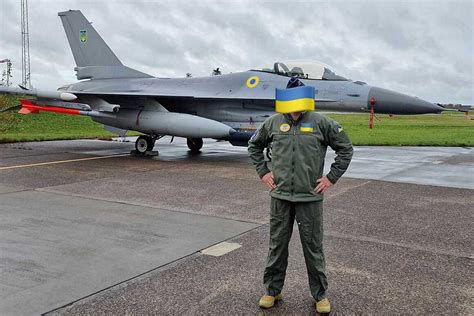
Among the most compelling developments in this incident is the growing speculation that the downing may have been executed by a Ukrainian-operated F-16 Fighting Falcon, possibly using a U.S.-supplied AIM-120 AMRAAM missile. Several unofficial sources have hinted at this scenario, which—if confirmed—would be a historic first air-to-air kill for Ukraine’s newly acquired Western jets.
The hypothesis, while unverified, has gained traction due to the absence of ground-based missile trails in initial video assessments, combined with the altitude and rapid descent pattern observed in the wreckage footage. These characteristics point to an aerial interception rather than a ground-launched strike.
Strategic Impact of a Possible F-16 Kill
If the F-16 involvement proves true, it would mark a dramatic shift in Ukraine’s aerial posture. The ability to intercept and destroy advanced Russian fighters from the air would elevate Ukraine’s defensive and offensive flexibility considerably. It would also mark a milestone in Western military support—not just in equipment delivery but in operational integration and real-time engagement capabilities.
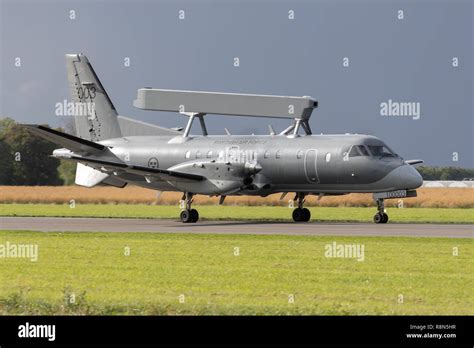
Such missions may have been supported by the Swedish-supplied Saab 340 AEW&C (ASC 890) airborne early warning and control aircraft, which enhance long-range detection and targeting coordination. This AEW&C-F-16 synergy would grant Ukraine a layered and responsive air defense grid, enabling real-time identification and engagement of Russian air threats far from the front lines.
Background on the Su-35S and Its Strategic Role
The Su-35S Flanker-E is among Russia’s most advanced fourth-generation fighters. It features thrust-vectoring engines, an Irbis-E passive electronically scanned array (PESA) radar, and an advanced electronic warfare suite. Built as a stopgap between the aging Su-27 and the yet-to-be-matured Su-57 stealth fighter, the Su-35S has been pivotal in Russian air operations over Syria and Ukraine.
Designed for BVR superiority and multi-role adaptability, the Su-35S is capable of carrying a wide range of air-to-air and air-to-ground munitions, including R-77 and R-73 missiles. Its deployment along the Ukrainian front was intended to deter NATO-supplied systems and reassert air dominance. The loss of another unit—notably the eighth confirmed Su-35S loss since the 2022 invasion—is a severe dent in both capability and morale.
Accumulating Russian Air Losses and Their Implications
This shootdown follows closely on the heels of a massive drone strike operation carried out by the Security Service of Ukraine (SBU) just days earlier. In that assault, over 40 Russian aircraft, including Tu-95 Bear and Tu-22M3 Backfire strategic bombers, were reportedly damaged or destroyed at various air bases deep inside Russian territory. The coordination and success of these attacks signal an alarming new phase for Russian air defenses, one in which neither fixed airfields nor airborne assets are safe.
Ukraine’s ability to sustain pressure both on the ground and in the skies is forcing a strategic recalibration within the Russian command structure. No longer can the VKS assume superiority by sheer volume. The quality and precision of Ukrainian strikes are shifting the dynamic from attrition to technological and tactical supremacy.
Kremlin’s Silence and Information Warfare
Despite mounting evidence, the Kremlin has remained silent on the latest Su-35S loss. This strategy of non-disclosure or delayed acknowledgment is not new. Russian authorities have consistently attempted to control narrative exposure, often refusing to confirm aircraft losses until long after wreckage has been independently verified or families of pilots begin to speak out.
This incident, however, presents a unique challenge. The circulation of detailed imagery, the widespread analysis by open-source experts, and the implied involvement of NATO-class weaponry make it increasingly difficult for Moscow to maintain its silence without incurring reputational costs both domestically and internationally.
Ukraine’s Tactical and Psychological Victory
From a tactical standpoint, the neutralization of a Su-35S fighter serves multiple purposes. It depletes Russian inventory, which is difficult and time-consuming to replenish under current sanctions and production constraints. It also sends a stark warning to VKS pilots: Ukrainian airspace is no longer permissive.
Psychologically, the downing feeds into a larger narrative of Ukrainian resilience and technological integration. It validates the Western strategy of enabling Ukraine with precision weaponry, high-end platforms, and intelligence coordination, showing the world that the recipient of such aid is more than capable of leveraging it effectively.
Broader Strategic Shifts in the Air War
The emergence of Western-supplied airframes and systems in Ukrainian operations is gradually tilting the scales in a long-static air war. Previously constrained to a largely defensive posture, Ukraine is now exhibiting offensive and proactive aerial capabilities. This change is not just symbolic; it threatens to erode the strategic depth from which Russian aircraft once operated with relative impunity.
Moreover, this development signals that Russian air doctrine—heavily reliant on overwhelming force and limited contestation—is facing real-world pushback. The future of air warfare in this conflict may depend less on numbers and more on integration, training, and real-time battlefield coordination.
Conclusion: A Sky No Longer Dominated
The downing of the Su-35S over Kursk stands as a testament to Ukraine’s evolving air power, reinforced by international cooperation and real-time battlefield execution. While unconfirmed details—particularly the potential use of an F-16 and AMRAAM—remain speculative, the implications are already reverberating through strategic assessments on both sides.
As Ukraine continues to dismantle Russian air superiority layer by layer, one thing is clear: the days of unchecked Russian dominance in the skies over Ukraine may be nearing an end. This incident, small in isolation but massive in consequence, marks a turning point in a conflict increasingly defined by speed, reach, and the relentless pursuit of air control.