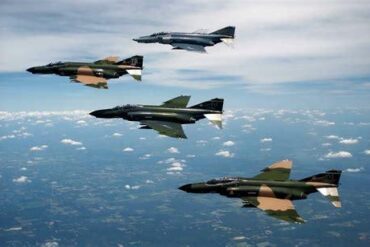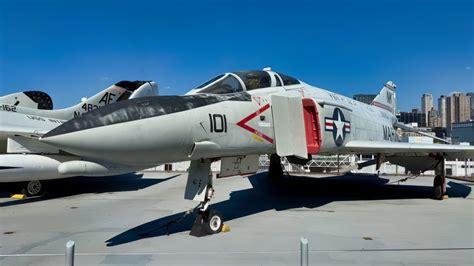
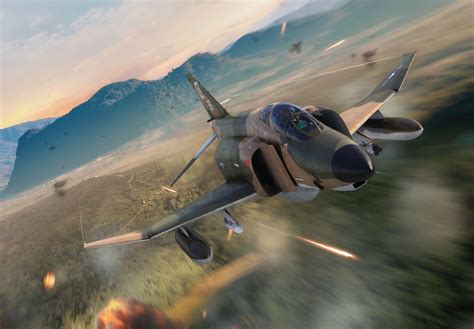
The McDonnell Douglas F-4 Phantom II occupies a unique place in military aviation history. Few combat aircraft have transformed from an unwanted acquisition into one of the most respected and versatile fighter aircraft ever operated by the United States Air Force (USAF). Originally conceived as a rugged carrier-based interceptor for the United States Navy, the Phantom was never intended to become the backbone of America’s tactical air power. Yet political decisions, technological innovation, and battlefield necessity combined to turn the naval fighter into one of the USAF’s greatest success stories.
The irony surrounding the Phantom’s career is difficult to ignore. Air Force leadership initially resisted adopting the aircraft, believing it was too heavy, too specialized for naval operations, and fundamentally incompatible with the service’s own fighter doctrine. However, once combat experience proved its capabilities, the aircraft evolved into far more than an interceptor. It became a fighter, bomber, reconnaissance platform, electronic warfare aircraft, suppression-of-enemy-air-defense specialist, and close air support workhorse.
By the time the USAF finally retired the F-4 in 1996, it had served for more than three decades and accumulated a combat record that few fighter aircraft can rival. More impressively, many international operators continue flying upgraded Phantoms today, proving that the aircraft’s original engineering was decades ahead of its time.
The Navy’s Ambitious Fighter That Changed Military Aviation
When McDonnell Aircraft began developing what would become the F-4 Phantom II during the 1950s, the objective was straightforward: build an aircraft capable of defending aircraft carriers against increasingly capable Soviet bombers and missiles.
Carrier operations demanded an exceptionally strong airframe. Naval fighters had to survive violent catapult launches, brutal arrested landings, corrosive saltwater environments, and extended deployments at sea. These requirements naturally produced an aircraft far more rugged than most land-based fighters.
Instead of prioritizing lightweight agility, McDonnell engineers emphasized raw engine power, structural durability, long-range radar capability, and exceptional payload capacity. The result became an aircraft powered by two General Electric J79 turbojet engines capable of pushing the Phantom beyond Mach 2, making it one of the fastest operational fighters of its generation.
Its enormous radar, two-person crew, and extensive weapons stations reflected a philosophy centered on intercepting threats long before they could threaten a carrier battle group. Rather than engaging in traditional dogfights, the Phantom was designed to destroy enemy aircraft using guided missiles at significant distances.
That philosophy would later prove remarkably valuable to the Air Force.
Why the US Air Force Didn’t Want the F-4
Despite the Phantom’s impressive specifications, the USAF initially viewed it with skepticism.
The Air Force already operated several members of the famed Century Series, including the F-100 Super Sabre, F-101 Voodoo, F-102 Delta Dagger, F-104 Starfighter, and F-105 Thunderchief. Service leaders preferred aircraft specifically designed around Air Force doctrine rather than adapting a Navy fighter.
Several objections seemed reasonable.
The Phantom lacked an internal cannon in its earliest variants, relying entirely on missiles during an era when missile technology remained relatively immature. The aircraft was also physically enormous compared to contemporary fighters, with a high empty weight and substantial operating costs.
Many USAF officers believed a carrier-based aircraft would inevitably compromise land-based performance.
Their resistance ultimately proved futile.
Robert McNamara Forced a Joint Fighter Solution
Defense Secretary Robert McNamara believed separate military branches wasted billions of dollars developing similar aircraft for overlapping missions.
Determined to reduce duplication, McNamara aggressively promoted standardized procurement across the armed forces. The Phantom became one of his first major successes.
Initially designated the F-110 Spectre before America’s aircraft designation system was unified, the Air Force version eventually adopted the Navy’s F-4 designation.
Although many USAF leaders accepted the decision reluctantly, operational testing quickly demonstrated the Phantom’s remarkable potential. Instead of merely replacing existing fighters, the aircraft complemented—and often exceeded—the capabilities of multiple aircraft already in service.
What began as a politically driven procurement gradually became one of the smartest investments the Air Force ever made.
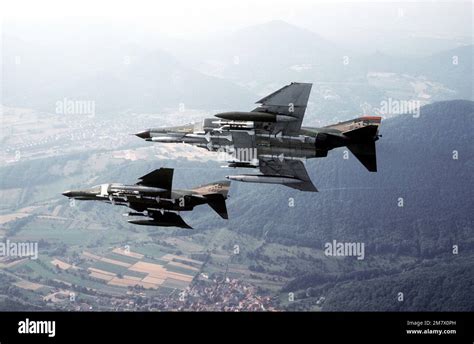
Power Over Elegance: The Triumph of Thrust
The F-4 earned the famous description as a “triumph of thrust over aerodynamics.”
Unlike later fighters emphasizing extreme maneuverability, the Phantom relied on overwhelming engine power. Its twin J79 engines generated tremendous acceleration and climb performance that compensated for the aircraft’s comparatively blunt aerodynamic profile.
The aircraft could climb at more than 40,000 feet per minute, rapidly reaching high-altitude interception positions before enemy aircraft crossed friendly airspace.
Speed became its greatest defensive weapon.
If an engagement turned unfavorable, Phantom crews could simply engage full afterburner and exploit their exceptional straight-line performance. Few contemporary opponents could maintain pursuit.
Rather than attempting to out-turn lighter fighters, Phantom pilots learned to control the engagement through superior speed, energy management, and altitude.
Vietnam Changed How the Phantom Was Flown
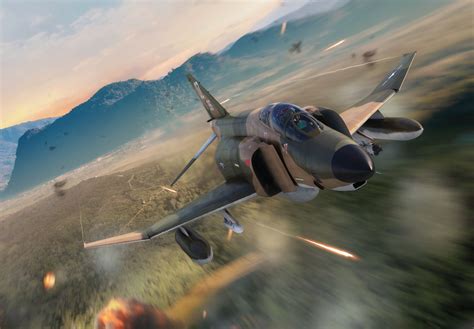
Combat over Vietnam exposed both the Phantom’s strengths and weaknesses.
North Vietnamese MiG-17 and MiG-21 fighters often enjoyed superior turning performance in close-range dogfights. Early American assumptions that guided missiles would eliminate traditional aerial maneuvering proved overly optimistic.
Instead of attempting to match Soviet fighters in turning battles, USAF pilots adapted.
They embraced boom-and-zoom tactics, diving into combat with tremendous speed, delivering missile attacks, then climbing away using the Phantom’s powerful engines before opponents could respond effectively.
The strategy capitalized on the aircraft’s natural advantages while minimizing its aerodynamic limitations.
Continuous improvements—including better pilot training, enhanced missile reliability, and eventually the addition of an internal cannon on later variants—significantly improved Phantom combat effectiveness throughout the conflict.
An Aircraft That Could Replace Several Others
Perhaps no feature defined the Phantom better than its incredible versatility.
While originally built as a fleet defense interceptor, the aircraft rapidly expanded into missions never envisioned during its design.
The F-4 successfully performed:
- Air superiority missions
- Ground attack operations
- Close air support
- Strategic interdiction
- Reconnaissance
- Electronic warfare
- Suppression of enemy air defenses (SEAD)
- Precision strike missions
Instead of maintaining separate specialized aircraft for every mission, commanders increasingly discovered that one Phantom squadron could accomplish work previously requiring multiple aircraft types.
This operational flexibility dramatically simplified logistics while improving combat responsiveness.
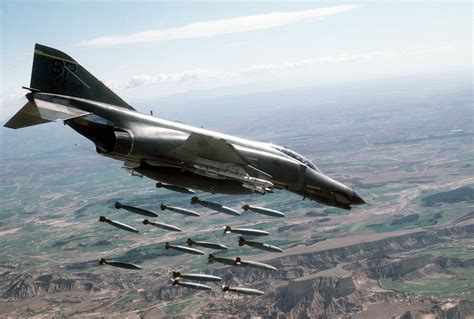
Payload Capacity That Rivaled World War II Bombers
One of the Phantom’s most astonishing characteristics was its payload.
The aircraft could carry approximately 18,650 pounds of external stores, exceeding the bomb load of the legendary Boeing B-17 Flying Fortress during many World War II missions.
Nine external hardpoints allowed nearly limitless combinations of weapons.
A single sortie could include:
- AIM-7 Sparrow radar-guided missiles
- AIM-9 Sidewinder infrared missiles
- External fuel tanks
- Conventional bombs
- Precision-guided munitions
- Cluster weapons
- Rocket pods
- Electronic warfare pods
This enormous carrying capacity transformed the Phantom into an exceptionally flexible battlefield asset.
Crews could destroy ground targets before immediately transitioning into an air-to-air engagement during the return flight.
Very few fighters before—or since—have offered that level of adaptability.
The Wild Weasel That Hunted Surface-to-Air Missiles
Perhaps the Phantom’s greatest legacy emerged in one of aviation’s most dangerous missions.
As North Vietnam deployed increasingly sophisticated surface-to-air missile (SAM) networks, the USAF developed specialized Wild Weasel tactics designed to locate and destroy enemy radar installations.
The F-4G Wild Weasel V became the definitive aircraft for this mission.
Engineers removed the internal gun and filled the aircraft with advanced radar receivers, electronic warfare equipment, and sophisticated targeting systems capable of detecting hostile radar emissions.
The second crew member became indispensable.
While the pilot concentrated on flying at extremely high speed through hostile airspace, the Weapon Systems Officer managed electronic sensors, identified enemy radar sites, and coordinated missile attacks.
Armed with AGM-88 HARM anti-radiation missiles, the F-4G hunted the very missile batteries attempting to destroy it.
Its success proved so remarkable that the aircraft remained America’s primary Wild Weasel platform well into Operation Desert Storm in 1991.
Built Strong Enough for Carrier Decks, Perfect for Battlefield Abuse
Many of the Phantom’s greatest Air Force strengths originated from naval engineering.
Carrier operations required exceptionally robust landing gear, reinforced fuselage structures, oversized control surfaces, and powerful arresting equipment.
Once transferred to Air Force service, these same characteristics allowed the aircraft to survive intense low-level strike missions, repeated high-G maneuvers, and exceptionally heavy weapons loads.
The spacious nose section, originally designed to house an enormous interceptor radar, easily accommodated increasingly sophisticated avionics as technology advanced.
Over successive upgrades, operators integrated:
- Terrain-following radar
- Laser designation systems
- Ground-mapping radar
- Electronic countermeasures
- Modern navigation equipment
- Advanced communication systems
Instead of becoming obsolete, the Phantom continually evolved.
Why So Many Countries Kept Flying the F-4
Unlike many Cold War fighters that disappeared shortly after retirement, the Phantom remained remarkably relevant.
Its enormous internal volume allowed operators to remove outdated electronics while installing entirely new generations of avionics without redesigning the aircraft itself.
This modernization potential made upgrades economically attractive.
Rather than purchasing entirely new fleets, countries could transform existing F-4s with modern radars, digital cockpits, precision weapons integration, and advanced electronic warfare systems.
Several air forces concluded that no equally affordable aircraft matched the Phantom’s combination of speed, payload, durability, and operational flexibility.
Even decades after production ended, upgraded Phantoms continue performing meaningful combat and deterrence roles.
How the F-15 and F-16 Divided the Phantom’s Responsibilities
The arrival of fourth-generation fighters eventually replaced the Phantom—but not with a single aircraft.
Instead, its responsibilities were divided.
The F-15 Eagle focused almost exclusively on air superiority, emphasizing acceleration, climb performance, and unmatched aerial combat capability.
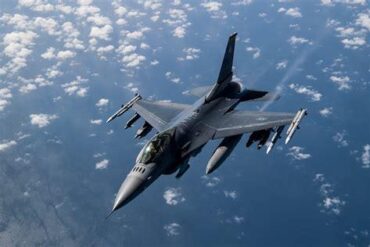
Meanwhile, the F-16 Fighting Falcon introduced revolutionary fly-by-wire controls, exceptional agility, and lower operating costs while gradually expanding into multirole operations.
Together they covered much of the Phantom’s workload.
Yet neither individually matched the F-4’s extraordinary breadth of capabilities.
Only when the Air Force introduced the F-15E Strike Eagle, combining two crew members with long-range strike capability and precision attack systems, did a true spiritual successor emerge.
Ironically, decades after initially rejecting the Phantom’s design philosophy, the Air Force ultimately embraced many of its defining concepts.
The Enduring Legacy of the Air Force’s Reluctant Hero
The F-4 Phantom II demonstrated that military success often comes from adaptability rather than perfection.
It never became the tightest-turning fighter, the lightest aircraft, or the most elegant design. Instead, it combined overwhelming thrust, exceptional durability, tremendous payload capacity, and remarkable versatility into a platform capable of evolving with changing warfare.
The Air Force may have been forced into acquiring the Phantom, but combat experience fundamentally changed institutional opinion. Pilots learned to exploit its strengths instead of lamenting its weaknesses. Engineers continuously modernized its systems instead of replacing the entire aircraft. Commanders discovered that one Phantom squadron could accomplish missions requiring multiple specialized aircraft.
Its influence extended well beyond its operational service. Modern multirole fighters, electronic warfare doctrine, precision strike tactics, and suppression-of-enemy-air-defense operations all owe part of their development to lessons learned from the Phantom.
More than sixty years after its first flight, the F-4 Phantom II remains one of the most influential combat aircraft ever built. What began as a Navy interceptor evolved into an Air Force legend, proving that the best military aircraft are not always those originally requested, but those capable of exceeding every expectation placed upon them.