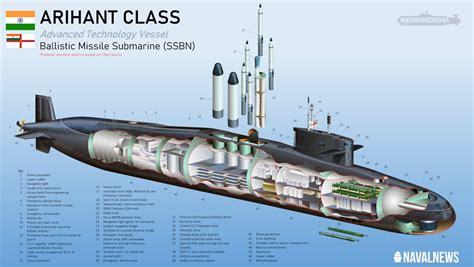
India is moving toward a decisive milestone in its strategic deterrence program as INS Aridhaman, the nation’s third Arihant-class nuclear ballistic missile submarine (SSBN), enters the final phase of harbour and sea trials. With commissioning expected shortly, the submarine will elevate India to a new level of undersea nuclear readiness, marking the first time the Navy fields three operational SSBNs simultaneously.
INS Aridhaman represents the culmination of nearly a decade of design refinements, engineering advancements, and incremental progress across the Advanced Technology Vessel (ATV) program. The submarine follows the induction of INS Arihant in 2016 and INS Arighaat in 2024, forming the backbone of India’s assured second-strike capability under its nuclear doctrine.
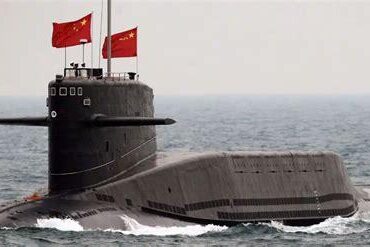
India’s pursuit of a robust SSBN fleet is rooted in long-standing strategic concerns, reinforced by rising Chinese naval activity in the Indian Ocean Region and the need for a survivable deterrent posture. With INS Aridhaman poised for commissioning, the Indian Navy gains greater flexibility in maintaining continuous at-sea deterrence patrols.
Enlarged Hull, Higher Displacement, and Improved Stealth
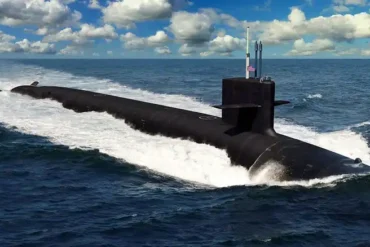
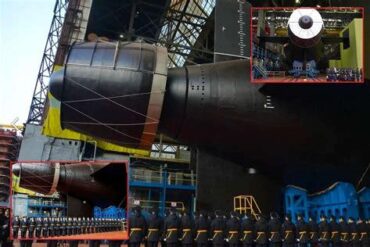
The vessel features a significantly enlarged hull compared to the first-of-class INS Arihant, enabling increased payload capacity and improved internal layout for crew operations. Measuring roughly 130 meters in length, 11 meters in beam, and with a draft approaching 10 meters, the submarine exhibits a surface displacement near 6,000 tonnes and a submerged displacement of approximately 7,000 tonnes.
The hull structure incorporates specialized low-carbon steel and may employ anechoic tiles for acoustic damping. Alongside a seven-blade propeller and refined machinery isolation, these measures lower the submarine’s acoustic signature, a critical factor in strategic patrol survivability.
Indigenous Nuclear Propulsion and Performance Parameters
INS Aridhaman is powered by the 83 MW CLWR-B1 pressurised light water reactor, an evolution of the prototype reactor at Kalpakkam. This system delivers enough power to drive the submarine at 12–15 knots surfaced and around 24 knots submerged, with operational endurance constrained only by maintenance cycles, provisions, and crew rotation.
Crew strength will range between 95 and 100, including officers and sailors trained specifically for nuclear submarine operations at the Kalpakkam facility.
Increased Missile Capacity with Eight VLS Tubes
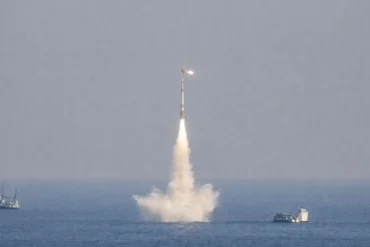
One of the most important distinctions of INS Aridhaman is its expanded missile payload. The raised hull section houses eight vertical launch system (VLS) tubes, doubling the loadout of INS Arihant and INS Arighaat. This configuration allows:
- Up to 24 K-15 Sagarika SLBMs (750 km range), or
- Eight K-4 SLBMs (approx. 3,500 km range)
The class is widely expected to be compatible with the in-development K-5 missile, projected to reach 5,000–6,000 km, significantly extending India’s strategic reach.
For conventional or tactical scenarios, INS Aridhaman retains six 533 mm torpedo tubes, capable of firing Varunastra torpedoes, mines, and select cruise missiles.
Advanced Sonar and Combat Management Suite
The submarine integrates a sophisticated sensor and combat suite including:
- USHUS sonar, originally developed for the Kilo-class
- Panchendriya unified sonar and tactical control system
- Bow, flank, and towed array sonars
Combined with a modern combat management system, these sensors provide crucial underwater situational awareness across the complex acoustic conditions of the Indian Ocean Region.
Origins in Cold War-Era Strategic Reassessment
India’s SSBN initiative originates in the aftermath of the 1971 Indo-Pakistani War, when the entry of the U.S. Seventh Fleet’s Task Force 74 into the Bay of Bengal—followed by Soviet submarine shadowing—highlighted the military and political weight of nuclear-capable submarines. The shift intensified after India’s 1974 nuclear test, prompting Project 932, an internal feasibility study that laid the groundwork for indigenous nuclear propulsion.
The ATV program crystalised in the 1990s, originally aimed at nuclear attack submarines, but realigned after India’s 1998 nuclear tests toward ballistic missile submarines under its no-first-use policy. The completion of the S1 prototype reactor in 2006 marked the pivotal turning point enabling India to enter the league of SSBN-operating nations.
Industrial Partners and the Engineering Base Behind the Fleet
India’s nuclear submarine ecosystem spans multiple industrial and scientific hubs. Larsen & Toubro contributed detailed engineering through its submarine design center; Tata Power SED supplied control systems; and Walchandnagar Industries manufactured steam turbines. Hindustan Shipyard, transferred to the Ministry of Defence in 2009, supports construction work. The Ship Building Centre in Visakhapatnam serves as the primary assembly site.
Expanded Class: From S1 to S4* and Beyond
The Arihant lineage includes:
- INS Arihant (S2) – commissioned 2016
- INS Arighaat (S3) – commissioned 2024
- INS Aridhaman (S4) – commissioning expected late 2025
- S4* – launched October 2024 with greater indigenous content
A larger successor class, the S5 SSBN, is planned, expected to displace around 13,500 tonnes and carry long-range missiles exceeding 5,000 km.
Meanwhile, India is also pursuing nuclear attack submarines via Project 77, sanctioned in 2024, and awaits the leased Chakra III Akula-class SSN from Russia around 2028.
A Navy on a Rapid Modernization Trajectory
India’s naval expansion is accelerating, driven by the need to secure vital sea lanes, maintain regional stability, and respond to China’s expanding footprint. As of late 2025, more than 54 vessels were in various stages of construction, with the Navy commissioning a new warship every 40 days on average.
Long-term plans aim for 230 surface combatants and submarines by 2037, supplemented by expanded bases in the Andaman & Nicobar Islands, Lakshadweep, and a new generation of unmanned and autonomous underwater systems.
Strategic Impact of INS Aridhaman’s Commissioning
Once commissioned, INS Aridhaman will be homeported at Rambilli under Eastern Naval Command and fall operationally under India’s Strategic Forces Command. The submarine’s deployment will enhance patrol persistence, reduce vulnerability gaps, and bolster India’s no-first-use doctrine with credible, survivable retaliatory capability.
As India prepares for a future maritime environment defined by increased competition and rapid technological change, INS Aridhaman stands as a critical pillar of national security and a testament to decades of indigenous innovation.