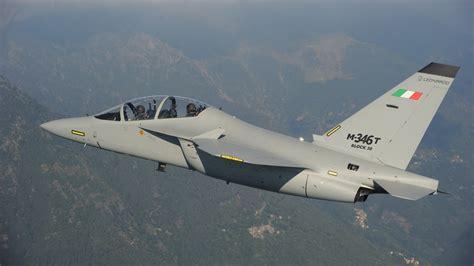
Indonesia is recalibrating its airpower strategy. After the collapse of its long-anticipated F-15EX Eagle II acquisition, Jakarta has moved decisively toward a new arrangement with Italy’s Leonardo for the M-346F Block 20, an advanced training and light combat aircraft designed to bridge operational gaps while strengthening domestic aerospace capacity.
The announcement, made during the Singapore Airshow on February 4, 2026, signals more than a simple aircraft procurement. It reflects a pragmatic shift in Indonesia’s modernization roadmap—one that balances capability, cost control, industrial participation, and near-term operational readiness.
Leonardo confirmed the signing of a Letter of Intent (LoI) with Indonesia’s Ministry of Defence and PT ESystem Solutions. Although non-binding, the agreement establishes the industrial, logistical, and operational framework necessary to proceed toward a full procurement contract.
From F-15EX Ambition to Interim Combat Capability
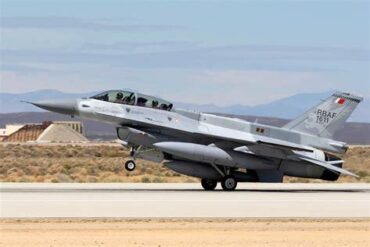
Indonesia’s pursuit of the Boeing F-15EX Eagle II, known locally in its proposed configuration as the F-15IND, had once represented a bold expansion of high-end air dominance capability. A Memorandum of Understanding signed in August 2023 envisioned the potential acquisition of up to 24 aircraft, following earlier approval for as many as 36 units.
The proposed F-15IND configuration was formidable. It included the AN/APG-82(v)1 Active Electronically Scanned Array (AESA) radar, AN/ALQ-250 EPAWSS electronic warfare suite, ADCP II mission computers, dual JHMCS helmet-mounted cueing systems, LANTIRN navigation pods, Sniper targeting pods, and the MS-110 reconnaissance pod. An infrared search-and-track system was also considered.
However, on February 3, 2026, Boeing confirmed that the campaign was no longer active. The collapse of this path fundamentally altered Indonesia’s short-term force structure planning. The M-346F Block 20 now assumes heightened importance—not as a replacement for a heavy fighter, but as a flexible, cost-effective solution addressing training requirements and limited operational needs.
The shift underscores a critical reality in defense procurement: modernization must remain adaptable to fiscal, political, and industrial realities.
Replacing Aging Hawk Trainers with a Multirole Platform
Indonesia’s existing fleet of BAE Systems Hawk Mk 109 and Mk 209 advanced jet trainers has served since the late 1980s. While still operational, these aircraft increasingly struggle to support modern pilot training standards and contemporary combat mission profiles.
The M-346F Block 20 addresses both deficiencies simultaneously. It is engineered to perform:
- Advanced jet training
- Lead-in fighter training (LIFT)
- Limited air-to-air and air-to-ground combat missions
This dual-role structure is particularly valuable for Indonesia’s geographically dispersed archipelago, where flexibility and rapid deployment matter as much as raw firepower.
Unlike a traditional trainer, the Block 20 configuration transforms the platform into a credible light combat asset, offering operational utility while reducing the burden on frontline fighters.
Block 20: Cockpit Revolution and Sensor Integration
The Block 20 standard, formally introduced in 2024, represents a significant leap from earlier M-346 variants. The cockpit redesign is central to its transformation.
Gone is the six multi-function display layout. In its place are two Large Area Displays (LADs)—one per seat—offering enhanced situational awareness and streamlined sensor management. A low-profile Head-Up Display is complemented by an augmented-reality helmet-mounted display system.
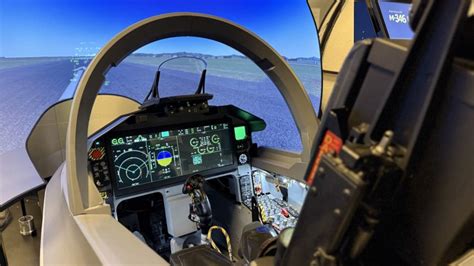
The aircraft integrates:
- An Active Electronically Scanned Array radar
- Link 16 tactical data link
- Electronic countermeasures suite
- Built-in missile data link
These systems enable modern network-centric warfare participation while maintaining full training functionality. Pilots can rehearse advanced mission management tasks without transitioning prematurely to high-cost frontline fighters such as the Rafale.
Performance and Combat Payload
Beneath its advanced avionics, the M-346F Block 20 retains the proven twin-engine M-346 airframe. Power is provided by two Honeywell F124-GA-200 turbofan engines, each delivering 2,850 kg of thrust.
Performance parameters include:
- Maximum speed: 1,065 km/h at low altitude
- Service ceiling: 13,715 meters
- Ferry range: up to 2,220 kilometers with external tanks
The fighter configuration features seven external hardpoints, supporting more than 2,000 kilograms of external stores. Integrated weapons compatibility spans both air-to-air and air-to-ground munitions, with expanded options under the Block 20 architecture. An aerial refueling capability further extends mission endurance.
This combination does not transform the aircraft into a heavyweight air superiority platform. It does, however, provide a cost-efficient light combat solution capable of maritime patrol support, airspace policing, and tactical strike missions in lower-intensity scenarios.
Live, Virtual, and Constructive Training Ecosystem
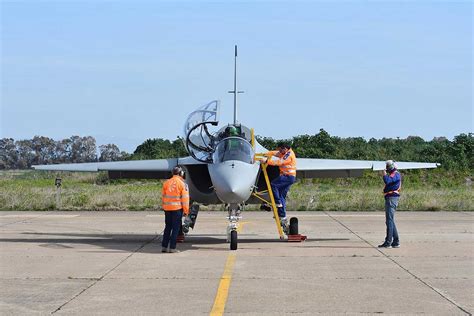
A defining strength of the M-346F Block 20 lies in its integration into a broader training architecture. The aircraft is embedded within a Ground-Based Training System and a Live, Virtual, and Constructive (LVC) environment.
In practical terms, this means real aircraft can fly alongside simulated threats, sensors, and weapons generated digitally. Pilots gain exposure to complex battlefield scenarios without expending expensive munitions or committing frontline assets.
This training model reduces operational costs while accelerating pilot progression toward advanced fighters. For Indonesia, which is simultaneously inducting Rafale aircraft and maintaining involvement in the KF-21 program, this layered training approach offers strategic coherence.
Industrial Localization and Domestic Aerospace Capacity
The Letter of Intent places strong emphasis on industrial cooperation and localization. Plans include establishing domestic maintenance and overhaul facilities, training Indonesian technicians and instructors, and building in-country training infrastructure.
Such localization serves multiple objectives. It reduces long-term sustainment costs, enhances national self-reliance, and develops domestic aerospace expertise. For a nation balancing multiple procurement programs, this industrial dimension may prove as strategically significant as the aircraft itself.
Indonesia would become the third Asian operator of an M-346 variant and the second operator of the Block 20 standard, following Austria’s December 2025 contract for 12 M-346FA Block 20 aircraft.
A Broader Modernization Mosaic
The M-346F decision unfolds within one of the world’s most ambitious air force modernization programs. Indonesia’s portfolio includes:
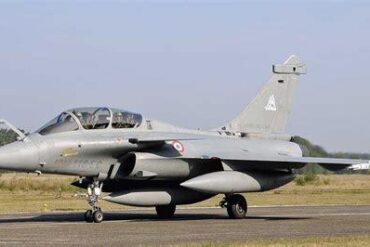
- A $8 billion acquisition of 42 Dassault Rafale fighters, with the first three delivered in January 2026
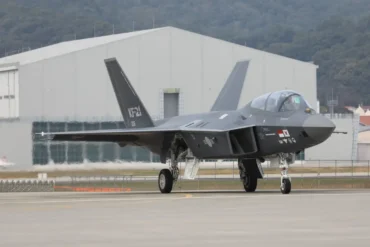
- Continued, though strained, participation in South Korea’s KF-21 Block 2 program, with a target of 16 aircraft
- Plans to acquire 48 Turkish Kaan fighters
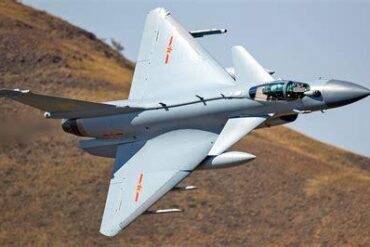
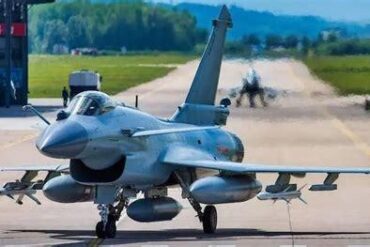
- Reported interest in at least 42 Chinese J-10 fighters
Simultaneously, Indonesia has expanded into naval aviation, purchasing the aircraft carrier Giuseppe Garibaldi for long-term maritime patrol and air defense integration.
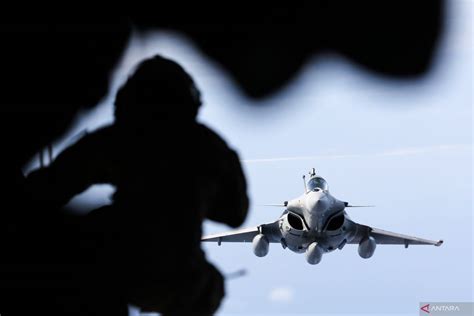
Within this mosaic, the M-346F Block 20 occupies a pragmatic niche. It strengthens training infrastructure, supplements light combat capability, and cushions the gap left by the F-15EX cancellation.
Strategic Implications for Southeast Asian Airpower
Indonesia’s pivot highlights a broader regional trend: diversification. Rather than relying on a single supplier or platform class, Jakarta is constructing a layered, multi-origin force structure. This approach distributes geopolitical risk while maximizing industrial leverage.
The M-346F Block 20 is not a symbolic purchase. It is a structural decision that reshapes pilot training pipelines and introduces a flexible operational asset capable of rapid deployment across Indonesia’s vast maritime territory.
With the F-15EX plan concluded, Indonesia’s near-term emphasis appears focused on scalable, interoperable systems that align with financial sustainability and industrial growth. The coming months will determine whether the Letter of Intent transitions into a formal contract—but the direction of travel is unmistakable.
Indonesia is not stepping back from modernization. It is recalibrating it—precisely, strategically, and with a clear eye on both capability and sovereignty.