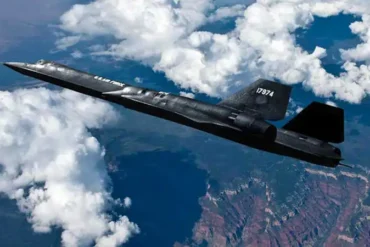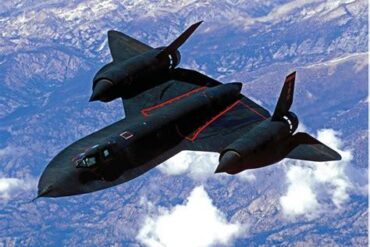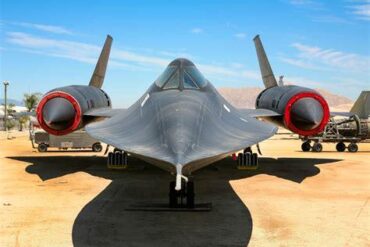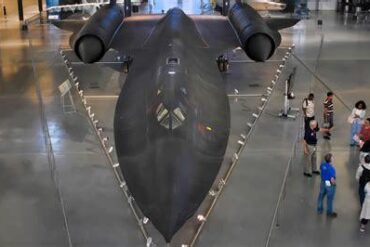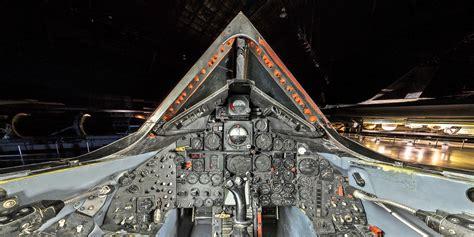
The SR-71 Blackbird did not simply fly fast—it operated in a realm where physics stopped being a background constraint and became the central character. At sustained speeds exceeding Mach 3.2, the aircraft transformed the thin, frigid air at 85,000 feet into a relentless source of heat. Every inch of its surface, from the needle-like nose to the cockpit glass, became a battleground against thermal energy. Among its most astonishing feats was a detail that sounds almost fictional: the cockpit windshield became so hot that pilots could warm their food directly against it.
This was not a gimmick or a curiosity—it was a consequence of deliberate engineering decisions pushed to their limits. The Blackbird’s windshield, glowing with heat generated by supersonic flight, represents one of the most elegant solutions ever devised in aerospace design. It embodies the intersection of materials science, aerodynamics, and human survival, all working in harmony under extreme conditions.
To understand how a cockpit window became a cooking surface, one must first understand the environment the SR-71 was designed to conquer. Unlike conventional aircraft, which primarily battle gravity and drag, the Blackbird confronted a far more aggressive adversary: kinetic heating.
Mach 3 and the Physics of Heat: Why Speed Becomes Fire
At subsonic speeds, air behaves gently, flowing around an aircraft with minimal resistance. But as velocity climbs toward and beyond the speed of sound, that calm disappears. At Mach 3, the air cannot move out of the way quickly enough. Instead, it compresses violently against the aircraft’s leading edges, converting motion directly into heat.
This phenomenon—aerodynamic compression heating—was the defining challenge of the SR-71 program. Temperatures across the aircraft were not just elevated; they were extreme:
- The nose reached approximately 800°F (427°C)
- Engine nacelles soared to 1,200°F (649°C)
- The cockpit windshield stabilized around 620°F (327°C)
These numbers are not theoretical peaks. They were sustained temperatures, maintained over long-duration reconnaissance missions that could last hours. Unlike fighter jets that briefly touch supersonic speeds, the Blackbird lived there.
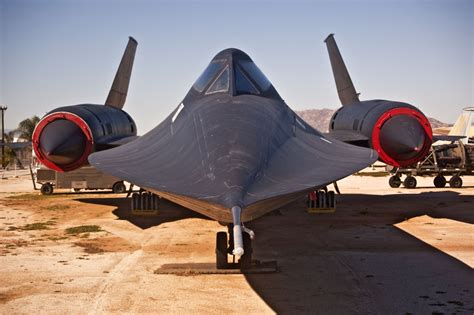
What makes this even more counterintuitive is the surrounding environment. At 85,000 feet, ambient air temperatures are well below freezing. Yet the aircraft itself became hotter than a kitchen oven. The reason lies in energy transfer efficiency: at hypersonic-adjacent speeds, kinetic energy converts into thermal energy with brutal effectiveness.
The result was an aircraft where the skin was often hotter than its engines, forcing engineers to rethink every assumption about materials, structure, and survivability.
Reinventing Transparency: Why the Windshield Could Not Be Ordinary
A cockpit windshield might seem like a simple component, but at Mach 3, it becomes one of the most technically demanding parts of the aircraft. Conventional materials fail quickly under such conditions.
Modern fighter jets use polycarbonate canopies, which are strong, lightweight, and optically clear. But at 620°F, polycarbonate would soften and deform almost instantly. Even borosilicate glass, known for its heat resistance, would warp enough to distort vision—an unacceptable flaw in a high-speed reconnaissance platform.
The SR-71 demanded something radically different: a material that could endure extreme heat while maintaining perfect optical clarity.
The solution was fused silica, a form of solid quartz glass. This material offered several critical advantages:
- A melting point near 3,000°F (1,650°C)
- Exceptional resistance to thermal distortion
- Stability under repeated heating and cooling cycles
Each windshield panel was machined to a thickness of 1.25 inches (3.2 cm)—far thicker than typical aircraft glass. This thickness was not just for strength; it ensured that the glass maintained its shape under intense thermal gradients.
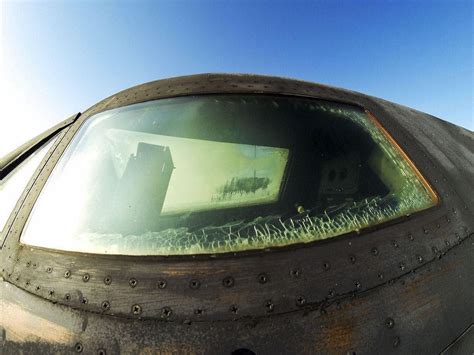
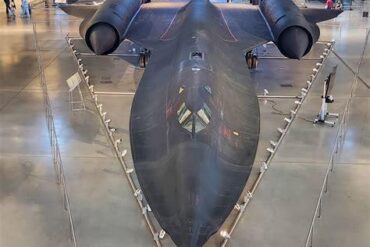
But even quartz presented a challenge. When exposed to extreme heat, materials expand. The titanium airframe expanded differently than the glass. A single large windshield would have cracked under these stresses. Engineers solved this by dividing the cockpit into four separate panels, each capable of absorbing and distributing stress more effectively.
The result was a windshield that was not just heat-resistant—it was thermally intelligent, designed to survive repeated exposure to conditions that would destroy conventional materials in seconds.
Bonding the Impossible: The $2 Million Engineering Breakthrough
Selecting quartz solved one problem but created another: how do you attach it to the aircraft?
At temperatures exceeding 600°F, traditional adhesives fail. Mechanical fasteners introduce stress points that can lead to fractures. The bond between the windshield and the titanium frame needed to be flawless, permanent, and capable of enduring thousands of thermal cycles.
The answer came from an extraordinary collaboration with Corning Glass Works, which spent three years and $2 million developing a solution. The breakthrough was ultrasonic fusing, a process that used high-frequency vibrations to bond the quartz directly to the titanium at a molecular level.
This method eliminated the need for adhesives entirely. Instead of being glued or bolted, the windshield became integrated into the airframe itself, forming a seamless interface capable of withstanding extreme heat and pressure.
The implications of this innovation extended beyond durability. The fused structure also created an exceptionally effective acoustic barrier, insulating the cockpit from the deafening roar of Mach 3 airflow. Inside, the environment was surprisingly controlled—almost serene compared to the chaos outside.
This was not just engineering; it was precision craftsmanship at the edge of possibility.
A Cockpit That Cooked: The Human Experience at 620°F
Numbers alone cannot capture the reality of flying the SR-71. For that, one must turn to the pilots themselves.
Among them, Brian Shul, a former Blackbird pilot, offered one of the most vivid illustrations of the aircraft’s thermal environment. During long missions, pilots wore full pressure suits and consumed food from tubes, similar to astronauts. With no onboard heating system for meals, they improvised.
They used the windshield.
By pressing a food tube against the hot quartz glass, pilots could warm their meals mid-flight. The windshield functioned like a radiant oven, transferring heat directly into the food.
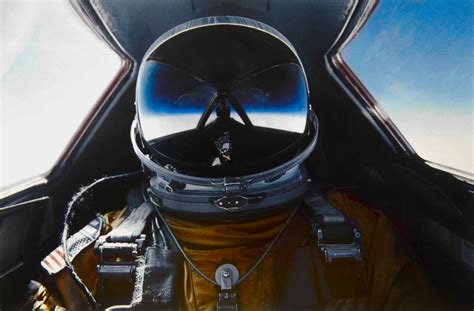
This was not a novelty—it was a practical solution born from necessity. At 620°F, the glass radiated enough heat to make cold rations palatable. The act itself became a symbol of the Blackbird’s extreme environment, where even the cockpit doubled as a survival tool.
It also underscored a critical truth: every component of the aircraft was operating at the edge of its design envelope, yet doing so reliably, mission after mission.
Fuel as a Cooling Lifeline: The Dual Role of JP-7
While the windshield protected the crew, another system quietly managed the aircraft’s overall thermal load: the fuel.
The SR-71 used a specialized fuel known as JP-7, designed for extreme stability. Unlike conventional jet fuel, JP-7 had a very high flash point, making it resistant to accidental ignition—even under intense heat.
This property allowed it to serve a second, equally vital function: coolant.
Before reaching the engines, JP-7 circulated through a network of heat exchangers, absorbing heat from:
- Engine oil systems
- Hydraulic lines
- Avionics and cockpit equipment
By the time the fuel entered the engines, it was already heated, having removed excess thermal energy from critical systems.
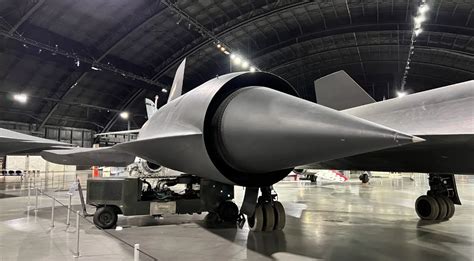
This approach turned a potential vulnerability into a strength. Instead of fighting heat with additional systems, the Blackbird repurposed an existing resource, achieving efficiency through integration.
At cruise speed, the propulsion system itself evolved. The Pratt & Whitney J58 engines transitioned into a hybrid mode, where the majority of thrust came from ram compression rather than traditional turbine operation. In effect, the faster the aircraft flew, the more efficient it became.
This created one of aviation’s most fascinating paradoxes: speed reduced strain. At Mach 3+, the aircraft settled into its optimal operating condition, with airflow, heat distribution, and propulsion working in balance.
Titanium and Expansion: Building an Aircraft That Could Stretch
The SR-71’s airframe was constructed from approximately 93% titanium, a material chosen for its strength and heat resistance. At the time, this was revolutionary. Titanium was difficult to source, machine, and assemble, yet it was the only material capable of surviving sustained Mach 3 flight.
But even titanium has limits. Under extreme heat, it expands significantly. Engineers embraced this reality rather than resisting it.
On the ground, the aircraft’s panels did not fit tightly together. Small gaps were intentionally designed into the structure. During flight, as temperatures rose, the metal expanded, sealing these gaps and creating a smooth aerodynamic surface.
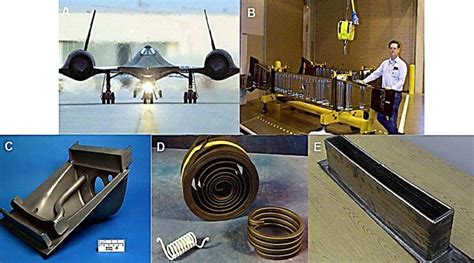
This design led to one of the Blackbird’s most unusual characteristics: fuel leaks before takeoff. JP-7 would seep from the seams while the aircraft sat on the runway. Only after reaching high speed and temperature would the structure fully seal.
The expansion was not trivial. The aircraft could grow several inches in length during flight. To accommodate this, certain sections used corrugated panels, allowing controlled flex without structural damage.
Even the Blackbird’s iconic black paint served a functional purpose. It enhanced radiative heat dissipation, helping the aircraft shed thermal energy more efficiently. At the same time, embedded ferrite particles contributed to radar signature reduction, making the aircraft harder to detect.
Legacy at the Edge of Hypersonic Flight
The SR-71 Blackbird was not merely a product of its time—it was a glimpse into the future. Every challenge it overcame—thermal management, material science, propulsion efficiency—remains central to modern aerospace development.
As engineers explore hypersonic aircraft capable of Mach 5 and beyond, the lessons of the Blackbird grow even more relevant. At those speeds, temperatures increase exponentially, pushing materials and systems even further.
The Blackbird proved that sustained high-speed flight is not just about engines or aerodynamics. It is about managing heat as a primary design factor, integrating it into every aspect of the aircraft.
The windshield that once warmed a pilot’s lunch stands as a powerful symbol of that philosophy. It represents a moment where engineering did not merely solve a problem—it redefined the boundaries of what was possible.
In the end, the SR-71 did more than fly fast. It mastered an environment where speed itself became fire, turning one of aviation’s greatest challenges into one of its most enduring triumphs.