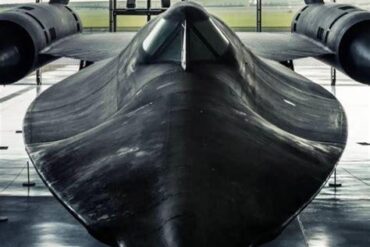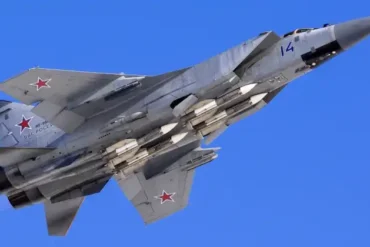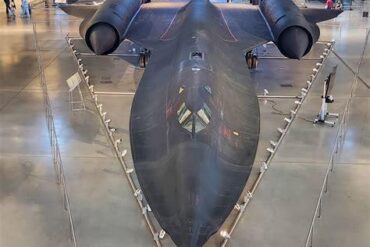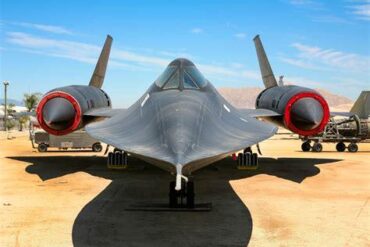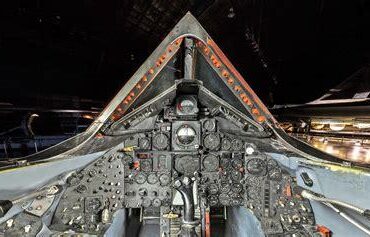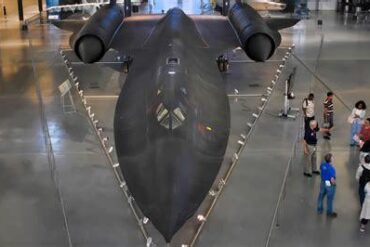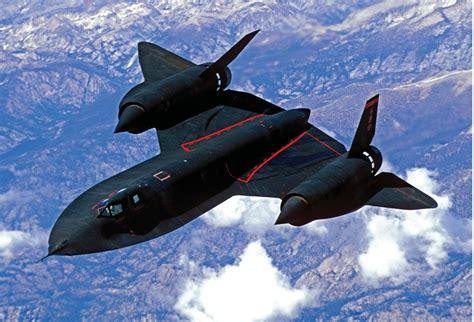
The SR-71 Blackbird remains one of the most legendary aircraft ever built — a marvel of stealth, engineering, and above all, speed. Developed in secrecy during the Cold War by Lockheed’s Skunk Works division, this aircraft was engineered not to fight, but to fly higher and faster than any enemy missile or interceptor. Operating at the edges of the atmosphere, it could cruise at speeds exceeding Mach 3.3, or 2,193.2 mph, securing its place in aviation history as the fastest air-breathing manned jet ever to fly.
Designed as a strategic reconnaissance platform, the SR-71 embodied decades of cutting-edge research into propulsion, materials science, and aerodynamics. Flying at 85,000 feet, it was nearly untouchable by enemy defenses — missiles couldn’t catch it, and radar couldn’t track it fast enough to target it effectively.
Top Speed of the SR-71 Blackbird: A Supersonic Masterpiece
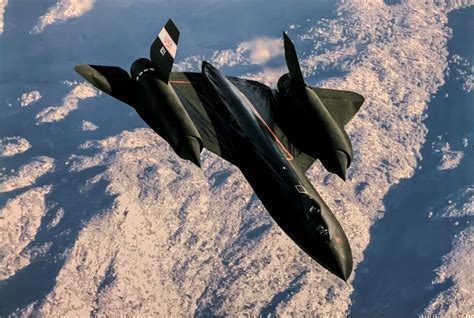
The SR-71’s top speed was officially clocked at Mach 3.3, which equals 2,193.2 mph. This figure alone dwarfs nearly every other jet aircraft ever built. While several unmanned vehicles and experimental crafts have since surpassed that velocity, no operational, manned jet has matched this performance.
There are unverified reports, including pilot Brian Shul’s dramatic account in The Untouchables, claiming that the aircraft briefly reached Mach 3.5 (approximately 2,685.4 mph) during a mission to evade a missile over Libya. Though not officially recognized, such anecdotes speak to the Blackbird’s untapped potential.
Flying at such speeds posed immense technical challenges. The aircraft would elongate by up to 4 inches mid-flight due to thermal expansion. The titanium skin, chosen specifically to endure high temperatures generated by atmospheric friction, could exceed 600°F on the nose and leading edges.
Powered by Innovation: The Engines Behind the Blackbird’s Velocity
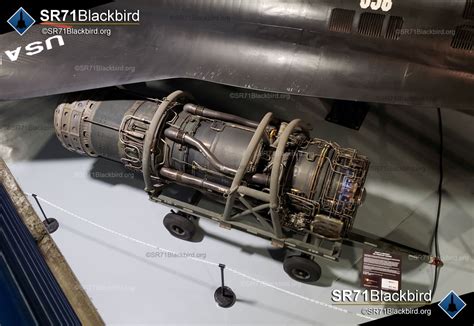
At the heart of the SR-71’s astonishing speed were two Pratt & Whitney J58 turbojet engines, each capable of generating 32,500 pounds of thrust. These were no ordinary engines — they were part turbojet, part ramjet. As the plane accelerated beyond Mach 2, traditional turbojet mechanics gave way to a ramjet-like function, allowing the Blackbird to gulp down air and compress it without the need for turbine stages.
What further set the SR-71 apart was its reliance on JP-7 fuel, a specialized fuel with an extremely high flash point. Unlike standard JP-4 or JP-8 used by other military jets, JP-7 wouldn’t ignite under the extreme heat generated at high speeds. In fact, the fuel was so stable that triethylborane (TEB) — a chemical that ignites spontaneously upon contact with air — had to be used as an ignition catalyst.
Surveillance at Supersonic Speeds: The SR-71’s Cold War Mission
Developed at the height of the Cold War, the SR-71 was created in direct response to the 1960 downing of the U-2 spy plane by Soviet forces. The United States needed a reconnaissance aircraft that could not only reach higher altitudes but also be too fast to be intercepted.
The SR-71’s ability to outrun surface-to-air missiles made it a strategic asset. If radar detected the aircraft, by the time missile batteries could lock on and fire, the SR-71 would have already left the strike zone. Pilots flying at 80,000 to 85,000 feet reported being able to see the curvature of the Earth, and the sky turning deep indigo — a stark contrast to the blue visible from lower altitudes.
Unbreakable Records Set by the SR-71
The Blackbird holds a suite of aviation records that have yet to be broken by any other manned aircraft. In 1974, it set a jaw-dropping transatlantic flight record:
- New York to London: 1 hour, 54 minutes, 56.4 seconds at speeds exceeding 2,000 mph.
- London to Los Angeles: Covered 5,447 miles in 3 hours, 47 minutes, and 30 seconds.
In 1976, it achieved two of the most significant aviation milestones:
- Absolute Speed Record: Mach 3.3 (2,193.2 mph), the fastest officially recorded speed for a manned, air-breathing jet.
- Absolute Altitude Record: 85,069 feet — higher than any jet-powered aircraft.
These feats were not one-offs. The SR-71 routinely conducted reconnaissance missions at these speeds and altitudes. One of its final missions, flown in 1990, saw the aircraft cover multiple U.S. city-to-city routes with time records that remain untouched:
- Los Angeles to Washington, D.C.: 64 minutes, 20 seconds.
- West Coast to East Coast (entire U.S.): 67 minutes, 54 seconds.
- Kansas City to Washington, D.C.: 25 minutes, 50 seconds.
- St. Louis to Cincinnati: Just 8 minutes, 32 seconds.
A Complex, Costly, and Cutting-Edge Marvel
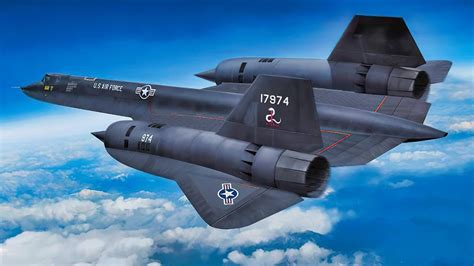
The SR-71 may have been unmatched in speed and altitude, but it came at a cost — both financial and operational. Each aircraft cost an estimated $34 million (equivalent to over $300 million today), and its support ecosystem was immense.
Missions required pre-planned refueling operations, often involving KC-135Q tankers that were specially modified to carry JP-7 fuel. Ground crews also had to account for thermal expansion by assembling the aircraft with loose-fitting panels that sealed tightly only at cruising speed and temperature. This meant that the aircraft leaked fuel while parked — a fact often misrepresented as a design flaw, but actually a calculated engineering trade-off.
The SR-71 required specialized pilot training and maintenance crews, with each sortie demanding precision planning, reconnaissance satellite coordination, and ground telemetry support.
NASA and the Final Flights
Though retired by the U.S. Air Force in 1990, the SR-71 wasn’t grounded entirely. NASA operated several units through the 1990s for high-speed aeronautical research, helping to inform future aircraft design, materials science, and propulsion systems.
The final SR-71 flight occurred in 1999, closing a chapter on what is arguably the most exotic aircraft ever built. Despite interest in modern replacements and hypersonic concepts, no aircraft has yet matched the SR-71’s unique blend of speed, altitude, and operational reliability.
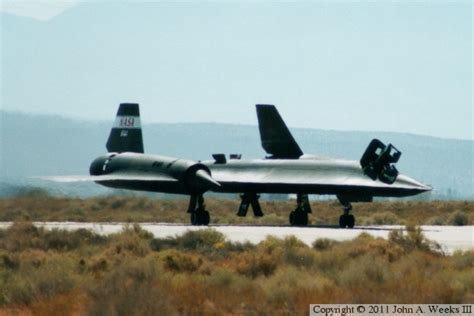
Legacy of the Blackbird: Untouched, Unchallenged, Unmatched
The SR-71 Blackbird is a triumph of Cold War-era aviation ingenuity. Its existence was driven by the relentless pressure of global espionage, but its legacy transcends geopolitics. In an age where satellites have become the backbone of reconnaissance, the SR-71 remains a poignant reminder of the era when intelligence had to be earned the hard way — by flying into hostile skies at three times the speed of sound.
To this day, the SR-71 remains not only a symbol of engineering excellence but also a benchmark for speed and altitude. Whether or not it truly hit Mach 3.5, its verified achievements are enough to ensure it maintains its mythical status in aviation circles.
In the pantheon of human-built machines, few are as breathtaking — or as fast — as the SR-71 Blackbird.