The Italian Army has formally launched one of its most consequential land modernization efforts with the delivery of the first Lynx KF-41 infantry fighting vehicles, marking the beginning of the transition away from the aging VCC-80 Dardo fleet. The handover of the initial vehicles signals not only a generational leap in combat capability, but also a structural shift in how Italy intends to design, produce, and sustain its armored forces over the coming decades.
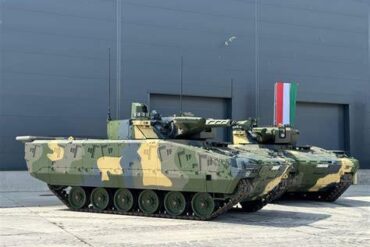
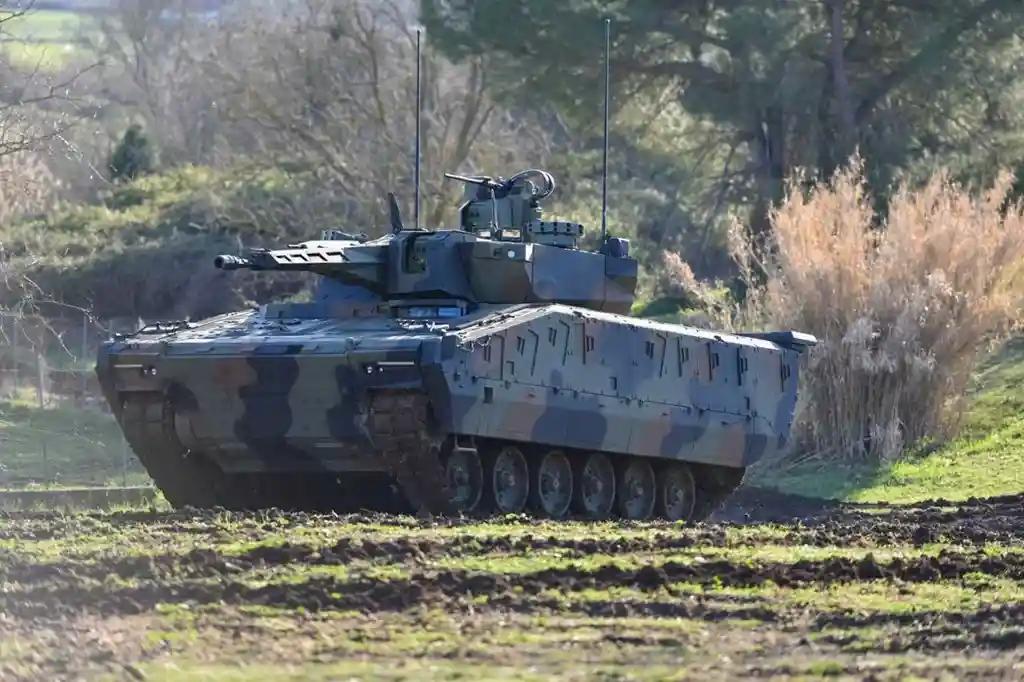
On 27 January 2026, four Lynx KF-41 IFVs were delivered to the Army Multifunctional Experimentation Center in Montelibretti, north of Rome. These vehicles represent the first tangible output of the Army Armoured Combat Systems (A2CS) program, Italy’s flagship initiative to rationalize multiple tracked vehicle fleets under a single, modular architecture. While modest in number, the delivery carries outsized strategic weight: it transforms A2CS from a conceptual framework into an operational reality.
The vehicles were handed over by Leonardo Rheinmetall Military Vehicles (LRMV), the 50–50 joint venture established to manage the program. The ceremony was attended by senior political, military, and industrial leadership, underlining the national importance of the effort. For the Italian Army, this moment marks the start of a long-planned renewal of its heavy brigades, driven by lessons learned from decades of expeditionary deployments and the hard realities of high-intensity mechanized warfare returning to Europe.
A2CS: The Backbone of Italy’s Future Armored Force
The Army Armoured Combat Systems program is far more ambitious than a simple infantry fighting vehicle replacement. Initiated in 2021 under its original designation AICS (Armoured Infantry Combat System), the program was conceived as a holistic fleet transformation aimed at overcoming fragmentation across Italy’s tracked platforms. Over time, evolving operational requirements and industrial alignment led to its rebranding as A2CS, reflecting its broader scope.
At full maturity, A2CS is expected to encompass up to 1,050 tracked vehicles across 16 distinct configurations, all derived from a common chassis. These variants will support heavy maneuver brigades, alpine formations, training units, and sustainment centers, enabling unprecedented standardization in logistics, training, and lifecycle management. The program is structured in two phases: a development and testing phase running through 2029, followed by series production beginning in 2030.
This approach deliberately mirrors the Army’s parallel effort to modernize its main battle tank fleet, centered on the KF-51 Panther. Together, these programs are designed to restore coherence to Italy’s heavy forces, ensuring that infantry, armor, command systems, and support vehicles evolve as an integrated ecosystem rather than as disconnected platforms.
Why the Dardo Reached Its Limits
Italy’s need for A2CS is inseparable from the structural constraints of the VCC-80 Dardo, which entered service in the late 1990s. At approximately 23 tonnes, the Dardo was well suited to the operational realities of its era, prioritizing strategic mobility and compatibility with lighter expeditionary forces. Armed with a 25 mm cannon, coaxial machine gun, and anti-tank missile launchers, it provided a credible baseline capability for decades.
Time, however, has not been kind to the platform. The Dardo’s aluminum-steel hull architecture leaves little room for further armor growth, while its electrical generation capacity struggles to support modern digital command-and-control systems, sensors, and active protection solutions. Despite successive upgrades, the vehicle has reached its structural ceiling in terms of payload, survivability, and growth potential. After more than 25 years of service, continued investment would yield diminishing returns.
The Italian Army’s operational analysis concluded that only a heavier, higher-margin platform could accommodate the protection levels, networking requirements, and future technologies demanded by contemporary and future battlefields. This assessment paved the way for the selection of a new-generation IFV capable of evolving over decades rather than years.
From Evaluation to Selection: Italy Chooses Lynx
Italy’s engagement with the Lynx KF-41 began in late 2024, when a vehicle produced in Hungary was delivered for evaluation trials at Montelibretti and Nettuno. These tests focused on mobility, ergonomics, integration flexibility, and the vehicle’s ability to host Italian subsystems without extensive redesign. The results confirmed that the Lynx could meet Italian requirements without the risks and delays associated with a clean-sheet national development.
Crucially, the KF-41 offered generous internal volume and payload margins, enabling Italy to integrate domestic turrets, communications suites, and mission systems while retaining long-term upgrade potential. By selecting an existing platform and adapting it through national industrial participation, Italy shortened development timelines while preserving sovereignty over configuration, testing, and evolution.
This strategy also allows the Army to plan a long-term fleet centered on a single tracked chassis adaptable to multiple roles, dramatically simplifying logistics and sustainment across the force.
Leonardo Rheinmetall Military Vehicles and Industrial Sovereignty
The industrial backbone of A2CS is the Leonardo Rheinmetall Military Vehicles joint venture, legally based in Rome with operational headquarters in La Spezia. Structured as an equal partnership, LRMV embodies Italy’s intent to balance access to proven foreign technology with strong domestic industrial control.
Under current planning, at least 60 percent of integration, qualification, delivery, and sustainment activities will be conducted in Italy. Leonardo brings deep expertise in electronics, turrets, and systems integration, while Rheinmetall contributes vehicle architecture, protection technologies, and tracked mobility know-how. Rheinmetall Italia plays a direct role in national integration and lifecycle support, ensuring that critical competencies remain on Italian soil.
This structure positions Italy not merely as a customer, but as a long-term stakeholder in the evolution of the Lynx family, with the capacity to upgrade, adapt, and export derivatives over time.
The Lynx KF-41: Designed for Growth
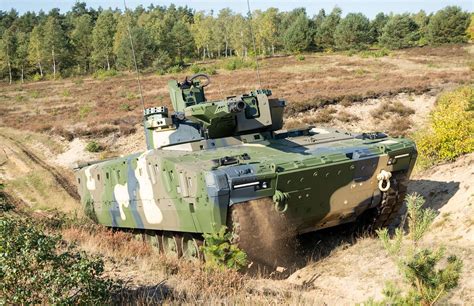
The Lynx KF-41 was unveiled by Rheinmetall in 2018 as the larger member of the Lynx family, following the KF-31. Designed from inception for growth, it occupies the 40–50 tonne class, depending on armor configuration, and prioritizes internal volume and modularity. Measuring approximately 7.7 meters in length, the vehicle accommodates a three-person crew—commander, gunner, and driver—alongside up to eight fully equipped infantry soldiers.
This layout reflects a deliberate emphasis on infantry capacity without compromising space for mission systems, ammunition, or future technologies. Unlike legacy IFVs constrained by Cold War design assumptions, the KF-41 anticipates decades of incremental upgrades without structural modification of the hull.
Mobility and Powertrain Evolution
In its current configuration, the Lynx KF-41 is powered by a Liebherr diesel engine producing over 1,100 horsepower, paired with a Renk HSWL 256 automatic transmission. This powerpack delivers a top road speed of around 70 km/h and ensures mobility comparable to modern main battle tanks, even under heavy armor loads.
For the Italian A2CS variant, plans call for the integration of a new Italian-produced V8 diesel engine, derived from the powerplant used in the Centauro II. This choice reinforces domestic industrial involvement while aligning maintenance and training pipelines across multiple vehicle families.
The suspension and drivetrain support demanding cross-country performance, enabling the Lynx to negotiate steep gradients, significant side slopes, wide trenches, and vertical obstacles, with fording capability up to approximately 1.5 meters without preparation.
Protection in the Age of Precision Threats
Survivability is central to the Lynx design. The vehicle employs a layered and scalable protection concept, combining a welded steel hull with modular add-on armor packages tailored to mission threat levels. Mine and improvised explosive device protection is addressed through reinforced hull geometry, decoupled floor elements, and energy-absorbing seating for crew and infantry.
The A2CS configuration is expected to integrate active protection systems, complementing passive armor with hard-kill and soft-kill measures. The Lynx architecture is compatible with solutions such as Rheinmetall’s StrikeShield, while smoke and obscurant launchers provide additional defensive layers against guided munitions and sensors. This approach reflects the realities of modern battlefields, where survivability depends on defeating threats before impact rather than merely absorbing them.
Turrets, Armament, and Italian Customization
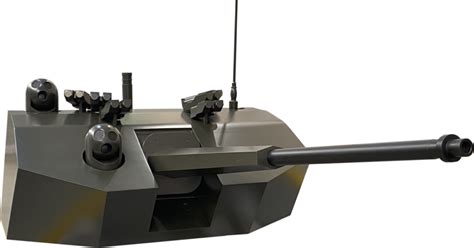
Armament on the Lynx KF-41 is turret-dependent, and Italy’s approach underscores its emphasis on national systems integration. The first four vehicles delivered in January 2026 are equipped with Rheinmetall’s Lance turret armed with a 30 mm cannon, serving as an interim configuration for testing and training.
These vehicles will later be retrofitted with Leonardo’s Hitfist 30 Plus turret, which will become the standard across the initial tranche. The remaining 17 vehicles under the first contract are scheduled for delivery directly with the Hitfist turret, ensuring early standardization. All 21 vehicles from the initial contract will ultimately share the same configuration.
The first Lynx combining a Rheinmetall hull with a Leonardo turret is planned for delivery in October 2026, a milestone that will validate the joint industrial concept underpinning A2CS.
A Strategic Shift, Not Just a New Vehicle
The arrival of the Lynx KF-41 in Italian Army service represents more than the replacement of an aging platform. It marks a strategic recalibration toward scalable, networked, and survivable armored forces, backed by a domestic industrial base capable of sustaining them over decades.
By anchoring its future tracked fleet around a single, adaptable chassis, Italy is positioning itself to respond more rapidly to evolving threats while controlling costs and complexity. The first four vehicles delivered to Montelibretti are only the opening chapter, but they set the tone for a transformation that will define the Italian Army’s heavy forces well into the mid-21st century.