Italy has officially entered the elite domain of long-range electronic warfare (EW) with its landmark decision to convert two Gulfstream G550 business jets into EA-37B Compass Call aircraft. On July 21, 2025, a $300 million contract was signed with L3Harris Technologies, marking the first international export of the EA-37B platform—a major milestone in NATO’s strategic capability enhancement.
Italy’s EA-37B Acquisition: A Strategic Milestone
The Italian procurement is part of a broader modernization strategy under the Piattaforma Multi-Missione, Multi-Sensore (P-MMMS) and the Joint Airborne Multi-sensor Multi-mission System (JAMMS) initiatives. The deal includes mission systems, crew training, integration support, ground logistics, and operational manuals, ensuring full-spectrum capability development.
The €1.2 billion first tranche covers two fully operational aircraft and six “green” G550 airframes designated for future conversions. This not only demonstrates long-term commitment to electromagnetic dominance but positions Italy as a strategic partner in next-generation EW development.

Transformation of the Gulfstream G550 into a Battle-Ready EW Platform
The G550—originally a civilian business jet—was selected for its robust range, fuel efficiency, short takeoff capability, and spacious fuselage, making it ideal for complex mission payloads. Modified first at Gulfstream’s Savannah, Georgia facility, the airframes are then shipped to L3Harris’s Waco, Texas site for high-tech mission system integration.
The EA-37B Compass Call is propelled by two Rolls-Royce BR700-710 C4-11 turbofan engines, each delivering 15,385 pounds of thrust. The aircraft boasts a maximum takeoff weight of 44,452 kg, a range of 8,167 km, a service ceiling of 13,716 meters, and a cruising speed of 767 mph. Crew requirements are reduced to nine personnel, thanks to automation and a streamlined human-machine interface, improving mission endurance and decreasing operational costs.
Next-Generation Electronic Attack Capability
The heart of the EA-37B is its Compass Call electronic warfare system, designed to execute Suppression of Enemy Air Defenses (SEAD) and disrupt enemy C5ISRT networks. The system includes:
- Network Centric Collaborative Targeting (NCCT)
- Radio Frequency Receivers (RFR)
- Counter Radar Assemblies
- Software-Defined Radios (SDR)
- AN/ARC-210 RT-2036 radios
- KG-250 encryptors
- KIV-77 IFF Mode 4/5
- SWORD-A architecture for rapid integration of new components
Italy’s variant may also include Baseline 4 features, which integrate BAE Systems’ SABER (Small Adaptive Bank of Electronic Resources)—a software-defined, modular system capable of evolving with emerging threats.
BAE Systems’ Critical Role and Subcontract
Simultaneously, BAE Systems secured a $12 million subcontract to supply racks, radomes, cables, and harnesses—essential for the complex integration of EW systems. This collaboration reflects growing transatlantic cooperation in high-tech defense systems and strengthens Italy’s industrial ties with key U.S. contractors.
A Modern Replacement for the EC-130H Legacy
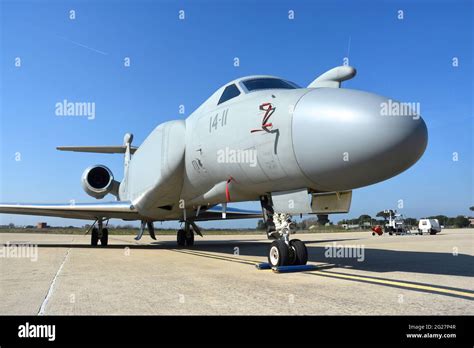
The EA-37B serves as a successor to the EC-130H Compass Call, a venerable platform that flew from 1981 to the mid-2020s and saw action in Iraq, Afghanistan, and Yugoslavia. By mid-2025, five EA-37Bs had already been delivered to the U.S. Air Force. Italy’s upcoming platforms align structurally with its G550 CAEW (Conformal Airborne Early Warning) aircraft, ensuring fleet interoperability and maintenance efficiency.
Integration with Italy’s Existing Aerospace Power
The EA-37B is designed to operate seamlessly alongside the F-35A, Eurofighter Typhoon, and NATO assets, providing force-multiplying EW coverage for joint all-domain operations. Capable of executing non-kinetic attacks, the aircraft delivers real-time jamming, communication disruption, and data fusion, significantly enhancing mission survivability in A2/AD environments.
JAMMS and the Long-Term Vision for 10 Aircraft
Italy’s long-term EW strategy under the €3.02 billion JAMMS program aims to field ten G550-based aircraft. The second funding tranche of €925 million will convert four more airframes. Alongside two CAEW and two SIGINT-configured aircraft, the fleet will enable a full spectrum of airborne ISR and electronic attack missions.
The program’s modular and scalable architecture ensures that additional capabilities—such as third-party software or AI-based EW suites—can be integrated without requiring complete airframe redesigns. This forward-thinking approach reflects Italy’s ambition to maintain technological parity with major NATO allies.
Cognitive Electronic Warfare and SABER’s Potential
Italy’s EA-37Bs will likely be early adopters of cognitive electronic warfare (CEW) features, which are currently under evaluation by the U.S. using the Angry Kitten ECM pod. This evolution allows real-time adaptation to enemy waveforms and jamming environments, providing machine-learning-based interference algorithms.
The SABER system further empowers operators with software-based upgrades, enabling faster mission configuration changes and improved detection-response cycles. The open architecture fosters domestic innovation, potentially involving Italian defense companies in future software development, maintenance, and operator training.

Industrial and Strategic Implications
Italy’s decision to join the Compass Call user community positions it as a southern European hub for electromagnetic warfare. No offset agreements have yet been disclosed, but analysts speculate that Italian defense firms may be involved in lifecycle support, contributing to the country’s €7.8 billion Aerospace Innovation Strategy.
Moreover, by fielding a fleet that can deliver non-kinetic electromagnetic dominance, Italy secures a critical role in NATO’s strategic balance, particularly in the Mediterranean and North African theatres. The EA-37B’s rapid deployment capabilities, combined with its interoperability with NATO standards, make it ideal for multinational operations and rapid response contingencies.
EA-37B in the Broader NATO and Indo-Pacific Context
The EA-37B complements platforms such as the EA-18G Growler and F-16CM Wild Weasel by offering longer endurance, greater range, and system flexibility. Its non-traditional airframe origin means reduced lifecycle costs, greater parts availability, and faster upgrade timelines.
As demand for electronic attack capabilities grows within NATO and among Indo-Pacific allies, Italy’s acquisition serves as a proof of concept for foreign integration of the EA-37B. This not only expands the strategic footprint of the platform but also deepens U.S.-Italy defense cooperation.
Conclusion: A New Era for Italian Electromagnetic Warfare
The EA-37B acquisition marks a transformational leap for Italy’s defense architecture. From its networked EW capabilities, strategic reach, and flexibility to evolve, the aircraft positions Italy at the cutting edge of 21st-century electronic warfare.
With the first delivery expected in 2027, Italy’s EA-37B fleet will soon become a cornerstone of NATO’s non-kinetic warfare capability—providing the alliance with unparalleled electromagnetic suppression, real-time data fusion, and electronic attack superiority across multiple theaters of operation.