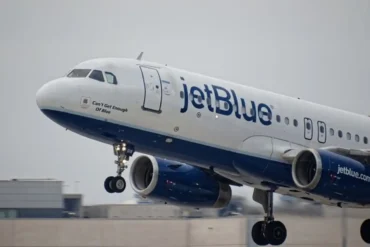
Vladimir Galkin, the second-largest shareholder in JetBlue Airways, is reportedly on the verge of offloading his nearly 10% stake in the airline, raising significant alarm bells across the U.S. aviation and investment sectors. As JetBlue’s stock plummets by over 43% in 2025, largely due to softened demand and rising operational costs, the looming possibility of Galkin’s exit threatens to undermine the company’s already fragile investor confidence.
JetBlue’s Financial Decline Deepens in 2025
JetBlue has endured a turbulent 2025 marked by sharp financial deterioration. A decline in leisure and discretionary travel, driven by lingering post-pandemic behavioral shifts and macroeconomic headwinds like inflation and surging fuel prices, has eroded the carrier’s revenue base. While the entire industry has faced pressure, JetBlue’s fall has been particularly steep, with the carrier’s valuation shrinking rapidly, and investor confidence shaken.

The airline’s difficulties are compounded by a hyper-competitive domestic market, where heavyweight legacy carriers like Delta and United enjoy economies of scale, broader networks, and deeper loyalty programs. JetBlue’s once-prized niche—affordable flights with high service standards—is now being squeezed from both ends, with ultra-low-cost carriers undercutting its price advantage and full-service airlines outmatching its network reach.
The Galkin Investment: A Risk That May Not Pay Off
Vladimir Galkin’s $200 million investment into JetBlue in 2024 was hailed as a bold move by a retail investor-turned-heavyweight. His financial arsenal was built on the back of the GameStop short squeeze in 2021, where he capitalized handsomely from the meme-stock frenzy. By betting big on JetBlue, Galkin signaled belief in a post-pandemic travel boom. But the anticipated surge never quite materialized.
His nearly 10% stake has since been battered by the airline’s waning performance. Galkin now finds himself at a crossroads. In a statement to Reuters dated June 26, 2025, he emphasized his ongoing hope for a JetBlue turnaround but warned that the window for confidence was narrowing. If the airline doesn’t make a compelling recovery soon, he may liquidate his position.
JetForward Plan: JetBlue’s High-Stakes Rescue Strategy
JetBlue’s leadership has placed significant faith in JetForward, a comprehensive restructuring and growth strategy aimed at generating $900 million in EBIT by 2027. The plan includes aggressive cost reduction, smarter route planning, and a renewed focus on premium seating and upscale customer experiences—designed to extract more revenue per passenger.
Central elements of JetForward include:
- Streamlining underperforming routes and redirecting aircraft to high-demand corridors.
- Introducing more premium cabin options to attract higher-spending travelers.
- Improving operational efficiency through digital optimization and labor reforms.

Yet, the JetForward plan is inherently risky. While its goals are ambitious and potentially transformative, the plan’s timeline extends several years into a future that remains economically uncertain. JetBlue’s competitors have responded quickly to post-COVID challenges, but JetBlue may have delayed key changes too long, limiting its runway for recovery.
The Broader Economic Squeeze on Airlines
JetBlue’s internal problems are magnified by external economic pressures. Rising fuel costs—often the single largest expense for airlines—have been especially punishing. The volatility in crude oil pricing has made it difficult to maintain predictable margins. On top of that, labor costs have soared, with pilots, cabin crews, and ground staff demanding higher wages after years of pandemic-era pay freezes and layoffs.
Inflation in maintenance, catering, and aircraft parts has also chipped away at profitability, and consumers are feeling the pinch too. Rising airfares and tighter household budgets have led to reduced passenger volumes, especially in non-essential travel.
These conditions have made it nearly impossible for JetBlue to stabilize its financials without a radical overhaul, and investor skepticism is mounting.
Investor Sentiment on a Knife’s Edge
Galkin’s stake is symbolic of a broader concern among institutional and high-net-worth investors. If someone as invested as Galkin is considering pulling out, it raises serious doubts about whether the JetForward strategy can achieve liftoff. If he divests, the market could interpret it as a sign that JetBlue’s internal leadership lacks sufficient control or foresight, leading to a potential domino effect of exits by other large stakeholders.

From a governance standpoint, Galkin’s decision would also reshape JetBlue’s boardroom dynamics. As a large shareholder, his voice has influence over strategic decisions, and his departure might weaken investor leverage in demanding more aggressive reforms.
The Competitive Landscape: JetBlue’s Uphill Battle
JetBlue’s road to recovery is being made more difficult by the consolidation and evolution of U.S. carriers. Delta, United, and American have made significant strides in premium offerings, tech integration, and route expansion, often backed by deeper balance sheets and diversified international exposure. Meanwhile, JetBlue’s size and reliance on U.S. domestic routes place it in a more vulnerable position.
Additionally, JetBlue’s failed attempt to merge with Spirit Airlines—struck down by U.S. regulators over antitrust concerns—dealt a major blow to its growth-through-acquisition strategy. The collapse of that deal eliminated a key pillar of its long-term plan, forcing the airline to pivot abruptly to internal reforms that were not yet fully developed or budgeted.
Can JetForward Deliver Fast Enough?
The ultimate question is whether JetForward can deliver meaningful, measurable improvements before investors like Galkin lose patience. Metrics such as load factor, RASM (Revenue per Available Seat Mile), CASM (Cost per Available Seat Mile), and passenger yield will be closely watched.
JetBlue will need to demonstrate quarterly progress—not just in cutting costs, but in generating sustainable revenue through improved load factors, successful pricing strategies, and growing brand loyalty. Any misstep could result in further downgrades from analysts and potential rating agencies.
The airline’s communications team is also under pressure. Convincing the market that JetForward is more than a public-relations tactic will require clear execution benchmarks, frequent updates, and—above all—positive financial results.
Conclusion: A Defining Moment for JetBlue
The coming months represent a pivotal juncture for JetBlue Airways. The airline’s JetForward strategy offers a structured, long-term vision, but whether it can survive the short-term scrutiny from investors is far from certain. Galkin’s hesitance reflects a broader market skepticism, and his eventual decision—whether to stay or divest—may set the tone for JetBlue’s financial narrative moving forward.
If the airline cannot demonstrate credible improvements by the end of 2025, JetBlue risks not only losing major investors, but also slipping into deeper financial instability that could threaten its independence or survival.
For now, the aviation world waits, watching JetBlue’s next moves closely. The fate of its restructuring plan—and its standing in the hyper-competitive U.S. airline industry—hangs in the balance.