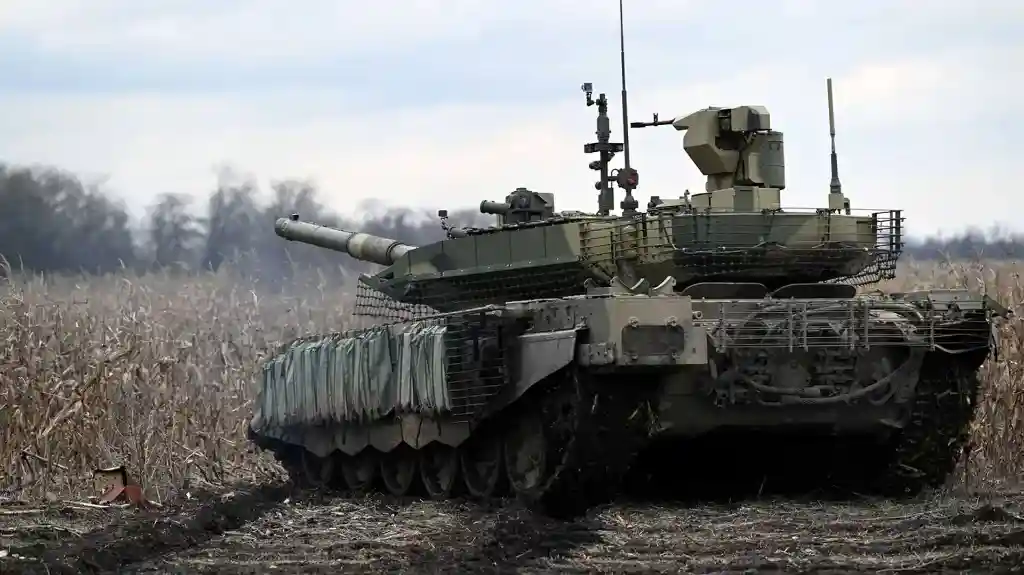
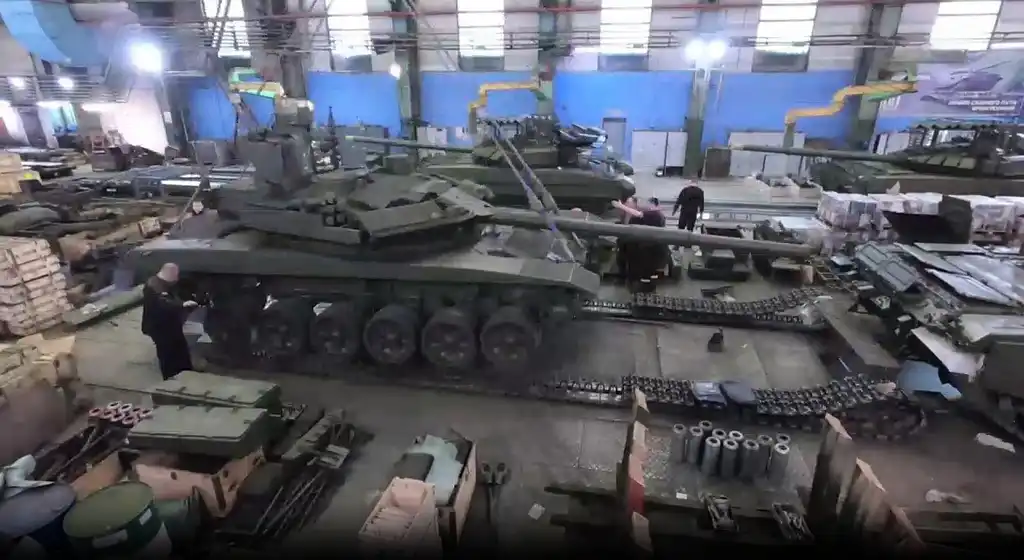
Leaked Russian defense documents have revealed an extensive armored vehicle production plan, detailing Moscow’s intent to manufacture over 1,000 T-90M2 Ryvok-1 main battle tanks by 2029 as part of a long-term strategy to rebuild its depleted tank fleet following substantial battlefield losses in Ukraine. The classified files, obtained and published by Frontelligence Insight on October 11, 2025, outline a structured ten-year armored program from 2026 to 2036, led by Uralvagonzavod, Russia’s primary tank manufacturer.
According to the leaked data, serial production of the T-90M2 Ryvok-1 is scheduled to commence in 2026 with an initial batch of ten units, followed by a sharp ramp-up phase. Between 2027 and 2029, production will peak with over 1,100 tanks either built, overhauled, or modernized—marking the most aggressive expansion of Russian tank output since the collapse of the Soviet Union. The year 2028 alone is projected to see 428 tanks completed, a striking 80% increase over 2024 levels, indicating a national mobilization of the defense-industrial base.
Russia’s Industrial Rebuild: Inside the 2026–2036 Armored Plan
The leaked program spans a full decade, combining new T-90M2 production, T-90M modernizations, and T-72 upgrades under a synchronized industrial schedule. Uralvagonzavod’s production goals outline at least 1,783 T-90M and T-90M2 units through 2036, but with no new T-90 entries listed after 2029, suggesting a strategic pause—likely for reorganization, retooling, or transition toward a next-generation tank design.
Correspondence within the documents identifies the T-90M2 by its internal designation, “Object 188M2”, an evolution from the T-90M “Proryv-3” (Object 188M). The “M2” designation and the code name “Ryvok-1” (Russian for “Dash-1”) point to a deep modernization program, not just incremental refinements. Analysts believe this variant aims to extend the service life of the T-90 line well into the 2030s while incorporating lessons learned from the war in Ukraine.
Technical Evolution: What the T-90M2 Ryvok-1 Brings
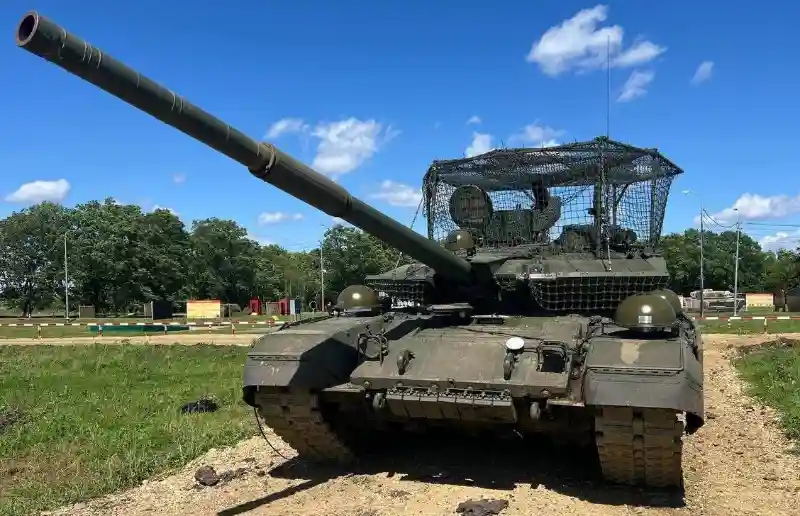
The T-90M2 Ryvok-1 represents the most advanced iteration of the T-90 family to date. It integrates the V-92S2F multi-fuel diesel engine rated at 1,130 horsepower, already proven in the T-90MS and T-90AM variants, enabling a top road speed of 70 km/h and a power-to-weight ratio of about 23.5 hp per ton.
Its 125 mm 2A46M-5 smoothbore gun, compatible with Invar-M laser-guided missiles, allows engagements at ranges up to 5 km, while the Kalina fire-control system—featuring Sosna-U multichannel optics, thermal imaging, and GLONASS/GPS navigation—ensures precision target acquisition in all weather conditions.
The Ryvok-1’s protection suite relies on modular Relikt explosive reactive armor (ERA), now extended to roof and side modules, combined with slat armor around the engine and turret rear. Internally, the tank features a revised welded turret with a rear ammunition bustle, crew thermal conditioning, improved fire suppression, and enhanced hydropneumatic suspension, reflecting Russian emphasis on crew survivability and mobility improvements drawn directly from recent combat feedback.
Strategic Significance: Rebuilding Russia’s Armored Might
The leaked Uralvagonzavod production targets underscore Russia’s long-term strategy of industrial endurance over technological revolution. Rather than investing in entirely new tank architectures like the T-14 Armata, whose production has stalled, Moscow appears to favor incremental, high-volume upgrades to proven platforms such as the T-90.
This approach maintains factory continuity, employment stability, and logistical familiarity, enabling Russia to replenish its armored units without straining supply chains or retraining crews on radically new systems. By keeping assembly lines active, the Kremlin preserves valuable industrial know-how that would take years to restore if interrupted—a critical consideration amid international sanctions and wartime attrition.
Parallel Modernization: T-72B3M and BMPT Programs
The same leaked materials confirm ongoing modernization of the T-72B3M, using procurement data for TKHP-12-150 cold-bore sighting tubes—an indirect metric for tracking upgrade volumes. Estimates suggest 828 T-72B3M units will be modernized through 2036, with a surge of 498 tanks between 2027 and 2029.
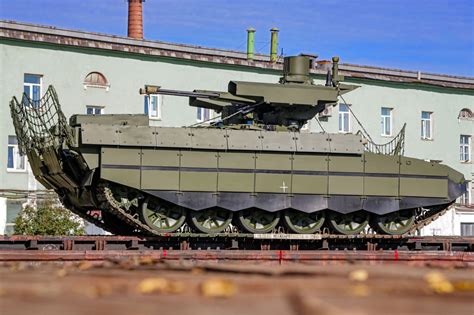
In contrast, the BMPT “Terminator” program remains a low priority, with only 86 vehicles slated for production or overhaul during the same decade. Despite its urban warfare role and unique twin 30 mm 2A42 autocannons, the Terminator has seen limited operational success and even confirmed combat losses in Ukraine, leading Russian planners to reallocate resources toward the more versatile T-90 line.
From Recovery to Continuity: A Calculated Industrial Gamble
Russia’s pursuit of over 1,000 T-90M2 tanks by 2029 reveals a strategic focus on quantity, reliability, and continuity. Instead of short-term replacement, Moscow appears to be banking on sustained production cycles that keep Uralvagonzavod’s capacity active and supply chains viable, even under wartime and sanctions pressure.
This model—steady, high-volume, evolutionary manufacturing—mirrors Cold War Soviet doctrine: a continuous production rhythm that ensures forces can be rebuilt, rotated, and maintained without halting industrial flow. While the T-90M2 Ryvok-1 may not match Western counterparts in digital integration or active protection sophistication, its balance of performance, survivability, and producibility makes it the cornerstone of Russia’s post-Ukraine armored recovery plan.
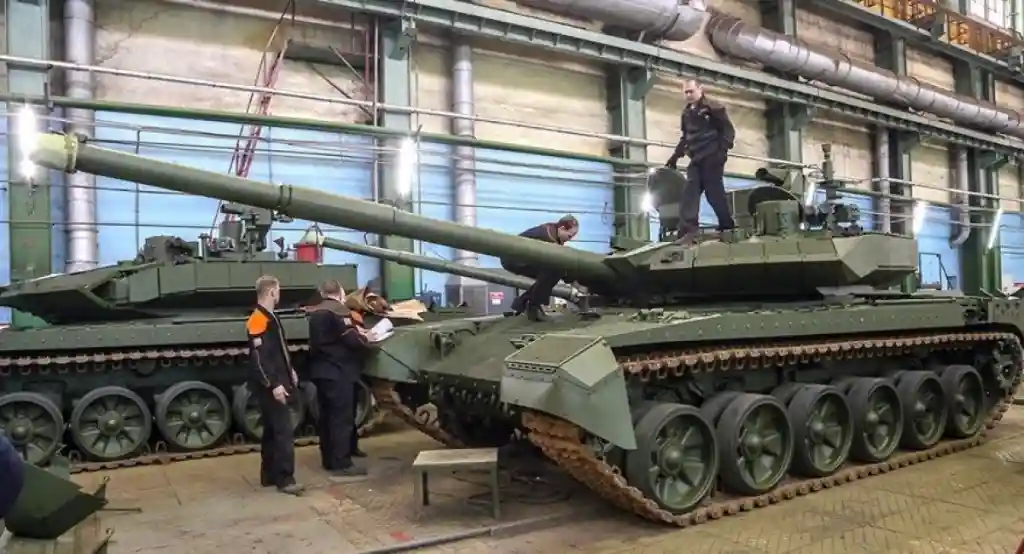
In essence, the T-90M2 Ryvok-1 program is not just a tank production effort—it is Russia’s industrial response to attrition, a statement of strategic resilience, and a blueprint for sustaining modern warfare capability through a disciplined, long-term approach to armored power.