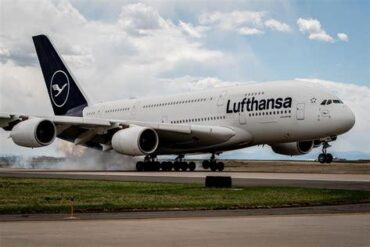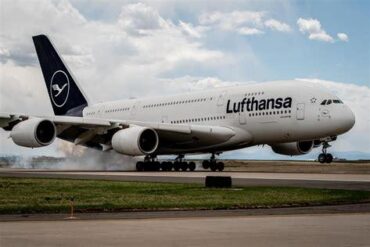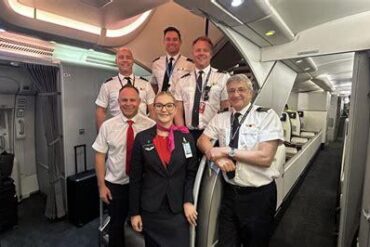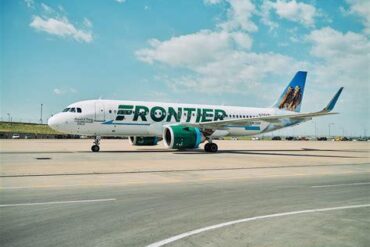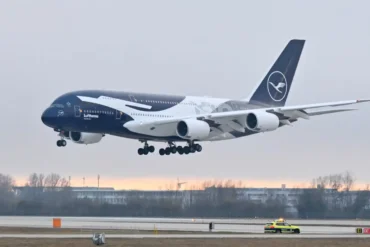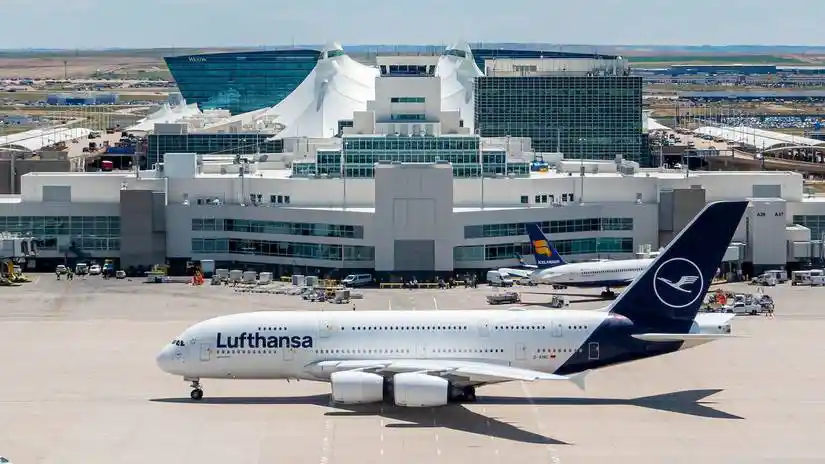
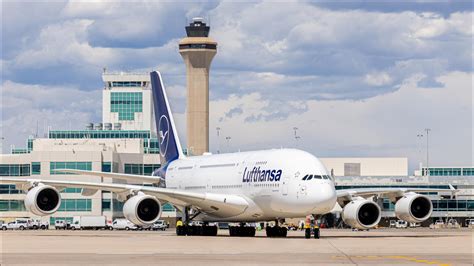
Denver International Airport has officially welcomed Lufthansa’s first Airbus A380 of the 2026 summer season, marking the return of the world’s largest passenger aircraft to Colorado just ahead of the Fourth of July holiday. While the arrival signals the continuation of the carrier’s flagship service between Munich and Denver, the celebration comes with a notable change. Lufthansa has significantly reduced its Airbus A380 schedule compared to last year after the route struggled to consistently fill the aircraft’s massive seating capacity during the 2025 season.
The first scheduled A380 operation of the summer did not go entirely as planned. An earlier flight was canceled before operations began, but aircraft D-AIMA ultimately became the first Lufthansa A380 to land at Denver International Airport (DEN) this year. Flight tracking data showed the superjumbo completing the transatlantic journey from Munich after crossing Greenland and Canada along one of the most efficient great-circle routes connecting Europe with the Rocky Mountain region.
The arrival once again places Denver among the select North American airports that regularly welcome Airbus A380 operations. In 2026, Lufthansa remains the only airline operating scheduled Airbus A380 flights into Denver, highlighting the strategic importance of the route despite its recent capacity adjustments.
Lufthansa Cuts Airbus A380 Flights Nearly in Half for 2026
Although the return of the Airbus A380 represents a milestone for aviation enthusiasts and international travelers alike, Lufthansa has adopted a much more conservative operating strategy this summer.
The airline introduced A380 service between Munich International Airport (MUC) and Denver in June 2025, operating through late October. The aircraft, configured with 509 seats, substantially increased available capacity compared with previous aircraft assigned to the route. Passenger numbers grew considerably throughout the season, but demand failed to keep pace with the enormous increase in available seats.
To improve profitability, Lufthansa delayed the beginning of its 2026 A380 schedule by approximately three weeks while maintaining a similar end date later in October. Weekly frequencies have also been reduced by roughly 20%, resulting in an overall seasonal schedule that is approximately 47% smaller than last year’s operation.
The difference becomes even more apparent when comparing total departures. During the 2025 season, Lufthansa scheduled 167 Airbus A380 departures between Munich and Denver. For the 2026 season, only 89 departures are currently planned, representing a dramatic reduction designed to better match passenger demand with available capacity.
Passenger Demand Prompted a Capacity Reset
The decision reflects a classic case of airlines adjusting aircraft deployment after evaluating real-world market performance.
During 2024, before the arrival of the Airbus A380, Lufthansa transported just over 97,000 passengers between Munich and Denver while achieving an impressive 89% load factor. Encouraged by strong demand, the airline upgraded the route to the Airbus A380 for the 2025 summer season.
While the larger aircraft increased passenger numbers to approximately 130,000 travelers, average seat occupancy declined to around 76%. Filling a 509-seat double-deck aircraft consistently proved considerably more difficult than operating smaller widebody jets.
Those empty seats carried significant financial implications. The Airbus A380’s four-engine design consumes more fuel and generally incurs higher operating and maintenance costs than modern twin-engine aircraft. Even with respectable passenger numbers, lower seat occupancy reduced overall efficiency and profitability.
Rather than abandoning the route altogether, Lufthansa chose to right-size capacity by reducing frequencies while preserving the prestige and customer appeal of operating its flagship aircraft to Denver.
Denver Remains a Strategic Gateway Between North America and Europe
Despite the reduced schedule, the Munich-Denver route continues to play an important strategic role within Lufthansa’s North American network.
Denver serves as one of the largest airline hubs in the western United States, offering passengers convenient onward connections throughout North America. Through Lufthansa’s joint venture and partnership with United Airlines, travelers arriving from Europe gain access to nearly 200 destinations beyond Denver.
The flow works equally well in the opposite direction. Munich functions as one of Lufthansa’s primary European hubs, allowing passengers departing Denver to connect seamlessly to more than 150 destinations across Europe, the Middle East, and beyond.
Traffic data illustrates how important these connecting passengers are to the route’s success. Approximately 24% of passengers flying between Munich and Denver continued onto another Lufthansa or United Airlines flight at either end of the journey. Another 13% connected to flights operated by other airlines after arriving in Denver, with Las Vegas ranking among the most popular onward destinations.
Interestingly, only about 12% of travelers were flying exclusively between Denver and Munich without making additional connections. This demonstrates that the route functions primarily as an international connecting corridor rather than serving local point-to-point demand alone.
Lufthansa’s Airbus A350 Continues Supporting Denver Operations
While the Airbus A380 remains the headline attraction, Lufthansa is maintaining additional capacity using the Airbus A350-900 from Frankfurt.
The Airbus A350 carries approximately 293 passengers, making it significantly smaller than the A380 while delivering substantially lower operating costs thanks to its efficient twin-engine design and modern composite airframe.
The combination of A350 and reduced A380 services allows Lufthansa greater flexibility in balancing passenger demand throughout the busy summer travel season while avoiding excessive overcapacity.
What Could Happen to the Denver Route in 2027?
The future of Lufthansa’s Airbus A380 operations to Denver will largely depend on how well the revised 2026 schedule performs.
If the reduced frequencies produce stronger load factors and improved profitability, the airline could continue seasonal A380 operations in future years. However, if demand remains insufficient, Lufthansa has several attractive alternatives.
One possibility is assigning the Airbus A350-900 as the primary aircraft year-round, providing lower operating costs while maintaining similar connectivity between Germany and Colorado.
Another longer-term option could arrive with Lufthansa’s long-awaited Boeing 777X deliveries. The airline expects to receive its first next-generation Boeing 777X aircraft in early 2027. Offering greater seating capacity than the A350 while operating far more efficiently than the four-engine Airbus A380, the Boeing 777X could eventually become the ideal aircraft for high-demand transatlantic routes such as Munich to Denver.
Denver’s Airbus A380 Era Continues—With a More Sustainable Approach
Lufthansa’s first Airbus A380 arrival in Denver for the 2026 season demonstrates that demand for premium transatlantic travel between Colorado and Germany remains strong. However, the airline’s nearly 47% reduction in scheduled A380 flights also reflects today’s data-driven approach to network planning.
Rather than maximizing capacity for its own sake, Lufthansa is prioritizing sustainable profitability by matching aircraft size and flight frequency more closely with actual passenger demand. The revised strategy preserves Denver’s unique position as an Airbus A380 destination while improving the route’s long-term commercial prospects.
For aviation enthusiasts, travelers, and the Denver region alike, the return of the iconic double-deck superjumbo remains an impressive sight. Whether the Airbus A380 continues flying to Colorado beyond 2026—or eventually gives way to newer aircraft such as the Airbus A350 or Boeing 777X—will depend on how successfully this carefully calibrated schedule performs over the coming summer months.