At approximately 5:15 PM local time on a busy Monday evening, routine operations at Phoenix Sky Harbor International Airport (PHX) were abruptly disrupted when a man gained unauthorized access to the active airfield, running onto a taxiway near departing aircraft. The incident unfolded in full view of pilots, passengers, and air traffic controllers, quickly escalating into a high-alert situation at one of the nation’s busiest aviation hubs.
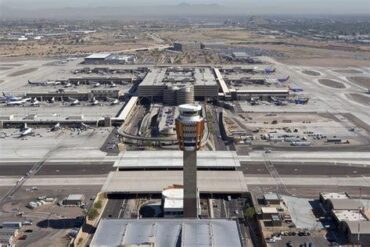
The first indication of trouble came from the cockpit of American Airlines Flight AA1804, bound for Tampa. As the aircraft taxied for departure, the pilot radioed the control tower with a startling question: could they see “the guy over there by Golf One?” Golf One refers to a taxiway positioned on the south side of the airfield, near runways 07L/25R and 07R/25L, both of which were active at the time. What began as a confusing sighting rapidly turned into a serious safety concern.
Witnesses reported that the man was waving his arms at aircraft and moving erratically near the hold-short line, a critical boundary that separates taxiways from active runways. Audio captured from air traffic control communications revealed a tense exchange as another pilot described the individual running toward an aircraft before dropping to his knees, seemingly pleading. In an environment governed by precision timing and strict procedures, the presence of an unauthorized person on the pavement introduced unpredictable risk.
Runway Intrusion at PHX: A Serious Aviation Safety Breach
Unauthorized access to a runway is treated as a severe breach under Federal Aviation Administration (FAA) safety protocols. Runways and taxiways are controlled environments where even minor deviations can have cascading consequences. Aircraft weighing tens of thousands of pounds operate under carefully sequenced instructions. Pilots rely on clear pavement and predictable movement. Introducing a pedestrian into that equation forces immediate recalibration.
The control tower instructed American Airlines Flight 1804 to hold position while ground crews and law enforcement were dispatched. Multiple other aircraft, including at least two Southwest Airlines jets awaiting departure, were also affected as controllers ensured that no aircraft movement would endanger the individual or compromise flight safety.
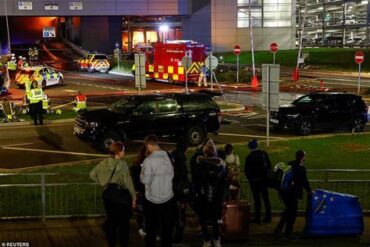
Despite the dramatic scene, operations were stabilized swiftly. Authorities subdued the man on the airfield, as captured in passenger-recorded video showing officers restraining an individual wearing a white T-shirt. Phoenix police confirmed they received calls shortly before 6:00 PM reporting a person on the runway and responded promptly.
Individual Transported for Mental Health Evaluation
Preliminary information indicates the man was experiencing a mental health crisis at the time of the intrusion. Rather than facing immediate criminal charges, he was transported to a local hospital for medical evaluation. This detail reframes the event not merely as a security lapse but as an intersection of aviation safety and public health.
Airports operate as high-security environments, yet they are also public spaces that intersect with broader societal challenges. Law enforcement and airport officials often must balance strict regulatory enforcement with compassionate response, particularly when mental health concerns are involved.
American Airlines Flight 1804 ultimately departed only minutes later than scheduled, and airport officials reported that overall operations were not significantly impacted. The rapid containment of the situation prevented what could have evolved into a far more serious disruption.
How Did the Man Access the Phoenix Sky Harbor Airfield?
An investigation is now underway to determine how the individual gained entry to the secured airfield perimeter. Reports indicate a suspicious vehicle was located near the airport boundary and later removed, suggesting the man may not have been a ticketed passenger.
Airports are protected by layered security systems that include fencing, controlled access gates, surveillance cameras, and patrol units. However, recent years have seen multiple high-profile airfield breaches across the United States, revealing vulnerabilities that often stem from human factors rather than structural failure.
In one recent case, a high-speed sedan drove across a taxiway before authorities discovered the driver was an airport contractor. In another widely reported incident at Chicago O’Hare International Airport, a DoorDash driver mistakenly entered a restricted airside area while attempting to complete a delivery. More tragically, in 2024 at Salt Lake City International Airport, a man experiencing a mental health episode breached security and was fatally injured after approaching an aircraft with engines running.
These events underscore a complex reality: while airport perimeters are heavily fortified, determined or distressed individuals sometimes find unexpected pathways into restricted zones. Each incident prompts renewed scrutiny of access controls, emergency response coordination, and surveillance systems.
Balancing Security, Safety, and Rapid Response at Major U.S. Airports
Phoenix Sky Harbor ranks among the busiest airports in the United States, handling hundreds of daily departures. Its operational tempo leaves little margin for anomaly. The incident highlights how quickly aviation systems must pivot when confronted with unpredictable human behavior.
Controllers must freeze aircraft movement without creating gridlock. Pilots must remain vigilant while managing passenger expectations. Ground teams must intervene safely around massive, moving machinery. It is choreography under pressure.
The swift resolution at PHX reflects the layered redundancies built into modern aviation safety. The system is designed not on the assumption that nothing will go wrong, but on the expectation that something eventually will. When it does, multiple safeguards activate simultaneously.
What remains is the unanswered question of perimeter access and whether additional measures will be implemented following the investigation. For now, the event stands as a reminder that even in highly regulated environments, unpredictability persists. Aviation safety depends not only on engineering precision and regulatory oversight, but also on rapid human judgment in moments that defy routine.
In the controlled geometry of runways and taxiways, where everything has its assigned path, a single unexpected presence can halt the machine. That it did not escalate further speaks to the resilience—and constant vigilance—embedded within modern air travel.