Phoenix Sky Harbor International Airport (IATA: PHX, ICAO: KPHX, FAA LID: PHX), a vital civil-military public international airport, stands as a cornerstone of aviation in the American Southwest. Located just three miles (2.6 nautical miles; 4.8 kilometers) east of downtown Phoenix, Arizona, within Maricopa County, it is not only Arizona’s largest and busiest airport but also a significant player on the national and international aviation stage. As of recent rankings, PHX consistently features among the largest commercial airports in the United States, underscoring its importance as a major transportation and economic engine for the Phoenix metropolitan area and beyond. Its coordinates, 33°26′03″N 112°00′42″W, place it strategically in the heart of a rapidly growing region.
The airport serves as a crucial hub for American Airlines and maintains a significant operating base for both Frontier Airlines and Southwest Airlines, facilitating connections across the country and to international destinations. Beyond its commercial operations, Phoenix Sky Harbor is also home to the 161st Air Refueling Wing (161 ARW) of the Arizona Air National Guard, an Air Mobility Command (AMC)-gained unit. This military enclave, known as Goldwater Air National Guard Base, operates KC-135R Stratotanker aircraft, fulfilling both domestic duties for the Governor of Arizona and global air refueling and mobility missions for the USAF. With a history stretching back to 1928, Sky Harbor has evolved dramatically, consistently adapting to the changing demands of air travel and cargo transport, reflecting the dynamic growth of Phoenix itself.
In 2024, Phoenix Sky Harbor International Airport achieved a remarkable milestone, serving over 52,325,266 passengers and managing 485,745 aircraft operations, alongside handling 339,148 tons of cargo. These figures not only highlight its immense operational scale but also its capacity to manage a high volume of traffic efficiently. The airport’s commitment to growth, passenger experience, and operational excellence continues to define its trajectory, promising further advancements and an even greater role in global aviation.
A Rich Tapestry of History: From Farmland to Global Gateway
The story of Phoenix Sky Harbor International Airport is one of vision, resilience, and relentless expansion, mirroring the ascent of Phoenix as a major American city. Its evocative name, “Sky Harbor,” was conceived by J. Parker Van Zandt, the owner of Scenic Airways. In November 1928, Van Zandt purchased 278 acres of farmland specifically for Scenic Airways’ winter operations, laying the literal and figurative groundwork for what would become a premier aviation facility. Van Zandt didn’t just name the airport; he founded and built it, commencing construction of a 100 x 120-foot airplane hangar and, by early 1929, a single runway. This marked the establishment of the fourth airport in Phoenix, a testament to the burgeoning interest in aviation in the region.
However, the infamous Stock Market Crash of 1929 imposed severe financial constraints on Scenic Airways, compelling Van Zandt to sell the airport to Acme Investment Company. Acme owned Sky Harbor until 1935, a pivotal year when the City of Phoenix acquired the airport for $100,000, a decision that would profoundly shape the city’s future development and connectivity. This public ownership set the stage for decades of strategic investment and growth, transforming Sky Harbor from a modest airfield into a sprawling international hub.
Pioneering Air Travel: Early Airlines and Route Development
The dawn of scheduled passenger service at Sky Harbor arrived on February 23, 1929, with Maddux Air Lines initiating a route connecting San Francisco and El Paso, with stops in Phoenix, Los Angeles, and other cities. Though this service was short-lived, ceasing by autumn 1929, it marked the beginning of Phoenix’s integration into the nascent air travel network. Standard Air Lines, which had been serving Phoenix via a different airfield since late 1927, began operations at Sky Harbor on August 5, 1929, offering a route between Los Angeles and El Paso, with intermediate stops in Phoenix, Tucson, and Douglas, Arizona. A significant development occurred in 1930 when Standard Air Lines was acquired by American Airways, the precursor to modern-day American Airlines. American extended this route eastward to New York, forging a southern transcontinental air corridor that passed through Dallas, Nashville, and numerous other cities, firmly placing Phoenix on the national aviation map.
The 1930s and 1940s saw further expansion of airline services. Transcontinental & Western Air (TWA) commenced service to San Francisco in 1938 and, by 1944, incorporated Phoenix into its own transcontinental network, linking it to Los Angeles and eastward to New York via Albuquerque and Kansas City. Intra-state connectivity improved in 1946 with the launch of Arizona Airways, which later merged into Frontier Airlines in 1950. Frontier subsequently introduced new routes to Denver, Albuquerque, and El Paso. Bonanza Air Lines entered the scene by 1951, initially flying to Las Vegas and Reno with multiple stops. The 1960s brought further growth for Bonanza, including routes to Salt Lake City, Southern California, and, by 1965, nonstop jet services to Las Vegas and Reno using Douglas DC-9 aircraft. In 1966, Bonanza Air Lines relocated its headquarters from Las Vegas to Phoenix, underscoring the city’s growing aviation importance. A series of mergers saw Bonanza combine with Pacific Air Lines and West Coast Airlines to form Air West in 1968, which was subsequently rebranded as Hughes Airwest in 1970 after its acquisition by Howard Hughes. Hughes Airwest expanded its network, including services to Mexico, and established a significant hub operation in Phoenix. This hub continued under Republic Airlines after it acquired Hughes Airwest in 1980, though Republic’s hub operations were scaled back by the mid-1980s. Other carriers establishing a presence included Western Airlines in 1957 (flights to Denver, Los Angeles, San Diego), Continental Airlines in 1961 (to El Paso, Los Angeles, Tucson), and Delta Air Lines by 1969 (to Dallas).
The Jet Age, Deregulation, and the Rise of Hubs
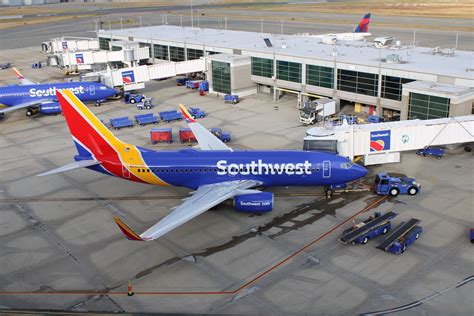
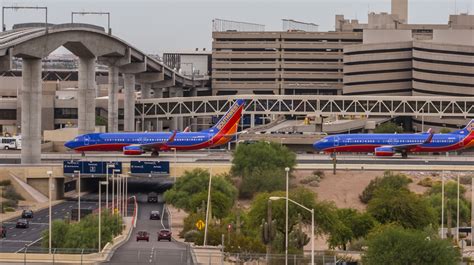
The Airline Deregulation Act of 1978 heralded a new era for Sky Harbor, ushering in a wave of new airlines and intensified competition. This period was particularly transformative. Ed Beauvais, a former Hughes Airwest executive, envisioned a new airline based in Phoenix and, in 1981, founded America West Airlines (AWA). AWA commenced operations from Phoenix in 1983 and experienced meteoric growth, doubling in size within its first year and establishing a formidable hub. The late 1970s and early 1980s also saw the arrival of Eastern Airlines and Allegheny Airlines (which soon rebranded as USAir) in 1979, followed by United Airlines in 1980. Southwest Airlines made its impactful debut at PHX in January 1982 with 13 daily flights to 12 cities. By 1986, Southwest’s presence had ballooned to 64 daily flights and a crew base. The airline further solidified its commitment to Phoenix by opening its largest maintenance facility at PHX in 1992.
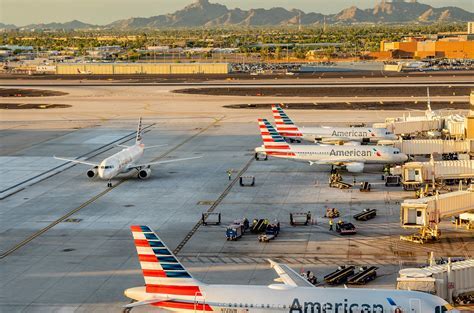
America West Airlines, despite filing for Chapter 11 bankruptcy protection in 1991 and divesting larger aircraft and its Japanese route authority, continued to expand its domestic operations from Terminal 4, often in cooperation with Continental Airlines. The 1990s were a period of significant growth for AWA at Phoenix. However, the aftermath of the September 11, 2001 attacks placed considerable strain on its financial position. AWA subsequently ended its partnership with Continental and, in a landmark move, merged with US Airways in 2005. The merged entity relocated its headquarters to AWA’s campus in Tempe, Arizona, with many AWA managers taking key roles. The lineage continued when US Airways merged with American Airlines in 2015. American Airlines has since built upon and expanded what is now its sixth-largest hub at Phoenix Sky Harbor, a testament to the airport’s enduring strategic importance.
Sky Harbor achieved a significant milestone in international travel in 1996 when British Airways inaugurated nonstop service to London-Heathrow, marking the airport’s first transatlantic flights. Initially operated with Douglas DC-10 aircraft, the route was soon upgraded to the larger Boeing 747-400, reflecting strong demand. Looking to the future, in May 2025, Starlux Airlines announced plans to launch nonstop service to Taipei, Taiwan, beginning in 2026, utilizing Airbus A350 aircraft. This will be a landmark development, providing PHX with its first-ever nonstop scheduled airline service to Asia and further enhancing its global connectivity.
Architectural Evolution and Terminal Development: Building for Phoenix’s Future
The physical landscape of Phoenix Sky Harbor International Airport has undergone continuous transformation to accommodate its ever-increasing passenger and aircraft traffic. Following World War II, the airport embarked on ambitious projects, including a new passenger terminal, a new parallel runway, and a diagonal runway. The February 1953 C&GS diagram shows runways 8L and 8R each at 6,000 feet (1,800 m) and runway 3 at 5,500 feet (1,700 m). The first dedicated passenger terminal, Terminal 1 (originally named the West Wing), opened in October 1952 at a cost of $835,000. This facility also housed the airport’s first control tower, marking a significant step in modernizing operations. A master plan redesign in 1959 eliminated the cross runway to create space for additional terminal development, a forward-thinking move that anticipated future growth.
Foundational Terminals: The Legacy of Terminals 1 and 2
As American Airlines and TWA introduced jet service to Phoenix in 1960 and 1961 respectively, the need for expanded facilities became apparent. Terminal 2 (originally the East Wing) opened in 1962 to meet this demand. Designed by the prominent Phoenix architectural firms of Weaver & Drover and Lescher & Mahoney, Terminal 2 was a product of its time. A distinctive feature of Terminal 2 was “The Phoenix,” a magnificent mural by the French-American artist Paul Coze, a full-time Phoenix resident. Commissioned in 1960 as Phoenix’s first piece of public art and installed in 1962, the 16-foot high and 75-foot wide mural, composed of 52 different materials including mosaic glass, gemstones, shells, and vintage toys, graced the main lobby. Following the decommissioning and demolition of Terminal 2 in 2021, this iconic artwork was carefully relocated to the Rental Car Center, preserving its legacy. Terminal 2 underwent two significant renovation projects: the first completed in 1988, and the second, a $24 million project designed by DWL Architects + Planners, Inc., completed in 2007. In November 2006, a Military and Veterans Hospitality Room, sponsored by the Phoenix Military and Veterans Commission, opened in Terminal 2, later relocating to Terminal 4 as the new USO club. Terminal 1 was eventually retired, and Terminal 2 accepted its final flight in February 2020 before being decommissioned and subsequently demolished in early 2021. The site is now utilized for concrete aircraft stands accessible by bus.
The Rise of Modern Terminals: Terminal 3 and the Barry M. Goldwater Terminal 4
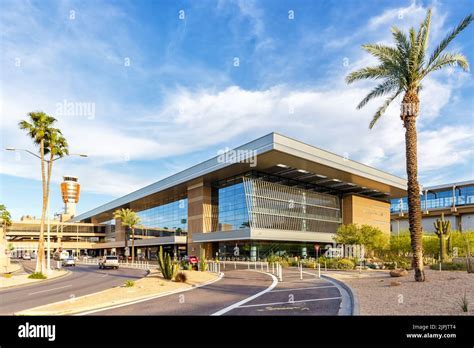
Construction on Terminal 3 commenced in January 1977. Designed by DWL Architects + Planners, Inc., it opened in October 1979. With its opening, the “East” and “West” naming conventions for the older terminals were dropped. Airlines previously using Terminal 2 were relocated to Terminal 3 following extensive renovations completed in January 2020. In a fitting tribute, the Phoenix City Council renamed Terminal 3 in honor of the late Senator John McCain in January 2021.
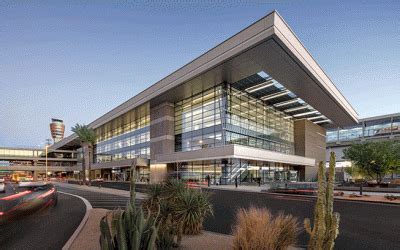
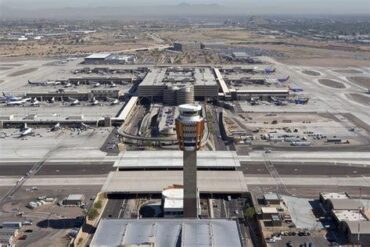
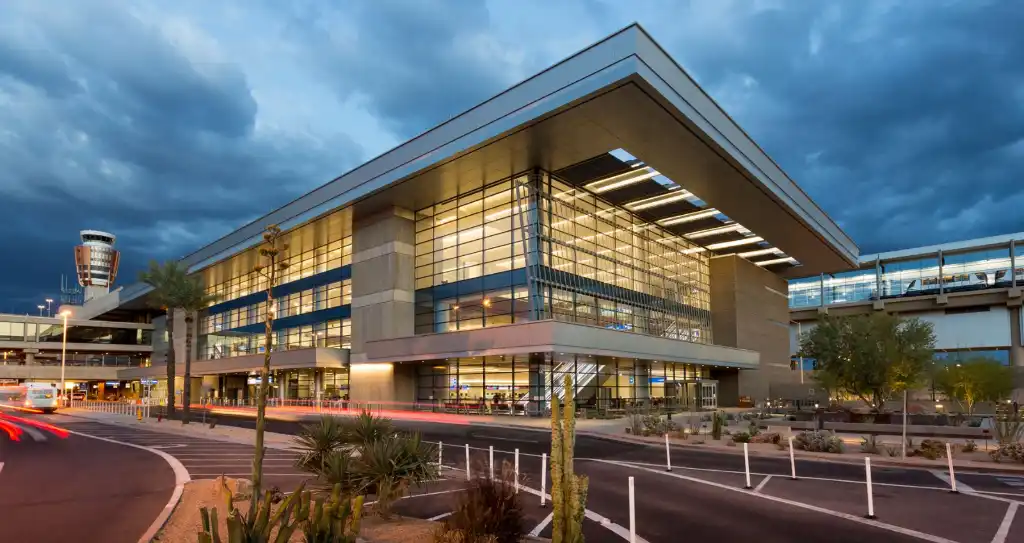
The most significant expansion came with Terminal 4, for which ground was broken in October 1989. This massive facility, the largest at PHX, opened on November 2, 1990, initially with four concourses: N2 and N3 on the north side, and S3 and S4 on the south side. Terminal 4 is named in honor of former Arizona Senator and 1964 Presidential candidate Barry M. Goldwater. Following Goldwater’s death in 1998, then-Mayor of Phoenix, Skip Rimsza, proposed renaming the entire airport in his memory, but strong public support for retaining the familiar “Sky Harbor” name prevailed. Terminal 4’s development continued with the opening of the N4 International Concourse in 1994, adding 10 gates and a sterile walkway to the S4 concourse. In 1997, construction began on the 14-gate N1 concourse for America West Airlines, completed in June 1998 at a cost of $50 million, finishing the north side expansion. On the south side, the eight-gate S2 concourse for Southwest Airlines was constructed starting in 2002 and completed in 2004, featuring a distinct architectural design. The eighth and final concourse for Terminal 4 began construction in May 2019. Designed by DWL Architects + Planners, Inc., Terminal 4 is the busiest terminal, boasting 86 gates across seven satellite concourses connected behind security.
Recent Enhancements and Future Visions
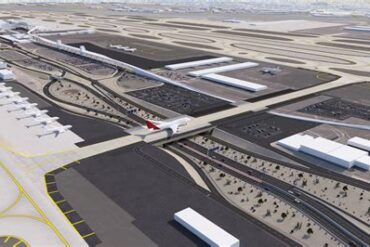
Phoenix Sky Harbor continuously invests in its infrastructure. In February 2024, the airport announced a $36 million project for significant infrastructure upgrades at its central utility plant in Terminal 4. Funded by an FAA Airport Terminal Program grant through the federal Infrastructure Investment and Jobs Act, this project aims to improve air conditioning capacity and efficiency throughout the terminal. Further demonstrating its commitment to future growth, Phoenix Mayor Kate Gallego announced on April 29, 2024, plans for a new terminal to be constructed on the west side of the airport property, near the former site of Terminal 2. Citing record passenger numbers in 2023 (over 48 million) and anticipated continued growth, the new terminal is deemed essential to accommodate increasing demand. It will feature a new customs facility and is slated to be designed with net-zero greenhouse gas emissions, emphasizing environmental sustainability. The airport also made history in 2007 when the Transportation Security Administration (TSA) introduced its first backscatter X-ray machines at PHX.
Navigating PHX: A Comprehensive Look at Current Airport Facilities
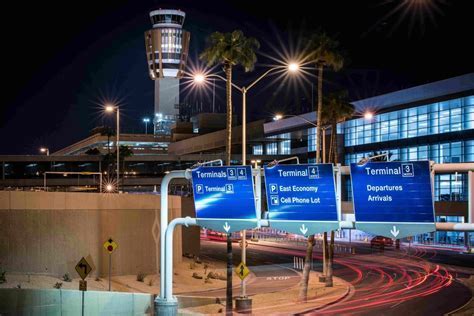
Phoenix Sky Harbor International Airport currently operates with 119 active aircraft gates distributed across its two main passenger terminals: Terminal 3 and Terminal 4. The designations for Terminal 1 and Terminal 2 have been officially “retired” by airport administration, who opted not to renumber the remaining terminals to maintain familiarity for passengers. Following the closure of Terminal 2, Terminals 3 and 4 retained their existing numbers. The area where Terminal 2 once stood is now planned for bus gates, providing flexible aircraft parking solutions.
Terminal 3: The John McCain Terminal – Modern Efficiency
Terminal 3, officially named the John McCain Terminal, serves as a key facility for numerous domestic carriers and handles precleared international arrivals. It is utilized by airlines such as Frontier Airlines for most of its operations. Alaska Airlines also uses Terminal 3 for both its arrivals and departures. Following comprehensive renovations completed in early 2020, Terminal 3 offers a modern and efficient passenger experience with 27 gates, streamlined security checkpoints, and enhanced amenities. Its strategic location and updated facilities make it a vital component of Sky Harbor’s overall capacity.
Terminal 4: The Barry M. Goldwater Terminal – The Bustling Heart of PHX
Terminal 4, the Barry M. Goldwater Terminal, is the largest and busiest operational facility at Phoenix Sky Harbor. It serves as the primary hub for American Airlines and is also heavily utilized by Southwest Airlines. Most international flights that require customs processing upon arrival are handled through Terminal 4, which features a dedicated international concourse. With a total of 92 gates spread across seven satellite concourses (N1, N2, N3, N4 International on the north side; S2, S3, S4 on the south side), Terminal 4 is designed to handle a massive volume of passengers and a wide variety of aircraft. Its extensive array of shops, restaurants, and passenger services caters to the diverse needs of travelers passing through this major aviation crossroads.
Runway Infrastructure: The Backbone of Sky Harbor’s Operations
Phoenix Sky Harbor International Airport covers an expansive 3,400 acres (14 km²) and sits at an elevation of 1,135 feet (346 m) above mean sea level. The airport’s air traffic is managed across three parallel concrete/grooved runways, designed for optimal efficiency and safety:
- Runway 8/26: Measuring 11,489 feet × 150 feet (3,502 m × 46 m).
- Runway 7L/25R: Measuring 10,300 feet × 150 feet (3,139 m × 46 m).
- Runway 7R/25L: Measuring 7,800 feet × 150 feet (2,377 m × 46 m).
All three runways are capable of accommodating aircraft with a maximum takeoff weight of 900,000 pounds (410,000 kg) or greater, allowing for operations by the largest commercial and cargo planes. The parallel runway configuration is crucial for managing the high volume of takeoffs and landings at one of the nation’s busiest airports. Additionally, Sky Harbor’s private airplane area includes one of eight service centers for the Medevac airline Air Evac.
Air Traffic Control Excellence: The Iconic Tower
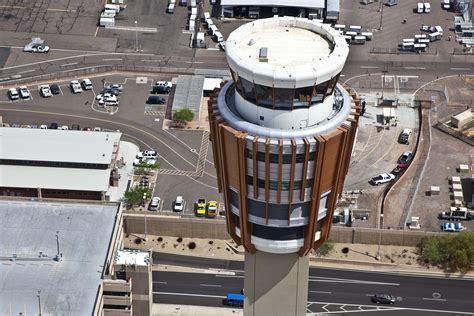
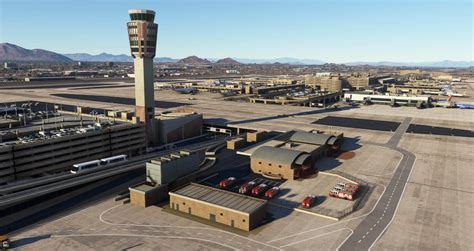
Dominating the airport’s skyline is its state-of-the-art Air Traffic Control (ATC) tower, which commenced operations on January 14, 2007. Standing at an impressive 326 feet (99 meters) tall, it is located just east of the Terminal 3 parking garage and also houses the Phoenix TRACON (Terminal Radar Approach Control). This is Sky Harbor’s third control tower and ranks among the tallest ATC towers in North America, providing controllers with an unobstructed panoramic view of the airfield and surrounding airspace, essential for managing the complex flow of air traffic safely and efficiently.
Military Operations: Goldwater Air National Guard Base
Integral to Phoenix Sky Harbor’s multifaceted operations is the Goldwater Air National Guard Base, home to the 161st Air Refueling Wing (161 ARW) of the Arizona Air National Guard. This Air Mobility Command (AMC)-gained unit is one of two flying units in the Arizona ANG and operates the KC-135R Stratotanker aircraft. The 161 ARW performs a dual role: serving the state of Arizona under the direction of the Governor, and supporting United States Air Force missions both domestically and internationally, primarily through air refueling and air mobility operations worldwide. This military presence underscores PHX’s strategic importance beyond civilian aviation.
The Phoenix Airport Museum: Art and Aviation Heritage
Enhancing the passenger experience, the Phoenix Airport Museum is an innovative program that integrates art and cultural exhibits throughout the airport terminals. Instead of a single, centralized museum building, displays are strategically located in various public spaces, showcasing a diverse collection of artwork by Arizona artists, as well as exhibits on local aviation history and memorabilia. This unique approach allows travelers to engage with art and culture as they navigate the airport, transforming terminals into dynamic gallery spaces.
Airlines, Destinations, and Global Connectivity: Your Gateway from Phoenix
Phoenix Sky Harbor International Airport stands as a critical nexus for air travel, offering an extensive network of flights operated by a multitude of domestic and international airlines. This robust connectivity makes PHX a preferred airport for millions of travelers annually, linking Phoenix to destinations across North America and beyond.
Extensive Passenger Network: Domestic and International Flights
As a major hub for American Airlines and a significant operating base for Southwest Airlines and Frontier Airlines, PHX provides passengers with a vast array of choices. American Airlines offers the most extensive network, connecting Phoenix to major cities like Atlanta, Boston, Chicago-O’Hare, Dallas/Fort Worth, Los Angeles, New York-JFK, and international destinations including Cancún, London-Heathrow, and various cities in Mexico. Southwest Airlines boasts a strong presence with numerous flights to destinations such as Baltimore, Denver, Las Vegas, Oakland, and San Diego. Frontier Airlines provides budget-friendly options to cities like Atlanta, Chicago, Denver, and Las Vegas.
Other major U.S. carriers serving PHX include Delta Air Lines (Atlanta, Detroit, Minneapolis/St. Paul, New York-JFK, Salt Lake City, Seattle/Tacoma), United Airlines (Chicago-O’Hare, Denver, Houston-Intercontinental, Los Angeles, Newark, San Francisco, Washington-Dulles), and Alaska Airlines (Boise, Portland, Seattle/Tacoma, Anchorage). Smaller and regional carriers like Advanced Air, Contour Airlines, Denver Air Connection, and Southern Airways Express provide vital links to smaller communities in Arizona and neighboring states.
International connectivity is strong with Air Canada and its affiliates offering flights to Vancouver, Toronto, and Montréal. British Airways provides daily nonstop service to London-Heathrow. Volaris connects Phoenix with Culiacán and Guadalajara in Mexico. European travelers can also utilize Air France for service to Paris–Charles de Gaulle. The upcoming Starlux Airlines service to Taipei, starting in 2026, will mark a significant expansion into the Asian market. Other international carriers include WestJet serving multiple Canadian cities.
Robust Cargo Operations: A Vital Logistics Link
Beyond passenger traffic, Phoenix Sky Harbor is a significant center for air cargo. A variety of dedicated cargo airlines operate from PHX, facilitating the movement of goods regionally, nationally, and internationally. Major cargo carriers include Amazon Air, connecting Phoenix to its national distribution network with flights to hubs like Allentown, Cincinnati, and Fort Worth/Alliance. DHL Aviation operates services to its Cincinnati hub and other western cities. FedEx Express maintains a strong presence with flights to its main hub in Memphis, as well as Oakland, and utilizes FedEx Feeder services for connections to smaller Arizona cities. UPS Airlines also has substantial operations, linking Phoenix to its Louisville hub and other key destinations like Dallas/Fort Worth and Denver. Regional cargo services are provided by carriers such as Air Cargo Carriers and Ameriflight, ensuring that businesses throughout Arizona and the Southwest have reliable air freight options.
PHX by the Numbers: A Deep Dive into Traffic and Statistics
Phoenix Sky Harbor International Airport’s impressive statistics underscore its role as a major aviation powerhouse. From its early days to the present, the airport has witnessed phenomenal growth in both passenger numbers and aircraft movements. Between 1951 and the end of 2024, a staggering 1,477,505,366 passengers (enplaned and deplaned, domestic and international) have transited through PHX. This equates to an annual average of nearly 20 million passengers over that extended period. During the same timeframe, the airport recorded 30,033,280 aircraft movements, encompassing commercial, military, and general aviation, averaging over 405,000 movements per year. In 2023, PHX was ranked the 14th-busiest airport in the United States and the 33rd-busiest in the world based on passenger boardings, a testament to its global significance. The year 2024 saw the airport surpass 52.3 million passengers, an all-time record for the facility.
Leading Domestic and International Routes from PHX
Analysis of route data from January 2024 to December 2024 reveals key travel patterns. The busiest domestic routes from PHX are:
- Denver, Colorado: 1,260,000 passengers (American, Frontier, Southwest, United)
- Seattle/Tacoma, Washington: 943,000 passengers (Alaska, American, Delta, Frontier, Southwest)
- Chicago–O’Hare, Illinois: 900,000 passengers (American, Frontier, Southwest, Spirit, United)
- Las Vegas, Nevada: 874,000 passengers (American, Frontier, JSX, Southwest, Spirit)
- Dallas/Fort Worth, Texas: 820,000 passengers (American, Spirit, Frontier)
On the international front, the busiest routes for the same period were:
- San José del Cabo, Mexico: 457,831 passengers (American, Frontier, Southwest)
- London–Heathrow, United Kingdom: 334,863 passengers (American, British Airways)
- Calgary, Canada: 312,085 passengers (Flair, Lynx Air, WestJet)
- Puerto Vallarta, Mexico: 310,506 passengers (American, Southwest)
- Cancún, Mexico: 219,996 passengers (American, Southwest)
Airline Market Share at Phoenix Sky Harbor
The distribution of passengers among airlines further illustrates the competitive landscape at PHX (January 2024 – December 2024):
- American Airlines: 21,159,778 passengers (40.4% market share)
- Southwest Airlines: 17,106,770 passengers (32.7% market share)
- Delta Air Lines: 3,750,908 passengers (7.2% market share)
- United Airlines: 3,003,303 passengers (5.7% market share)
- Frontier Airlines: 2,717,138 passengers (5.2% market share)
- Alaska Airlines: 1,584,419 passengers (3.0% market share)
- Other Airlines: 3,002,989 passengers (5.8% market share)
These figures clearly show the dominance of American Airlines and Southwest Airlines at Phoenix Sky Harbor, reflecting their extensive hub and base operations, respectively.
Seamless Journeys: Ground Transportation at Sky Harbor
Phoenix Sky Harbor International Airport offers a comprehensive array of ground transportation options designed to provide travelers with convenient and efficient access to and from the airport terminals. Whether arriving by private vehicle, public transit, or ride-sharing services, passengers can navigate the airport grounds with relative ease.
The PHX Sky Train®: Effortless Terminal and Parking Connections
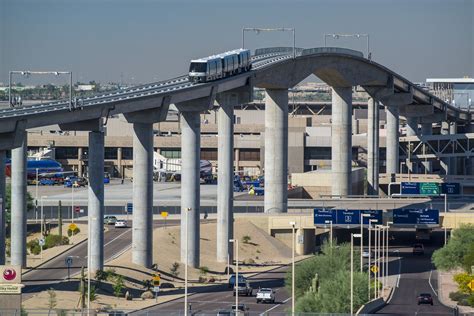
A cornerstone of Sky Harbor’s ground transportation network is the PHX Sky Train®. This free, automated people-mover operates 24/7, connecting key points within the airport campus. Phase 1, which opened on April 8, 2013, links the 44th Street and Washington Light Rail station and the East Economy Parking lot to Terminal 4. Phase 1A extended this service to Terminal 3, opening on December 8, 2014. The most recent expansion, Phase 2, completed on December 20, 2022, further extends the Sky Train to the Rental Car Center, creating a seamless connection for passengers renting vehicles. This system significantly reduces vehicular traffic around the terminals and provides a quick, reliable mode of transport for passengers moving between terminals, parking areas, and public transit links.
Road Access, Parking, and Public Transportation
For those arriving by car, Sky Harbor is easily accessible via major roadways including Interstate 10 (I-10), Arizona State Route 143 (Hohokam Expressway), and Arizona State Route 202 (Loop 202). Ample parking is available, with terminal parking garages adjacent to both Terminal 3 and Terminal 4, as well as economy parking options like the East Economy Parking garages and uncovered lots, all served by the PHX Sky Train® or shuttle buses. Until the PHX Sky Train® fully services all desired points, the airport continues to operate shuttle bus services between terminals and the Rental Car Center, with dedicated routes for each terminal.
Public transportation is well-integrated. The Valley Metro Rail has a station at 44th Street and Washington, directly connecting to the PHX Sky Train® station via a moving sidewalk bridge. This allows for an easy transfer from the regional light rail system to the airport terminals. Several Valley Metro bus routes also serve the airport vicinity; Route 13 stops near the Airport Operations building west of Terminal 3, providing a connection for those heading to or from the Greyhound station, while Route 44 serves the PHX Sky Train® station at 44th Street and Washington. A variety of taxi services, limousine companies, and ride-sharing operators (such as Uber and Lyft) are authorized to provide service at designated pick-up and drop-off locations at each terminal, offering further flexibility for travelers.
Safety, Security, and Notable Incidents at PHX
Phoenix Sky Harbor International Airport prioritizes the safety and security of its passengers, employees, and facilities. Comprehensive security measures, in coordination with the Transportation Security Administration (TSA) and local law enforcement, are in place throughout the airport. However, like any major transportation hub, Sky Harbor has experienced its share of incidents over its long history.
One of the most recent and significant events occurred on December 25, 2024. An apparent family dispute among a group of five individuals at a restaurant inside Terminal 4 escalated dramatically into a shooting and stabbing incident. This resulted in three people sustaining gunshot wounds and another suffering a stab wound. Authorities detained a man and a juvenile female in connection with this altercation. Compounding the situation, another man, reportedly responding to false information about an active shooter at the airport, arrived at PHX shirtless and armed. He had an altercation with police before also being taken into custody. This incident highlighted the challenges of managing security in a high-traffic public space, even during holiday periods.
Historically, other incidents have been recorded. On June 27, 1969, a Cessna 182 Skylane en route from Hawthorne, California, struck high-tension power lines east of the airport while attempting to land on Runway 26R in the Salt River bed. The crash, occurring at 10:48 pm, tragically killed all three occupants and caused a power outage at the airport. On March 13, 1990, an Alaska Airlines Boeing 727 taking off from PHX struck and killed a man who had breached security and run onto the runway; authorities later determined he was a patient from a nearby mental hospital. There were no injuries aboard the aircraft. An America West Airlines Airbus A320 (Flight HP794) arriving from Houston on August 28, 2002, experienced a nose-gear collapse while taxiing after landing, though no serious injuries were reported. On July 11, 2009, a British Airways Boeing 747 (Flight BA288) bound for London was evacuated on the tarmac due to fumes detected in the cabin. A notable operational event occurred on August 17, 2017, when a Qantas Airbus A380 (Flight QF7) en route from Sydney to Dallas diverted to Phoenix due to a passenger medical emergency. This marked the first recorded arrival of an A380 superjumbo at PHX; the aircraft had to taxi to a remote stand as the airport at the time did not have a gate capable of handling its size. More recently, on December 6, 2017, another British Airways Boeing 747 (Flight BA288/BAW38P) experienced an engine problem (#3 engine) during climb-out and had to return to the airport after dumping fuel, an event captured on camera.
Acclaim and Recognition: A Top-Tier Airport Experience
Phoenix Sky Harbor International Airport has consistently earned accolades for its operational efficiency, passenger amenities, and overall travel experience. Its commitment to excellence has been recognized by industry observers and travelers alike. Notably, in its 2019 airport rankings, The Wall Street Journal distinguished Sky Harbor as the best airport overall among the 20 largest airports in the United States. This prestigious ranking was based on a comprehensive evaluation across 15 categories. The Wall Street Journal highlighted that “Phoenix excelled in several of the 15 categories, with short screening waits, fast Wi-Fi, good Yelp scores for restaurant reviews, short taxi-to-takeoff times for planes and cheap average Uber cost to get downtown.”
This recognition was not an isolated event. Sky Harbor continued its impressive performance, once again securing the top spot in The Wall Street Journal’s 2023 rankings for large U.S. airports. In this assessment, PHX surpassed other major hubs like Minneapolis–Saint Paul International Airport and Los Angeles International Airport. Such consistent high rankings underscore the airport’s successful efforts in maintaining a superior passenger experience, investing in modern infrastructure, and optimizing operational workflows. These awards reflect the dedication of the airport staff, the strategic planning by the City of Phoenix Aviation Department, and the continuous improvements made to meet and exceed the expectations of modern travelers.
The Future is Bright: Continued Growth and Innovation at Phoenix Sky Harbor
Phoenix Sky Harbor International Airport is not resting on its laurels. With passenger traffic consistently breaking records and the Phoenix metropolitan area experiencing sustained population and economic growth, the airport is poised for an even more dynamic future. Ambitious plans for infrastructure development, technological integration, and enhanced sustainability initiatives are already underway, ensuring that PHX remains a leading aviation facility for decades to come. The recently announced new West Terminal, designed with net-zero greenhouse gas emissions and a new customs facility, exemplifies this forward-looking approach. This project, along with ongoing upgrades to existing terminals like the Terminal 4 utility plant enhancement, will significantly increase capacity and improve passenger comfort.
The strategic pursuit of new international routes, such as the upcoming Starlux Airlines service to Taipei, will further cement Sky Harbor’s status as a global gateway, opening up new markets for tourism and business. Continued investment in the PHX Sky Train® system will further streamline ground transportation, enhancing connectivity and reducing environmental impact. As a major economic engine for Arizona, generating billions of dollars in economic activity annually, Phoenix Sky Harbor’s continued success is intrinsically linked to the prosperity of the region it serves. With a clear vision for growth, a commitment to innovation, and a focus on providing a world-class travel experience, Phoenix Sky Harbor International Airport is well-equipped to meet the challenges and seize the opportunities of the future of aviation.