The McDonnell Douglas MD 500 Defender stands as a bold testament to innovation in light military helicopter design, born from the combat-proven OH-6 Cayuse. What began as a nimble utility platform evolved into a fierce multipurpose war machine, tailored for armed reconnaissance, anti-armor operations, and maritime patrol. Lightweight, agile, and cost-effective, the Defender family became a backbone for smaller and mid-sized militaries needing affordable, high-performance rotary capabilities.
The story of the MD 500 Defender begins in 1976, when Hughes Helicopters re-engineered its civilian MD-500 into a military configuration. This new platform retained the OH-6’s iconic compact profile but gained muscular new roles—armed scout, tank killer, sub-hunter—earning it the ‘Defender’ title and a loyal global following.
Early production focused on the 500MD Defender, produced in significant numbers (200 units) between 1976 and 1984. Of these, 50 were fitted with TOW anti-tank missiles, while the rest served in transport and support roles. The aircraft’s affordability and modularity made it a natural choice for U.S. allies, with Israel, Kenya, and South Korea among its earliest adopters.
A Modular Combat Workhorse Across Continents
At the heart of the Defender’s appeal lies its versatility. The base airframe supported a wide array of mission kits, enabling operators to quickly reconfigure the aircraft for diverse scenarios:
- Anti-Tank: Models like the 500MD/TOW and 500MD/MMS-TOW featured mountings for four TOW missiles, enabling highly mobile anti-armor strikes.
- Armed Reconnaissance: The 500D Scout Defender and later MD 530F Cayuse Warrior included FN M3P .50 caliber machine guns and Hydra 70 rocket pods, suitable for precision scouting and hit-and-run tactics.
- Maritime Warfare: In the 500MD/ASW Defender configuration, the helicopter carried search radars, MAD sensors, and lightweight torpedoes—ideal for coastal nations with modest naval budgets.
The aircraft’s simplicity belied its battlefield impact. During the Israeli-Syrian clashes of the late 1970s and 1980s, Defenders equipped with TOW missiles devastated Syrian armored columns in the Bekaa Valley, cementing the aircraft’s combat reputation.
Evolving Through Innovation: Variants and Upgrades
The Defender lineage continuously adapted to evolving tactical requirements and advancing technology. Over the decades, it has spawned a broad array of variants:
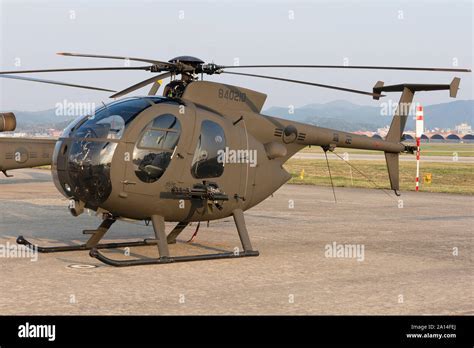
- 500M Defender: Licensed production in Japan (OH-6J) and Italy (by Breda Nardi), tailored for localized needs.
- 500MG Defender: Derived from the MD-500E, this variant featured modernized avionics and structural enhancements.
- MD530MG Paramilitary Defender: Adapted for police and internal security forces, used by Colombia and other Latin American operators.
- 520MG Defender and 520MK Black Tiger: Customized for the Philippine Air Force and Korean Air, respectively, with new electronics and light attack weaponry.
- MD530G and BII: Latest-generation attack platforms with enhanced lethality, sensor suites, and survivability.
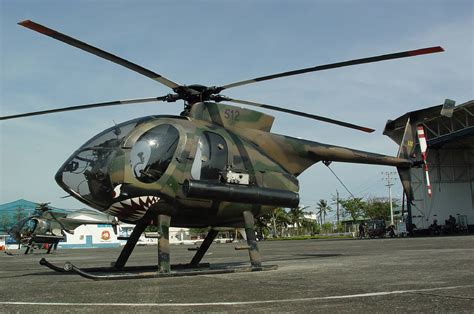
Another milestone came with the MD540F, a more advanced combat model proposed for the U.S. Army’s Armed Aerial Scout program. Despite a legal challenge from Boeing, a court ruled in favor of MD Helicopters’ participation. Though the Army ultimately canceled the program in 2013, the MD540F remains a benchmark in light helicopter modernization, boasting a glass cockpit, upgraded rotor, FLIR targeting, and helmet-mounted displays.
Emergence in the Unmanned Age
By the 2010s, the Defender platform began migrating toward the unmanned frontier. In 2012, Boeing unveiled the Unmanned Little Bird (ULB) concept, an autonomous derivative of the MD-500 series capable of autonomous ISR and precision strike missions. The concept was taken further by Korean Air in 2015, which revealed a KUS-VH unmanned variant with an endurance of four hours and weapon loadouts including Hellfire missiles and EO/IR sensors. Though still in prototype form, such systems reflected the continued relevance of the MD 500 airframe.
Global Service Footprint
With over 471 units built, the Defender has seen combat in nearly every corner of the globe. It currently remains in service in over 20 nations, notably:
- Republic of Korea: Army and Air Force operate both manned and experimental unmanned versions.
- Philippines: As of 2024, 24 of 32 MD-520MGs remain active, primarily in counterinsurgency and urban warfare roles.
- Iraq and Lebanon: Deployed for light attack and border surveillance duties.
- Kenya: Inherited Israeli-retired TOW-equipped Defenders for border security and rapid reaction forces.
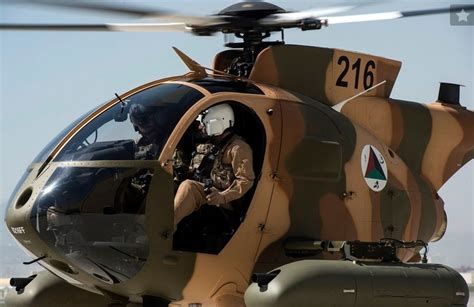
Past operators, such as Israel, Croatia, and the Afghan Air Force, phased out their fleets after decades of operational service, often due to attrition or platform modernization.
Technical Profile: A Study in Agility and Simplicity
At its core, the MD 500 Defender emphasizes simplicity, speed, and survivability. Its mechanical layout minimizes maintenance complexity while delivering impressive performance:
- Powerplant: Allison 250-C20B turboshaft engine, outputting 420 shp
- Rotor System: Two-blade main rotor, 8.04 meters in diameter
- Weight: Empty 686 kg; max takeoff weight (MTOW) 1,157 kg (normal), 1,361 kg (overload)
- Dimensions: Length 9.385 meters; height 2.654 meters
- Speed: Max 244 km/h; cruise 217 km/h
- Range: 589 km
- Ceiling: Service 1,340 m; hover IGE 2,500 m; OGE 1,600 m
Armament configurations vary but often include:
- Four BGM-71 TOW anti-tank missiles
- Two 7.62 mm minigun pods
- Two seven-shot rocket pods
- Four Stinger air-to-air missiles
- Lightweight Mk 44/46 torpedoes for ASW roles
These parameters allow the Defender to function in both low-intensity conflicts and peer-threat environments, particularly in scenarios requiring rapid deployment and light logistics.
A Helicopter That Refused to Fade
Despite the entry of heavier, faster, and more complex helicopters, the MD 500 Defender endures because of its nimbleness, cost-efficiency, and adaptability. It’s no coincidence that nearly 50 years after its first flight, new derivatives like the MD530F Cayuse Warrior and MD530G are still in production, particularly for export clients seeking proven counterinsurgency and ISR platforms.
Even today, the Defender remains a popular choice for defense modernization programs in nations with limited defense budgets but demanding security environments. Its ability to integrate modern weapons and sensor systems while retaining its small footprint makes it an ideal candidate for asymmetric warfare and agile operations.
Conclusion: A Small Helicopter with a Giant Footprint
The McDonnell Douglas MD 500 Defender is more than a helicopter—it is a strategic enabler. Built on a proven commercial and military platform, it offers a compelling blend of speed, firepower, and simplicity. As defense forces around the world recalibrate for light, mobile warfare, the Defender continues to earn its place on the front lines.
From the Bekaa Valley to the Pacific islands, and now into the unmanned age, the MD 500 Defender has proved again and again that agility, not mass, wins the future of battlefield aviation.