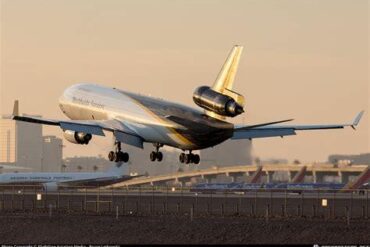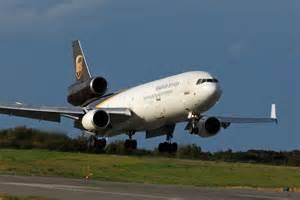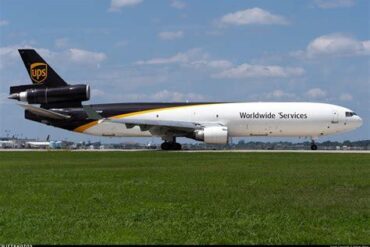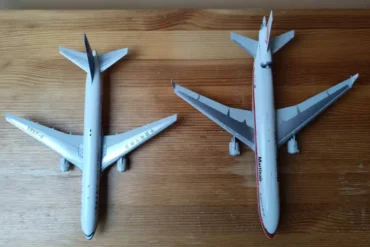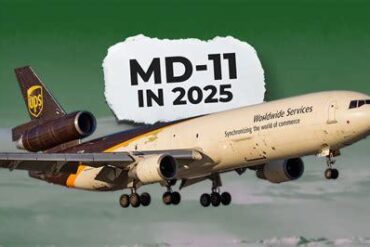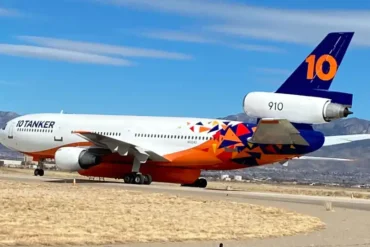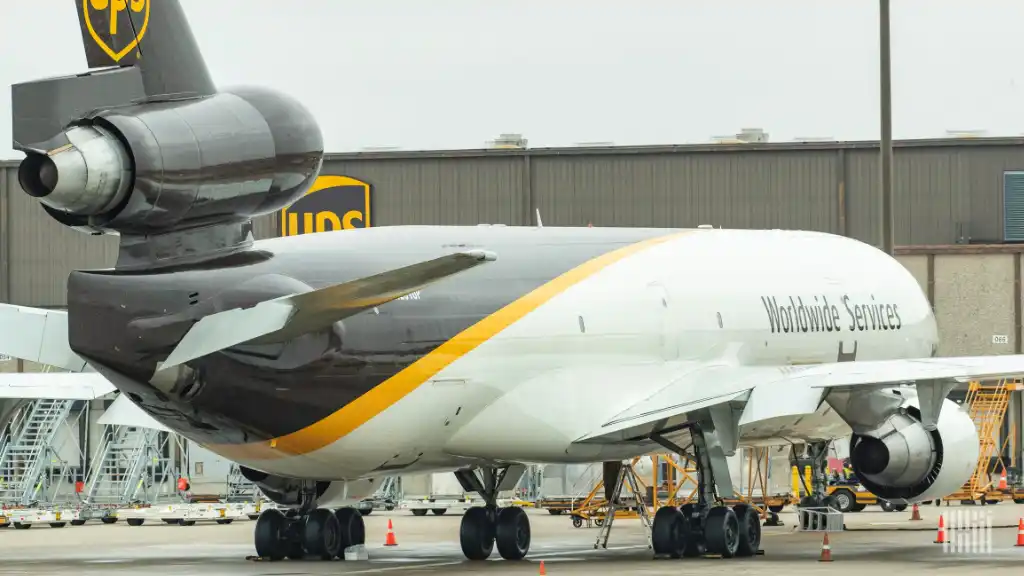
The McDonnell Douglas MD-11 occupies a curious niche in modern aviation: a relic of a bold trijet era that has otherwise vanished, yet still deeply embedded in the operational backbone of UPS Airlines. In a world ruled by sleek, fuel-efficient twin-engine freighters, the presence of more than two dozen aging MD-11Fs in UPS’s fleet raises an essential question: why does one of the world’s leading cargo carriers continue to depend on a design born in the 1980s? The answer lies in economics, engineering, operational pragmatism, and the strategic realities of global freight logistics.
The MD-11’s unique blend of structural strength, payload capacity, and acquisition cost still delivers tangible value in UPS’s network, even in 2025. Understanding the rationale behind UPS’s commitment to this aircraft requires tracing its evolution from a short-lived passenger jet to one of the most economically useful cargo platforms available in the second-hand market.
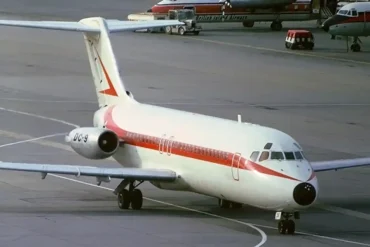
When McDonnell Douglas launched the MD-11 program in late 1986, the company intended it to be the successor to its widely successful DC-10. Rather than pursue a clean-sheet design, the manufacturer opted for a fast-track development strategy, updating the DC-10 airframe with a longer fuselage, winglets, modern avionics, and upgraded engines.
The aircraft entered commercial service with Finnair in 1990, marketed as an ultra-efficient long-range trijet capable of outperforming contemporary competitors like the Boeing 767. But the momentum of airline innovation was already shifting. Boeing and Airbus were preparing the 777 and A330—aircraft that would redefine efficiency, reliability, and range. The MD-11 simply couldn’t catch up.
Its fuel burn exceeded projections, range performance fell short, and the economics made it uncompetitive for passenger airlines.
Despite initial optimism, major carriers quickly began phasing out their MD-11 fleets. American Airlines, Delta Air Lines, and Japan Airlines all retired the type far earlier than planned. In passenger service, the MD-11 was considered a disappointment. But in the cargo world, its fortunes were about to change entirely.
From Misfit to Cargo Champion: How the MD-11 Found New Purpose
The very characteristics that undermined the MD-11’s passenger career became powerful assets when it transitioned into cargo operations. Cargo carriers do not prioritize the same mission profiles as passenger airlines, and the MD-11’s robust build and high maximum takeoff weight made it surprisingly effective as a freighter.
The jet’s MTOW of more than 602,000 pounds—remarkably high for its size—gives it a payload advantage unmatched by many newer twin-engine freighters in its class. Cargo operators value “weight efficiency” as much as volume, and the MD-11 excels at hauling dense freight loads over medium to long distances.
Moreover, because airlines were eager to retire their MD-11s, UPS and FedEx had access to the aircraft at heavily discounted acquisition prices. This created a unique opportunity: buy sturdy, structurally overbuilt long-range airframes cheaply, convert them to freighters, and operate them for decades at a fraction of the ownership cost of new jets.
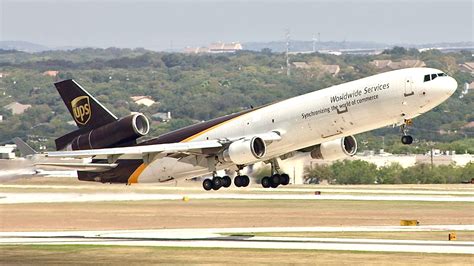
This advantage is still relevant today, especially as demand for air freight steadily grows.
Economic Logic: Fully Depreciated Aircraft That Still Earn Their Keep
UPS’s MD-11s are financially attractive because they are fully depreciated assets. That means all major acquisition and financing costs have already been absorbed or written off. While a brand-new Boeing 777F or 767F represents a multimillion-dollar investment with ongoing interest or lease expenses, the MD-11 requires only operational expenditures.
Those expenditures—fuel, crew, maintenance—are significantly lower on a total-cost basis than purchasing new aircraft. This economic reality makes each MD-11 an exceptionally profitable machine.
UPS doesn’t need the MD-11 to be the most fuel-efficient aircraft in the sky. It merely needs the aircraft to generate revenue at a low enough cost to justify its place in the fleet. And it still does.
Operational Strengths: The Trijet Works Well for UPS’s Network
UPS operates a complex global network shaped around package flows, overnight schedules, and peak demand cycles. In this system, the MD-11 plays multiple roles effectively.
First, UPS flies its MD-11s less frequently than passenger airlines flew them. Because cargo operations emphasize long-haul, overnight flying, the MD-11 experiences fewer takeoff and landing cycles. Fewer cycles mean less structural fatigue and lower long-term maintenance burdens. The aircraft’s lifespan stretches much farther than it would have in the passenger world.
Second, UPS runs many routes at night when airspace and airport congestion are minimal. The MD-11’s higher fuel burn is partially offset by shorter taxi times, smoother climbs, and efficient routing.
Third, the MD-11 fits perfectly into mission profiles involving lower-demand long-haul or volume-driven domestic routes, where its payload advantage and low ownership cost outweigh its extra fuel consumption.
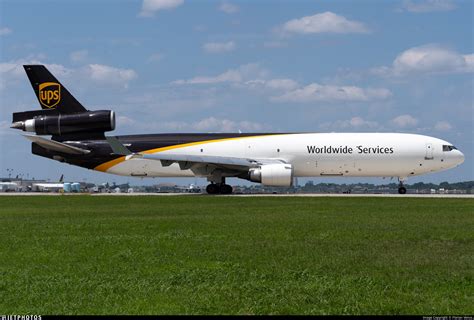
Structural over-engineering, inherited from its DC-10 lineage, also makes the MD-11 well suited to heavy freight that stresses an airframe far more than passenger luggage ever could.
Inside UPS’s MD-11 Fleet: Age, Origins, and Deployment
UPS currently operates 26 MD-11F aircraft, making it the second-largest operator after FedEx. The fleet’s average age is just over 30 years, with most airframes originally delivered in the 1990s. UPS’s oldest MD-11, registered N258UP, is more than 34 years old and began life at Thai Airways. The youngest, N262UP, flew first for Lufthansa and is approaching 25 years of service.
These aircraft represent a generation of widebody technology that predates the Boeing 777 entirely. Yet they continue to meet UPS’s reliability and performance needs.
UPS’s broader fleet includes 260 aircraft, including the Boeing 757, 767, 747, Airbus A300, and a smaller number of leased or specialized freighters. Within this ecosystem, the MD-11 occupies a strategic slot as a mid-capacity, long-range freighter that costs relatively little to operate.
The MD-11’s role is not glamorous, but it remains essential.
The 2025 Grounding and the Impact of Flight 2976
On November 4, 2025, tragedy struck when UPS Flight 2976, an MD-11F departing from Louisville, crashed shortly after takeoff following the detachment of its number one engine. The accident killed all three pilots on board and eleven people on the ground. In response, UPS immediately grounded all 26 of its remaining MD-11s.
The grounding has intensified scrutiny of aging trijet operations. While investigations are ongoing, the event accelerated internal and external discussions about the MD-11’s long-term viability. FedEx and Western Global Airlines also grounded their MD-11 fleets, temporarily removing 44 additional aircraft from the global cargo network.
Even before the accident, UPS had scheduled the retirement of five MD-11s by late 2025 and seven more by 2027. The remaining aircraft were expected to continue flying until 2029, though this timeline is now under review.
Preparing for the Next Era: UPS’s Fleet Modernization Strategy
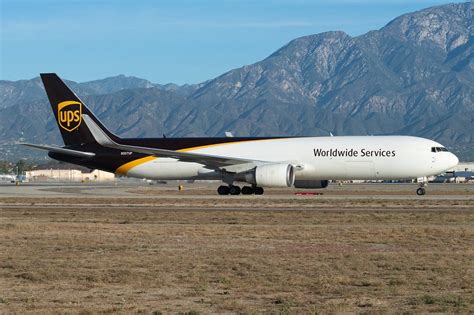
UPS is actively acquiring more Boeing 767-300F aircraft—at least 10 additional airframes—to reinforce its medium-widebody operations. The company also continues to rely on its 747-8F fleet for heavy-lift, ultra-long-haul missions and is evaluating future investments in the upcoming Boeing 777-8F.
Newer aircraft offer clear advantages in sustainability, fuel efficiency, and maintenance predictability. But they come with steep acquisition costs, and aircraft availability is constrained by production backlogs. The MD-11 thus remains a practical, cost-effective buffer as UPS transitions toward a more modern fleet.
Why UPS Still Values the MD-11—Despite Everything
The case for keeping the MD-11 in service rests on a pragmatic equation. Despite its age, the MD-11 offers:
- Fully depreciated ownership costs, making each flight more profitable
- High structural strength, ideal for dense freight loads
- Large payload capacity for its category
- Availability of spare parts thanks to the retirement of passenger fleets worldwide
- Proven operational reliability when maintained correctly
- Compatibility with UPS’s night-heavy, long-haul network
Even with modern aircraft entering service, no replacement matches the MD-11’s unique combination of low capital cost and high cargo utility. For an overnight express carrier that prizes profitability as much as performance, the MD-11 continues to be a dependable workhorse.
Looking Toward the MD-11’s Final Chapter
The MD-11 is firmly in the twilight of its career, but it remains far from obsolete. UPS’s current projections show the type retiring entirely by 2029—a remarkable lifespan for an aircraft widely considered a disappointment during its passenger years.
FedEx seems likely to operate its MD-11s into the early 2030s. Western Global Airlines will follow a similar path, keeping its trijets until maintenance economics or regulatory pressures force a change.
The MD-11 may not have fulfilled its initial promise as the future of commercial aviation, but it has carved out a different legacy: one of resilience, adaptability, and long-term value in the global freight market. As long as the economics make sense and the airframes remain structurally sound, UPS will continue to extract every last dollar of efficiency from this unlikely champion.
Its retirement will mark the end of the trijet era in commercial cargo operations. And when the final UPS MD-11 lifts off for the last time, it will carry with it a legacy defined not by what it failed to be, but by what it ultimately became—one of the most effective cargo platforms of its generation.