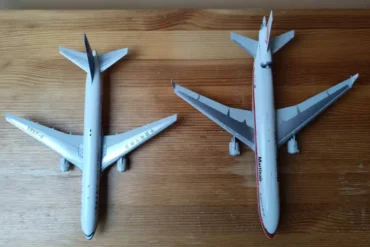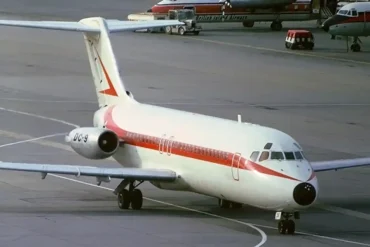
The McDonnell Douglas MD-90 occupies a strange, almost ghostlike space in commercial aviation history. It was not a failure in the traditional sense. It flew reliably for decades in the hands of a determined operator. It carried millions of passengers. It represented a genuine technological evolution over its predecessor. And yet, only 116 aircraft were ever built. In an industry where competitors sold thousands, that number feels almost mythical—like a limited production concept car that somehow made it into airline service.
Understanding why the MD-90 became such a rare aircraft requires stepping into a transitional moment in aviation—when technology, economics, corporate mergers, and market timing collided in ways that quietly sealed its fate.
The MD-90’s Place in the DC-9 Family Tree
The MD-90 was the third-generation descendant of the Douglas DC-9, an aircraft that first flew in 1965. The DC-9 was a rugged, efficient short-haul jet designed for smaller airports and shorter runways. Its signature features—a T-tail, rear-mounted engines, and a narrow five-abreast cabin—defined an entire family line.
The MD-80 series extended that design in the 1980s. It was longer, more powerful, and sold extraordinarily well—nearly 1,200 units delivered. For a time, it competed effectively against early Boeing 737 Classic models and the emerging Airbus A320.
The MD-90 was supposed to be the logical next step. It stretched the fuselage even further to 152 feet 7 inches (46.5 meters)—longer than today’s Airbus A321-200—while maintaining the DC-9’s narrow fuselage. Passenger capacity landed in the A320-200 range, but within a slimmer cross-section.

Technically, the aircraft was modernized. It adopted the IAE V2500-D5 turbofan, a high-bypass engine also used on Airbus A320 variants. It featured improved avionics and optional glass cockpit upgrades. It promised better fuel burn than the MD-80’s older Pratt & Whitney JT8D engines.
On paper, this was not a relic. It was an evolution.
But evolution in aviation is brutal. The strongest designs survive. The rest fade into footnotes.
A Narrowbody Caught Between Generations
Timing matters in aerospace more than almost any other industry. The MD-90 entered service in the mid-1990s, but its conceptual DNA was still anchored in the 1960s.
The Airbus A320 family, introduced in 1988, had already revolutionized the narrowbody market with:
- Fly-by-wire flight controls
- A modern, wide cabin cross-section
- Advanced cockpit automation
- Multiple size variants (A318, A319, A320, A321)
Meanwhile, Boeing was preparing the 737 Next Generation (737NG) family, which would dramatically improve range, avionics, and efficiency.
The MD-90, by contrast, retained the MD-80 wing. That decision limited range and field performance. Fuel capacity remained constrained. Airlines increasingly wanted flexibility—the ability to fly coast-to-coast or operate from hot-and-high airports. The MD-90’s performance envelope simply did not stretch far enough.
It was not dramatically inferior. It was strategically misaligned.
In commercial aviation, “almost competitive” translates to “commercially endangered.”
The Engine Gamble That Backfired
The adoption of the IAE V2500-D5 engine was intended to modernize the platform and align it with industry trends. High-bypass turbofans promised lower fuel burn and quieter operations.
Yet early reliability problems plagued the V2500-D5 in MD-90 service. Airlines experienced maintenance headaches. Parts availability was inconsistent. Engine overhauls were expensive. When reliability falters in airline operations, reputations harden quickly.
Compounding the issue, the MD-90 introduced a completely new electrical system that also suffered early technical issues. The result was a reputation as a “hangar queen”—an aircraft spending more time undergoing maintenance than flying revenue missions.
Reputations in aviation behave like gravitational fields. Once established, they are difficult to escape.
The Market Was Shrinking When It Needed to Grow
The early 1990s were not kind to aircraft manufacturers. The global airline industry was recovering from recession, restructuring, and weak passenger demand. Airlines were cautious. Orders were conservative.
McDonnell Douglas launched the MD-90 with strong backing from Delta Air Lines, which initially ordered 50 aircraft with 110 options. Delta intended to replace aging Boeing 727s.
Then restructuring hit. Financial pressures mounted. Delta ultimately took delivery of only 16 new-build aircraft from its original order.
Losing that scale mattered enormously. Aircraft programs rely on production volume to amortize development costs. When launch customers shrink commitments, the economics unravel quickly.
Without sustained large orders, the MD-90 program lost momentum. Airlines watching from the sidelines saw limited uptake and hesitated further. Commercial aviation is deeply influenced by herd behavior; fleet commonality and global support networks matter as much as performance.
The Fleet Size Problem: Economics at Scale
Only 116 MD-90s were built worldwide. That number created structural disadvantages.
Operating a small fleet introduces high per-aircraft costs for:
- Spare parts inventory
- Pilot training programs
- Maintenance certification
- Engineering support infrastructure
An airline with six or twelve MD-90s faced disproportionately high support costs compared to carriers operating hundreds of A320s or 737s.
Delta eventually grew its fleet through aggressive acquisition of second-hand units between 2010 and 2013, expanding to 65 operational aircraft, plus 13 airframes for parts. But Delta was uniquely positioned. Its TechOps division possessed deep expertise with DC-9 derivatives.
Other airlines did not share that institutional familiarity. Without scale, the MD-90 became an operational outlier.
Airlines prefer ecosystems. The MD-90 became an island.
The Boeing Merger: A Corporate Pivot
In 1997, Boeing merged with McDonnell Douglas. From a strategic perspective, Boeing was primarily interested in McDonnell Douglas’ military division, which included iconic platforms such as:
- The C-17 Globemaster III
- The F-15 Eagle
- The F/A-18 Hornet
The commercial division was less attractive. Boeing already had the 737 family covering the narrowbody segment. Continuing development of the MD-90 risked internal competition.
The result was predictable. Boeing prioritized its own products. The MD-90 program quietly wound down. The smaller MD-95 was rebranded as the Boeing 717, but it too struggled in a market dominated by Airbus and the increasingly capable 737NG family.
The MD-90 did not die in a dramatic cancellation announcement. It simply stopped being a strategic priority.
Corporate gravity can be as powerful as aerodynamic lift.
Why Delta Made It Work
Delta Air Lines deserves attention for extracting value from the MD-90 long after most carriers had moved on.
Following the Great Recession, Delta faced a capital allocation choice: purchase brand-new aircraft at high cost, or acquire used MD-90s at deeply discounted prices. The economics favored the latter.
Used MD-90s could be purchased cheaply while offering operating costs comparable to newer A320-200s and 737-800s. Delta expanded its fleet dramatically, integrating the aircraft into hubs such as:
- Atlanta
- Salt Lake City
- Minneapolis
- Detroit
The MD-90 shared cockpit commonality with the MD-88, simplifying pilot training. Delta configured the cabin with 16 First Class seats, 25 Comfort+ seats, and 117 economy seats, making it well-suited for domestic trunk routes.
For Delta, the MD-90 became a pragmatic bridge—an aircraft that delivered capacity without massive capital outlay.
But even Delta could not overcome long-term structural challenges.
The Final Years and the Pandemic’s Acceleration
As the 2010s progressed, aftermarket support for the V2500-D5 engines became more expensive. Maintenance complexity increased. Delta began retiring MD-90s in 2017, replacing them with the Airbus A321-200.
The COVID-19 pandemic accelerated fleet simplification across the industry. In June 2020, Delta operated the world’s final commercial MD-90 flight, from Houston to Atlanta.
An aircraft that once symbolized modernization quietly exited the stage.
No dramatic farewell tour. Just an efficient retirement decision in extraordinary times.
Structural Limitations That Couldn’t Be Fixed
Several fundamental characteristics ensured the MD-90’s rarity:
The wing, inherited from the MD-80, limited performance improvements. Unlike Airbus and Boeing, which iterated aggressively on aerodynamics, McDonnell Douglas relied heavily on stretching existing structures.
The fuselage cross-section, narrower than competitors, restricted cargo flexibility and passenger comfort perception compared to the wider A320.
The lack of family variants reduced market flexibility. Airbus and Boeing offered multiple sizes within a unified cockpit ecosystem. The MD-90 came essentially in one primary configuration.
Airlines prefer platforms, not single-use solutions.
A Transitional Aircraft in a Transformational Era
The MD-90 arrived during a moment of technological transformation. Fly-by-wire systems were redefining cockpit philosophy. Digital avionics were becoming standard. Airlines were standardizing fleets around global support networks.
The MD-90 was modernized, but it was not revolutionary. It was evolutionary in an era demanding leaps.
There is a subtle but important distinction between “updated” and “reimagined.” The A320 was reimagined. The 737NG was reengineered and optimized. The MD-90 was updated within structural boundaries set decades earlier.
In competitive markets, architectural flexibility wins.
Why the MD-90 Still Matters
Rarity does not equal irrelevance. The MD-90 represents the final stretch of a design lineage that began in the 1960s and shaped short-haul aviation for decades. Its T-tail silhouette and rear-mounted engines were instantly recognizable. It preserved a design philosophy that valued rugged simplicity.
For aviation historians and enthusiasts, the MD-90 marks the end of the DC-9 bloodline. For Delta, it was a strategic asset during a period of disciplined growth. For manufacturers, it stands as a case study in how timing, market conditions, corporate mergers, and incremental design decisions can combine to limit even technically competent aircraft.
The MD-90 was rare not because it failed outright, but because it existed at the intersection of shifting industry tectonics.
A narrowbody caught between eras.
A derivative in a decade demanding reinvention.
A capable aircraft without a large ecosystem to sustain it.
In a world where thousands of A320s and 737s dominate global skies, the McDonnell Douglas MD-90 remains a reminder that aviation history is not written solely by technical merit. It is written by scale, strategy, timing, and sometimes sheer corporate gravity.
And that is precisely why the MD-90 became one of the rarest mainline jets of the modern age.