Missed Approach
Description
When an approach or landing cannot be safely completed, pilots must execute a missed approach or go-around. There are various reasons for this decision:
-
The necessary visual references are not established by the Decision Altitude/Height (DA/DH) or Minimum Descent Altitude/Height (MDA/MDH), or they are lost after being established.
-
The approach or landing becomes unstable.
-
The aircraft’s position does not allow for a safe touchdown within the designated runway zone, posing a risk of damage.
-
The runway is obstructed.
-
Landing clearance is not received or is canceled after being granted.
-
A go-around is performed for training with ATC approval.
Missed Approach Procedure
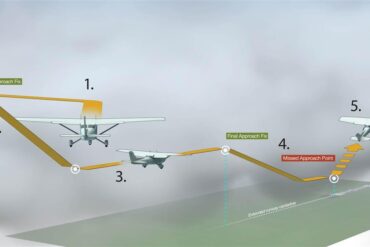
A missed approach procedure outlines what to do if an approach cannot continue. It specifies where the missed approach starts and where it ends, as detailed in ICAO Doc 8168: PANS-OPS. Every airfield has a specified missed approach for both Precision and Non-Precision approaches, considering ground obstacles and nearby air traffic.
Typically, there is one primary missed approach procedure for each instrument approach. Alternate procedures may also be available, often used when the primary navigation aid fails. Generally, pilots should follow the published missed approach unless ATC directs otherwise or safety dictates a different course.
If a missed approach is initiated below the DA/H in precision approaches or beyond the missed approach point (MAPt) in non-precision approaches, pilots must evaluate whether they can safely follow the published procedure or need a special routing, especially in emergencies like engine failure. If a missed approach happens before reaching the MAPt, it’s crucial to proceed to the MAPt and then follow the missed approach procedure to stay within protected airspace. The MAPt is defined by the intersection of an electronic glide path with the applicable DA/H in precision approaches or a navigation facility or fix in non-precision approaches.
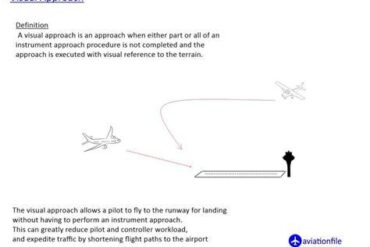
A visual go-around can occur after a failed visual approach if no published missed approach is available. Go-arounds can be unexpected, placing significant demands on pilots who may not practice this procedure frequently outside of simulators. Important aspects to study include:
-
Conducting a manual go-around
-
Executing a go-around from low airspeed or thrust
-
Transitioning to instrument flying
-
Monitoring and coordinating during go-around initiation
-
Understanding initial level-off altitude versus pitch attitude and thrust settings
-
Being aware of fuel levels and available options
In emergencies during the final stages of an approach, pilots may continue to land. However, in situations like configuration issues (flaps or gear), it might be wiser to perform a missed approach, complete necessary drills, and prepare for either a second landing attempt or diverting to a safer airport.
Accidents and Incidents
Several noteworthy events related to missed approaches have occurred:
-
A321, Abu Dhabi UAE, 2023: On April 29, an Airbus A321 attempted a go-around after a tail strike due to improper pitch control during a low-speed approach. Confusion over the aircraft’s status led to significant dual sidestick input without a control transfer. After climbing, the crew successfully completed the circuit.
-
B38M, London Stansted UK, 2023: On December 4, a Boeing 737-8200 crew misjudged their ILS approach and began a go-around, climbing above the 3,000 feet altitude they had failed to set until alerted by ATC. Following a near-miss, they leveled at 3,000 feet and completed the approach normally.
-
B738 / E195, Sao Paulo Congonhas Brasil, 2020: On December 3, an Embraer 195-200 was cleared to land on a runway occupied by a Boeing 737-800. The E195 crew was instructed to go around only after prompting from the 737 crew, resulting in dangerously close proximity between the two aircraft.
-
F70, Port Moresby Papua New Guinea, 2023: On February 20, a Fokker 70 realized too late that the landing altitude was not set, leading to a go-around. A rapid increase in cabin pressure resulted in multiple passenger injuries, which were eventually resolved.
-
AT72, East Midlands UK, 2023: On January 17, an ATR 72-200 experienced significant electrical malfunctions during a CAT 2 ILS approach, leading to a successful diversion to Birmingham.
-
B738, Billund Denmark, 2023: On December 21, a Boeing 737-800 experienced a flap system malfunction during a night go-around, requiring a MAYDAY declaration due to low fuel reserves before landing safely.
-
A320 / P28A, Seville Spain, 2022: On October 6, a student pilot mistakenly entered an active runway, prompting a call from an Airbus A320 that was cleared to land, resulting in a go-around.
-
B737 / B763, Austin USA, 2023: On February 4, a Boeing 767-300 initiated a go-around in poor visibility, narrowly avoiding a collision with a departing Boeing 737-700.
-
A320 / B738, Barcelona Spain, 2022: On April 29, an A320 and a B737-800 came dangerously close at night due to improper communication and procedural adherence by ATC.
-
A320 / DR40, Bordeaux France, 2022: On December 31, an A320 nearly collided with a stationary light aircraft during landing, prompted to go around only after a concerned pilot’s call.
-
A320, Pointe-à-Pitre Guadeloupe, 2022: On February 11, an A320 initiated a go-around after descending below the minimum safe altitude, highlighting poor decision-making.
-
B738 / B738, Sydney Australia, 2023: On April 29, a delayed takeoff clearance resulted in a go-around due to reduced separation between two Boeing 737-800s.
-
B38M / Vehicle, Toronto Canada, 2022: On October 15, an airport vehicle entered an active runway, necessitating a go-around by a Boeing 737-8 on short final.
-
CL60, London Stansted UK, 2022: On January 31, a Bombardier Challenger 604 experienced a bounced landing and runway excursion due to premature flare and loss of control.
-
B773, Batam Indonesia, 2022: On October 25, a Boeing 777-300ER declared a ‘MAYDAY Fuel’ while attempting to land in deteriorating weather after a delayed diversion.