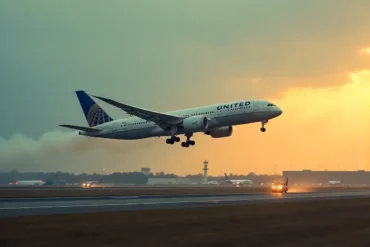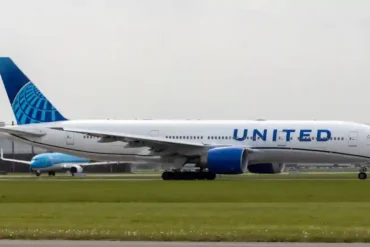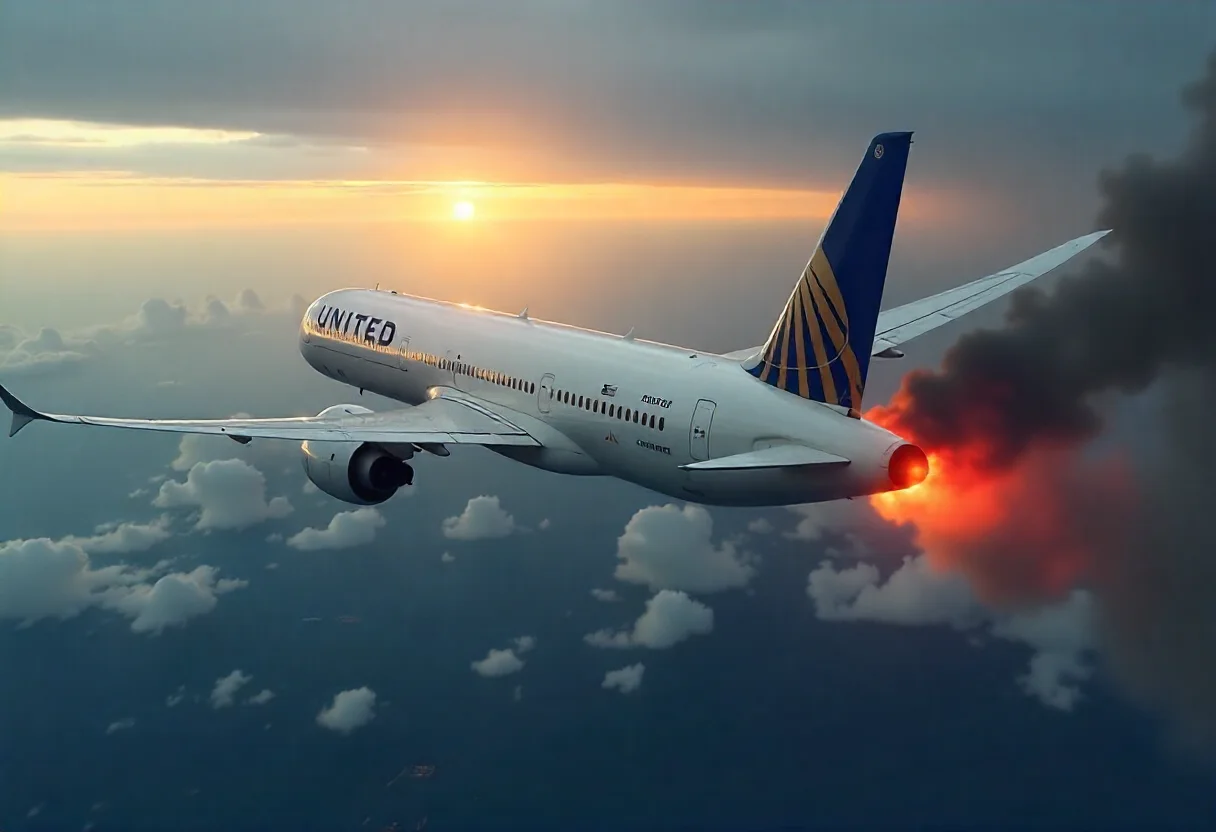
On July 25, 2025, United Airlines Flight UA108, a Boeing 787‑8 Dreamliner en route from Washington Dulles International Airport (IAD) to Munich Airport (MUC), experienced a critical left‑engine failure at approximately 5,000 feet. Within seconds of detecting abnormal vibrations and warning indications, the crew declared MAYDAY, initiating an immediate response that would test both their training and the robustness of modern safety protocols. Despite the gravity of the situation, decisive action by the pilots and seamless coordination with air traffic control (ATC) ensured a controlled fuel dump, a climb to 6,000 feet, and a precision Instrument Landing System (ILS) approach to Runway 19 Center at Dulles. The Dreamliner touched down safely and was towed off the runway with no injuries reported.
Flight UA108’s Emergency Declaration and Response
The moment the left engine suffered a sudden loss of thrust, the cockpit crew swiftly assessed instrument readings and recognized the engine was no longer producing sufficient power. Without hesitation, they declared MAYDAY, the international distress call reserved for life‑threatening emergencies, and alerted ATC to their intent to return to Dulles. The decision to dump fuel was taken to reduce landing weight, a maneuver that requires precise timing and altitude management to avoid structural stress. ATC vectored UA108 into a holding pattern clear of other traffic, allowing the crew to jettison excess fuel safely. Once the aircraft reached the optimal weight, the pilots requested vectors for an ILS approach. Against the backdrop of rising alarm across the cabin, flight attendants reassured passengers in calm tones, underscoring the value of crew coordination under pressure.
Technical Anatomy of the 787‑8 Engine Failure
The Boeing 787‑8 is equipped with either Rolls‑Royce Trent 1000 or GE Aviation GEnx engines, both designed for high efficiency and low emissions. In UA108’s case, the fault originated in the left GEnx engine’s high‑pressure turbine section, where a blade root fracture triggered rapid loss of compressor pressure. Such a failure can result from manufacturing defects, metal fatigue, or undetected debris ingestion. An immediate shutdown was necessary to prevent cascading damage. Once the crew isolated the engine, they followed the emergency checklist to secure fuel flow and electrical drives connected to the faulty unit. Though the Dreamliner’s redundant systems allow continued operation on a single engine, the severity of the malfunction mandated a full return to base.
Comparing Recent 787 Incidents Worldwide
In recent years, the Dreamliner fleet has faced several high‑profile engine and system anomalies, prompting industry‑wide scrutiny:
- On June 12, 2025, Air India Flight 171 suffered a catastrophic dual‑engine failure shortly after departing Ahmedabad. An inadvertent activation of fuel cutoff switches led both engines to flame out, causing a crash that claimed 241 lives onboard and 19 on the ground. Investigators point to potential design vulnerabilities in the fuel control system and inadequate crew alerts during critical phases of flight.
- In November 2021, an El Al 787‑9 departing Bangkok registered a fuel‑leak warning light. Erring on the side of caution, the crew shut down the affected engine and diverted to Goa, where ground inspections found no leak. The episode highlighted the sensitivity of engine‑monitoring sensors and the need for improved fault‑filtering algorithms.
- All Nippon Airways (ANA) encountered a rare dual‑engine shutdown on a 787‑8 during landing in 2019. Activation of thrust reversers appeared to trigger a software anomaly that placed both Rolls‑Royce Trent 1000 engines into idle mode. Although safely landed, the incident spurred software validation reforms.
- In June 2025, an Ethiopian Airlines 787 experienced mid‑air depressurization en route to Mumbai, forcing an emergency descent. While unrelated to engine function, the event underscored the interconnected challenges of modern aircraft system monitoring.
- A 2024 Air Canada 787 presented an engine fire on the runway shortly after landing. Rapid ground response extinguished the blaze, but the scare revived debates about on‑wing fire detection and suppression systems.
Together, these cases illustrate that even the most advanced jets remain susceptible to mechanical, software, and human‑machine interface failures.
The Imperative for Engine Design Innovations
GE Aviation and Rolls‑Royce, the principal engine suppliers for the 787 series, have invested heavily in next‑generation materials and cooling techniques aimed at extending inspection intervals and reducing the risk of turbine‑blade fatigue. Recent upgrades include advanced ceramic matrix composites (CMCs) in hot‑section components and enhanced blade‑root fillet geometries to distribute stress more evenly. Ongoing research into real‑time health‑monitoring sensors promises to alert maintenance crews to early signs of wear or foreign object damage before catastrophic failure.
However, technological advances alone cannot eliminate risk. Airlines and manufacturers must collaborate on accelerated fatigue testing, supply‑chain inspections, and predictive maintenance models driven by big‑data analytics. By integrating flight‑data recorder outputs with machine‑learning algorithms, operators can anticipate anomalies and schedule service proactively, minimizing unscheduled groundings and bolstering passenger confidence.
Crew Training and Emergency Protocols Under the Microscope
The flawless execution of UA108’s emergency landing underscores the critical role of rigorous pilot training and standardized checklists. Simulator scenarios now routinely expose crews to compound emergencies—engine failures compounded by hydraulic or electrical anomalies—to prepare for real‑world complexity. Likewise, cabin crews undergo specialized drills for passenger briefings, brace‑position commands, and post‑landing evacuation procedures. Industry regulators are considering mandating recurrent multi‑crew, multi‑threat simulations to ensure that even veteran crews maintain peak readiness for low‑probability, high‑consequence events.
Moreover, ATC’s role in orchestrating emergency returns cannot be overstated. In UA108’s case, controllers quickly rerouted traffic, provided clearances for fuel dumping, and guided the Dreamliner through a precision ILS approach, all while deconflicting airspace and liaising with ground emergency services. Improved digital data links between ATC and flight decks, offering real‑time aircraft performance metrics, can further streamline responses and reduce pilot workload during crises.
Regulatory Oversight and Future Safety Mandates
In the wake of multiple 787 mishaps, the FAA, EASA, and other civil aviation authorities are ramping up audit schedules for both engine manufacturers and airlines. Proposed measures include shorter inspection intervals for critical hot‑section turbine components, mandatory software integrity audits for flight‑control systems, and enhanced third‑party oversight of parts suppliers. Public hearings are underway to evaluate stricter airworthiness directives targeting blade‑root inspection techniques and to refine emergency‑response time benchmarks for airports serving wide‑body jets.
Passenger advocacy groups are also pressuring regulators to publish redacted flight data summaries and post‑incident analyses, arguing that transparency accelerates industry learning. As a result, we may see a shift toward open‑data platforms where anonymized maintenance and incident records inform global best practices.
Sustaining Passenger Confidence in the Dreamliner Era
Despite occasional high‑profile failures, the Boeing 787 Dreamliner remains one of the safest and most efficient long‑haul aircraft in operation. Its composite fuselage, advanced avionics, and improved cabin environment have redefined passenger comfort and airline economics. To preserve public trust, carriers must communicate openly about safety initiatives, maintenance rigor, and the low statistical likelihood of engine‑related emergencies.
Onboard announcements, safety videos, and post‑flight debriefs can incorporate brief explanations of redundant systems and emergency procedures, reassuring travelers that multifaceted safeguards exist. Airlines might also offer voluntary factory tours, virtual reality experiences, or in‑flight seminars led by engineers to demystify the technology that underpins modern aviation.
Conclusion: Charting a Safer Course for 787 Operations
The emergency declared by United Airlines Flight UA108 on July 25, 2025, serves as a powerful reminder that vigilance and innovation must remain paramount in aviation. While the crew’s expert handling averted disaster, the incident joins a growing list of events that challenge complacency and drive continuous improvement. By harnessing cutting‑edge materials science, refining software validation processes, expanding simulator‑based training, and reinforcing regulatory standards, the industry can strengthen the integrity of the Boeing 787 fleet. In doing so, airlines and manufacturers will honor the fundamental promise of air travel: to carry every passenger—and every dream—safely to its destination.