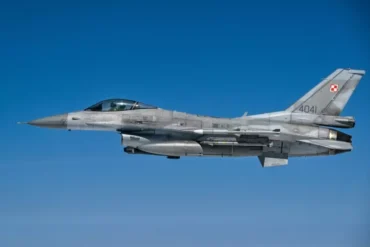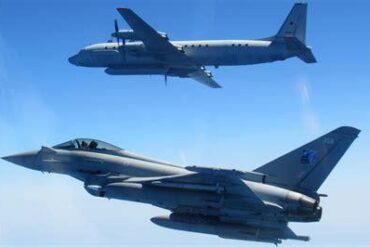
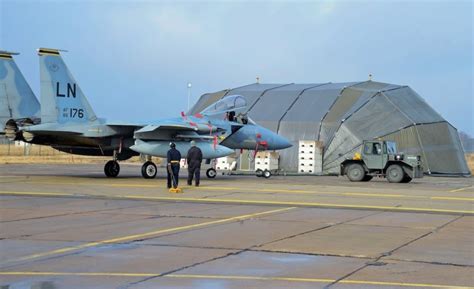
At approximately 11:30 local time on July 10, 2025, Lithuanian radar systems detected a low-flying, unidentified aerial object crossing from Belarusian airspace into Lithuania. Within minutes, NATO fighters conducting routine patrols under the Baltic Air Policing Mission were ordered into a heightened state of readiness. Although the response was rapidly initiated, the mission was aborted shortly after the object crash-landed near the closed Shumsk border checkpoint, situated roughly one kilometer from the Belarusian border.
A Suspicious Flight Across a Tense Border
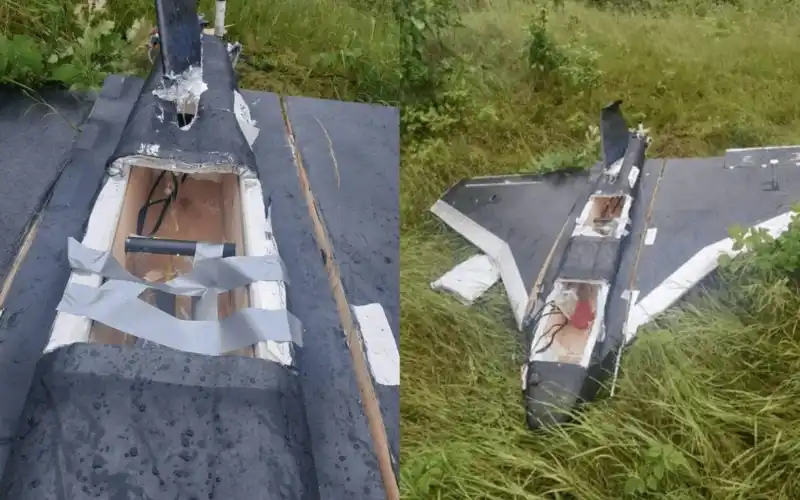
According to reports from the Lithuanian State Border Guard Service, the aircraft appeared to descend suddenly and crash without delivering any payload or causing physical harm. Border guards at the Kena checkpoint, stationed in the Vilnius district, were the first to visually confirm the object’s descent. Within the hour, troops were deployed to secure the crash site, and an early assessment revealed something startling: the aircraft, initially suspected to be a Shahed-136 loitering munition, was in fact a makeshift, rudimentary flying device constructed primarily from foam and plywood.
Lithuanian Authorities Identify the Mystery Craft
Upon closer inspection, Lithuanian Armed Forces confirmed the aerial vehicle was not a combat drone, but a homemade object mimicking a kamikaze drone in form—but not in function. Their official statement indicated, “The object is likely homemade and is not dangerous.”
Despite its seemingly amateur construction, analysts drew comparisons between the downed aircraft and the Gerbera UAV, a Russian-manufactured decoy drone. These are low-cost replicas of the Iranian-designed Shahed-136, frequently used in Ukraine by Russian forces to saturate and mislead air defenses. The Gerbera is built in Tatarstan, reportedly using Chinese engines and Western electronic components, and is designed to replicate the radar signature of more lethal drones.
Airspace Breach Triggers Governmental Precaution
The aerial incursion triggered an immediate security lockdown in Vilnius. Prime Minister Gintautas Paluckas and Parliament Speaker Saulius Skvernelis were briefly escorted to secure shelters by the Lithuanian Public Security Service. Though no explosion occurred and no hostile payload was identified, the incident served as a sobering test of Lithuania’s rapid-response mechanisms and its coordination with NATO.
Meanwhile, NATO fighters that had been in training mode at the time of detection were swiftly switched to task mode under air policing directives. Their mission was aborted once confirmation came in that the object had already fallen. However, the speed and decisiveness of the reaction reflected the heightened vigilance of NATO’s eastern flank.
Context: NATO’s Fragile Frontline with Belarus
Since Russia’s full-scale invasion of Ukraine in February 2022, NATO has significantly bolstered its surveillance and readiness along its eastern borders. In the last two years, repeated airspace breaches—ranging from stray missiles to misfired drones—have prompted reinforced air defense deployments across Poland, Romania, and the Baltic States.
Lithuania, in particular, has emerged as a frontline state, with Belarus serving as a strategic buffer for Russian military logistics and hybrid operations. The close proximity of Vilnius to the Belarusian border makes it a key vulnerability point. The frequent presence of NATO fighters in Lithuanian skies is now routine, aimed at deterring potential incursions or escalations.
Homemade or Hybrid Threat?
While the aircraft was described as non-lethal and carrying no cargo, defense experts have warned not to underestimate the strategic intent behind such launches. Whether it was a failed reconnaissance drone, a decoy test, or a smuggling cover, its penetration of NATO airspace signals a provocative gesture that tests reaction speed, radar coverage, and political resolve.
Notably, the Gerbera UAV—which the downed craft closely resembles—has been used extensively in Ukraine, especially to overwhelm radar systems before actual kamikaze drones are deployed. Their signature on radar is designed to mimic more dangerous threats, complicating air defense decisions and potentially triggering costly defensive actions against cheap decoys.
Heightened Smuggling Activities Using Aerial Vehicles
Beyond military applications, Lithuanian authorities have been facing a sharp rise in cross-border smuggling via aerial means. According to the State Border Guard Service, 30 drones have already been seized in 2025 transporting illegal cigarettes from Belarus—continuing a troubling trend from 2024 when 54 such drones were intercepted.
The adaptation of unmanned aerial systems by smugglers further complicates the border surveillance landscape. As these UAVs become more technologically sophisticated yet inexpensive, their dual-use potential—both for espionage and illicit trade—has turned them into a growing concern for Lithuania and its NATO allies.
Political and Strategic Ramifications
The incident arrives at a time when Lithuania is already under domestic and international pressure to maintain high defense standards amid escalating geopolitical tension. For local leaders, the breach represents both a public safety alarm and an opportunity to reinforce their commitment to NATO’s collective defense protocols.
Moreover, this event could reignite discussions within the NATO alliance regarding rules of engagement for aerial incursions by non-state or ambiguous actors. With drones and UAV-like devices increasingly blurring the lines between military attack and civil disruption, crafting clear engagement policies becomes critical.
The Bigger Picture: Drones as Hybrid Warfare Tools
The downed aircraft, though seemingly harmless, fits into a larger pattern of asymmetric and hybrid tactics employed by Russia and its allies. Using cheap, radar-visible UAVs to bait NATO air defense responses is a technique aimed at creating confusion, wasting resources, and probing the limits of NATO’s tolerance.
Such operations—while deniable and non-lethal—can be strategically disruptive. They demand intelligence coordination, public messaging, and at times, political intervention, turning an otherwise insignificant crash into a multi-layered security event.
This blurring of lines between military aggression and civilian disruption, especially with homemade aerial vehicles, creates an environment where constant readiness becomes the norm, and each incident must be treated with the same seriousness as a traditional military incursion.
Conclusion: A Warning, Not an Accident
While no one was hurt and the aircraft turned out to be non-threatening, the airspace breach on July 10, 2025, is a wake-up call for Lithuania and NATO alike. It underscores the complexity of modern aerial threats, the vulnerability of border states, and the need for robust detection, response, and diplomatic escalation frameworks.
As low-cost UAV technology continues to evolve and proliferate, future incursions may carry payloads—if not of explosives, then of misinformation, disruption, or strategic provocation. The skies over Eastern Europe are no longer just a battlefield of machines, but a contested space where every unidentified object can be a signal, a test, or a message.