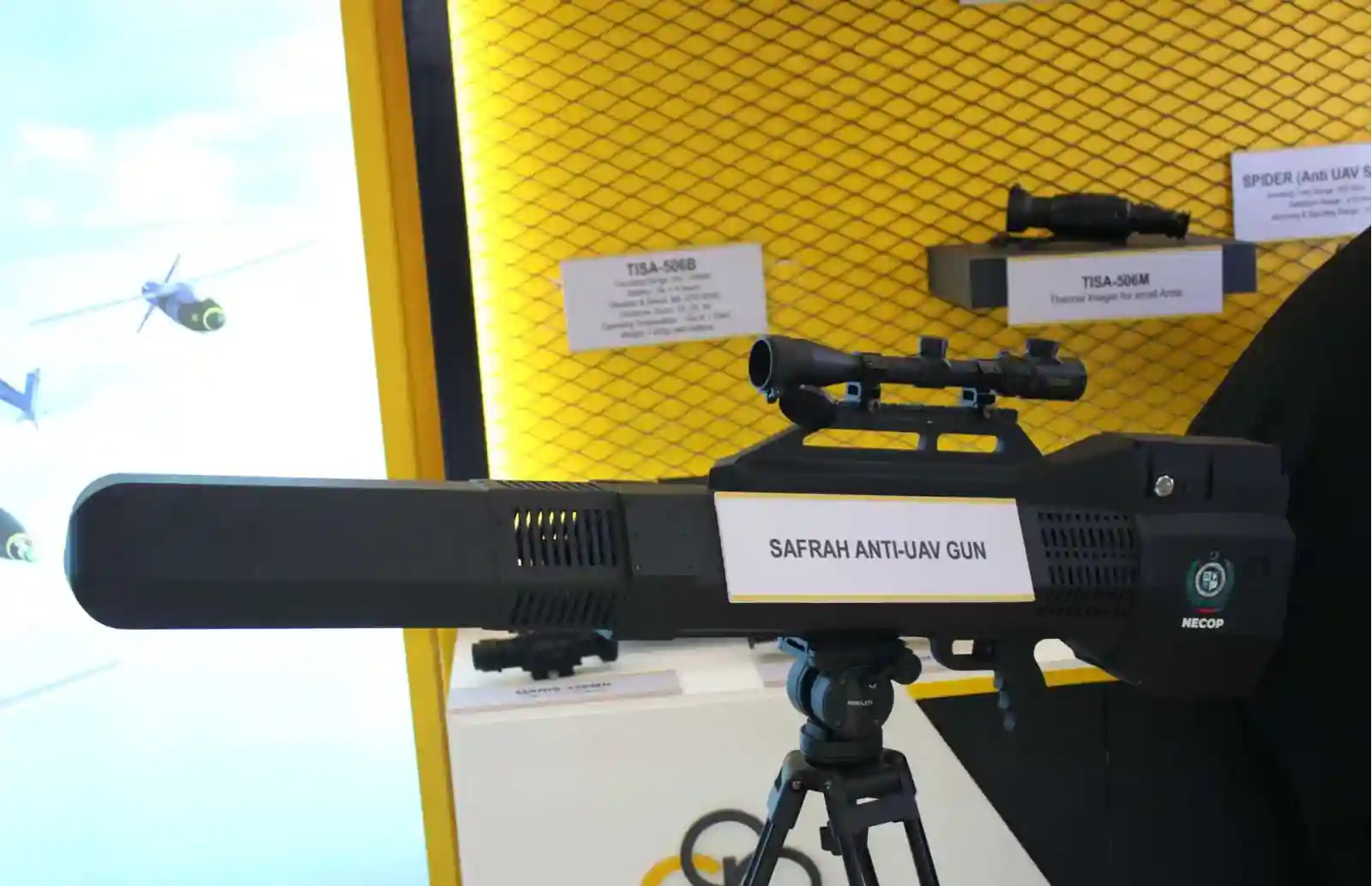
At EDEX 2025 in Cairo, Pakistan presented one of its most consequential counter-UAV innovations to date: the Safrah Drone Jamming Gun, a handheld directional effector engineered to neutralize commercial and improvised drones at ranges up to 1.5 kilometers. Developed by the National Electronics Complex of Pakistan (NECOP) and showcased on the GIDS stand, Safrah’s battlefield pedigree and focused jamming power drew steady attention from military delegations across Africa, the Middle East, and South Asia.
Safrah enters the global counter-drone market at a moment when lightweight, quickly deployable anti-UAV tools have become indispensable for border security units, infantry platoons, and critical-infrastructure protection forces. Unlike experimental systems still seeking validation, Safrah arrives with documented operational use on Pakistan’s western border, where it reportedly disrupted multiple kamikaze drone attacks earlier in 2025. That real-world performance has accelerated export interest, with the first confirmed buyers coming from African nations now facing escalating drone incursions.
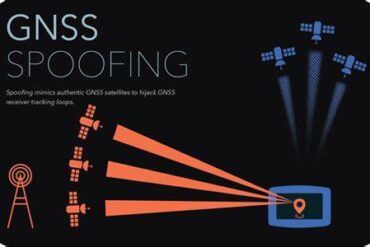
Safrah’s design philosophy centers on delivering maximum disruption power through a compact, man-portable platform. The gun integrates three high-gain directional antennas, each tuned to sever a specific category of drone communication links. NECOP lists its active jamming bands as 1560–1620 MHz for GPS denial and 2.4 GHz and 5.8 GHz for control and video links—precisely the frequencies relied upon by commercial quadcopters and many improvised FPV attack drones.
Each band is driven by a 30-watt transmitter, producing focused jamming energy strong enough to overpower drone radio links without the need for external amplifiers or cumbersome power modules. Operators can trigger continuous jamming for approximately 40 minutes or execute 70–80 short engagements using two swappable batteries, a practical advantage for rapid-response teams and mobile patrols. The gun’s total weight sits near 9 kilograms, and its 110×27×14 cm frame remains manageable for prolonged use in harsh terrain or dense urban environments.
In operation, Safrah cuts all communication channels between a hostile UAV and its controller, immediately disrupting live video feed, command signals, and navigational references. Most drones respond to this by entering an automatic landing sequence or returning to their launch point, neutralizing the threat without kinetic engagement. NECOP emphasizes the system’s ability to affect drones equipped with frequency-hopping radios, a growing trend among FPV-based loitering munitions adapted for frontline attack roles.
Radiation safety was another deliberate design priority. NECOP engineers kept emission levels within non-hazardous limits to allow police, paramilitary, and military personnel to operate the gun for extended durations in tight spaces such as checkpoints, urban corridors, and transport hubs.
Pakistani officials at EDEX described Safrah as a tactical, unit-level defensive tool intended to operate as part of a layered counter-drone network. Although it does not incorporate organic detection sensors, the gun is typically paired with small radars or electro-optical trackers, which cue the operator to shoulder the weapon, acquire the target through a 9× day optic, and trigger the jammer once the drone enters the 1.5-kilometer envelope. The tripod displayed in Cairo allows semi-static coverage over high-value points like ammunition depots, forward operating bases, VIP routes, or border chokepoints.
NECOP’s official material highlights several mission sets—border security, perimeter defense, VIP convoy protection, airport safeguarding, and event security—as primary use cases. In resource-constrained nations where layered air defenses remain prohibitively expensive, a battery-powered directional jammer like Safrah provides an affordable, rapidly deployable answer to the proliferation of commercially modified attack drones.
Safrah enters a competitive global market that includes systems such as DroneShield’s DroneGun Tactical and Chinese integrated detection-and-jamming rifles from manufacturers like TATUSK. DroneShield’s offering weighs roughly 7.3 kilograms and boasts IP54 environmental protection with a similarly wide band spread. Chinese all-in-one rifles integrate mapping and detection modules but bring added weight, higher prices, and greater maintenance complexity. Safrah positions itself differently—lean, rugged, and field-tested, intended for operators who value reliability and simplicity over integrated digital features.
For governments racing to establish layered counter-UAV architectures, the Safrah Drone Jamming Gun represents a meaningful new option: a combat-validated, directional effector capable of plugging the gap between detection radars and more expensive hard-kill interceptors. Its debut at EDEX 2025 signals Pakistan’s growing ambitions in the global defense electronics arena, where cost-effective counter-drone solutions are rapidly becoming essential procurement priorities.
Safrah’s emergence underscores a broader shift in the counter-drone ecosystem: the rise of practical, operator-friendly systems born from real conflict zones rather than lab-only prototypes. As drone warfare continues to evolve, systems like Safrah are poised to become frontline tools that define modern force protection across unstable borders, high-risk urban sectors, and rapidly shifting operational landscapes.