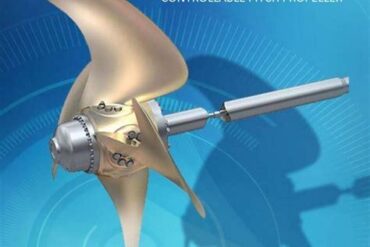
An aircraft propeller is a crucial component that transforms rotational energy into thrust, allowing the aircraft to move forward. This thrust is typically directed almost perpendicular to the plane of rotation. The rotational energy can come from various sources, such as a piston engine, a gas turbine, or, in some cases, an electric motor. In many light aircraft, the propeller connects directly to the crankshaft of a piston engine. Alternatively, it may be powered through a reduction gear box (RGB) linked to a piston or jet engine. The RGB adjusts the engine’s high rotation speed to a level suitable for propeller operation.
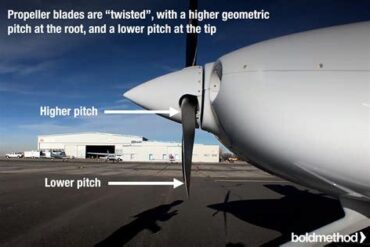
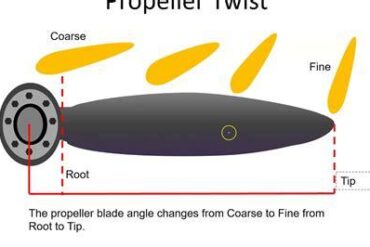
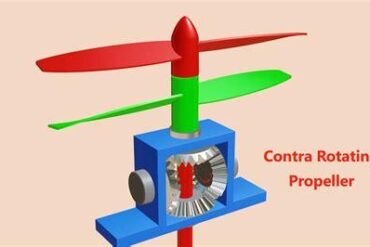
Propellers consist of two or more blades evenly arranged around a central hub. They can be found in fixed pitch or variable pitch configurations. More advanced designs include constant speed, contra-rotating, and counter-rotating propellers. The cross-section of a propeller resembles that of a low-drag wing, facing similar aerodynamic challenges such as angle of attack, stall, drag, and transonic airflow. To maintain efficiency, propeller blades are twisted along their length since the blade tip moves faster than the root. This twist helps keep a consistent angle of attack across the blade.
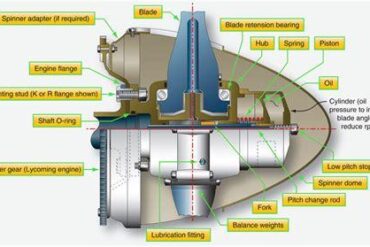
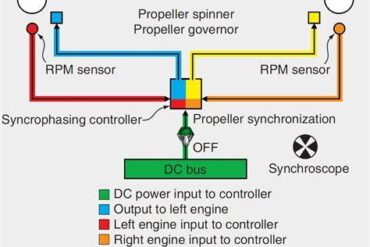
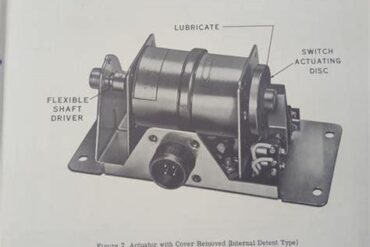
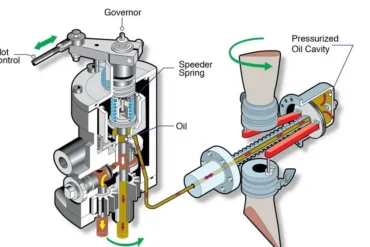
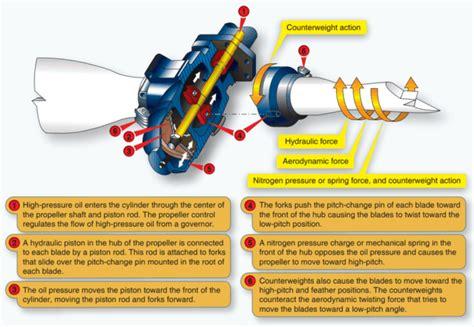
Like wings, propeller performance drops when not at the optimal angle of attack. To address this, many propellers use a variable pitch mechanism to adjust the blade angle as engine speed and aircraft velocity change. When designing a propeller, factors like the number and shape of the blades are essential, but compromises often arise. For instance, increasing the aspect ratio of the blade can reduce drag. However, to maintain thrust, longer blades or more blades are needed, as thrust correlates with blade area. Longer blades may reach transonic speeds at lower RPMs than shorter blades, and adding more blades increases interference effects between them.
As blades approach transonic speeds, their performance significantly declines. The airspeed at any point on a propeller combines the tangential rotational speed and the aircraft’s speed. Consequently, the blade tip can reach transonic speeds before the aircraft does. At critical speeds, shock waves form, leading to increased drag and noise. Some installations use swept-back, scimitar-shaped propellers to raise critical speeds and minimize shock wave formation.