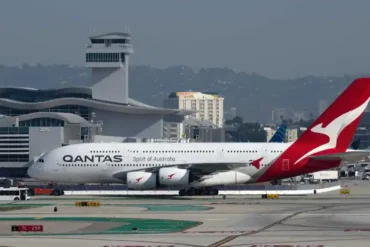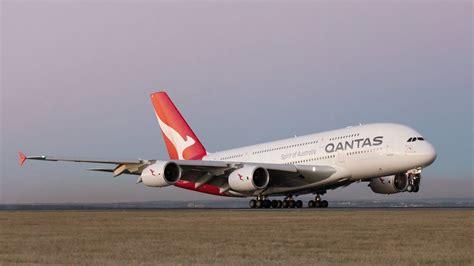
Qantas has quietly introduced an additional Airbus A380 service from Sydney to London Heathrow, creating the appearance of a brief return to the airline’s historic double-daily superjumbo operations between Australia and the United Kingdom. Yet the announcement carries a fascinating twist: the extra flight will operate only once and only in one direction.
At first glance, the move seems like a straightforward response to surging demand. With geopolitical instability in parts of the Middle East disrupting travel plans and leaving many passengers stranded in Australia, airlines are under pressure to move people across continents efficiently. Qantas has framed the additional service as a way to help travelers return home. However, aviation watchers have noticed that the deeper explanation lies in the intricate logistics of aircraft positioning and long-haul fleet maintenance.
A Rare Double A380 Departure From Sydney
On March 7, Sydney Airport will witness a rare event: two Airbus A380 departures from Qantas bound for London Heathrow on the same day. The airline’s iconic flagship route, flight QF1, will operate as usual via Singapore. Alongside it, a special flight numbered QF331 will also depart Sydney, heading toward the same destination but under very different circumstances.
Both flights follow the familiar kangaroo route structure—Australia to Singapore, then onward to London. However, the timings reveal that the second flight is anything but routine. QF331 departs Sydney later in the evening and arrives in Singapore in the early hours of the morning, where it sits on the ground for nearly four hours before continuing to Heathrow.
The unusually long stopover in Singapore Changi Airport—particularly at such inconvenient hours—suggests that the schedule was designed not for passenger convenience but to fit within Heathrow’s tightly controlled slot system. Landing rights at the UK’s busiest airport are among the most valuable assets in global aviation, and securing a temporary arrival slot often requires precise scheduling.
Why This Extra Flight Exists At All
Although the airline highlights passenger demand as the primary reason for the additional flight, the deeper reality appears to be operational efficiency. Aviation analysts have pointed out that QF331 has no return leg from London to Sydney. There is no corresponding QF332 service scheduled.
That detail reveals the likely explanation: the aircraft operating QF331 is almost certainly heading to Europe or the Middle East for scheduled maintenance. Instead of flying the aircraft empty across half the globe, Qantas has chosen to fill seats with paying passengers for most of the journey.
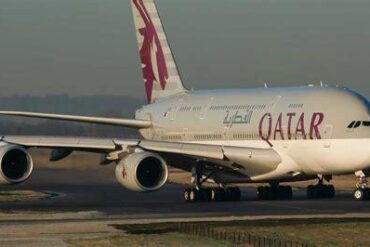
This approach turns what would otherwise be a costly positioning flight into a partially revenue-generating operation. Considering the Airbus A380’s enormous capacity—around 485 passengers in Qantas’ configuration—even a single sector with paying travelers can offset a significant portion of the trip’s operating costs.
Airlines regularly move aircraft between continents for heavy maintenance checks, which are required periodically for safety and reliability. These checks often occur at specialized facilities located far from an aircraft’s normal operating base. In the case of Qantas, likely destinations for such work include Dresden in Germany or facilities in the United Arab Emirates.
Rather than flying the aircraft empty across thousands of miles, the airline has cleverly aligned the maintenance positioning with passenger demand.
Ticket Sales With An Unusual Restriction
Another interesting quirk of the special flight is the ticketing limitation between Singapore and London. On Qantas’ standard QF1 route, passengers can book the Singapore–Heathrow segment independently thanks to so-called fifth freedom traffic rights.
Fifth freedom rights allow an airline to carry passengers between two foreign countries as part of a longer international route. For example, Qantas can sell seats between Singapore and London even though neither city is in Australia.
The special QF331 flight does not appear to have these rights available, meaning passengers cannot book only the Singapore–London portion. Travelers must begin their journey in Australia, reinforcing the idea that the flight’s primary purpose is aircraft repositioning rather than normal commercial service.
Fares for the one-off flight have also been notably high, suggesting that rebooked passengers and urgent travelers have been prioritized. Full flexibility tickets dominate the inventory, often carrying premium pricing that reflects both the long-haul nature of the route and the limited availability.
A380 Maintenance Logistics Behind The Scenes
The logistics of maintaining the Airbus A380, the world’s largest passenger aircraft, are uniquely complex. Each aircraft requires periodic deep maintenance checks that can take weeks to complete and involve specialized infrastructure.
Facilities capable of servicing the superjumbo are relatively rare. Among the most prominent is Elbe Flugzeugwerke (EFW) in Dresden, a facility that has handled numerous heavy maintenance projects for global airlines operating the A380 fleet.
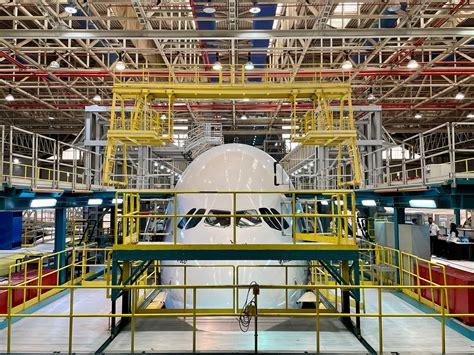
Historical flight tracking data shows Qantas performing similar operations before. In early 2025, one of its A380s flew from Sydney to Dresden via Singapore as a non-commercial positioning flight. After maintenance, it later repositioned to London and resumed passenger service back to Australia.
The current one-off London service appears to follow the same strategic logic: combine operational necessity with passenger demand whenever possible.
A Brief Echo Of Qantas’ Former Double-A380 Era
For longtime aviation observers, the sight of two Qantas A380 flights heading toward Heathrow on the same day evokes memories of a different era. During the early 2010s, the airline regularly operated two daily Airbus A380 services to London.
One originated in Sydney, while another departed Melbourne, both connecting through international hubs before reaching Heathrow. Initially, these flights stopped in Singapore, mirroring today’s routing.
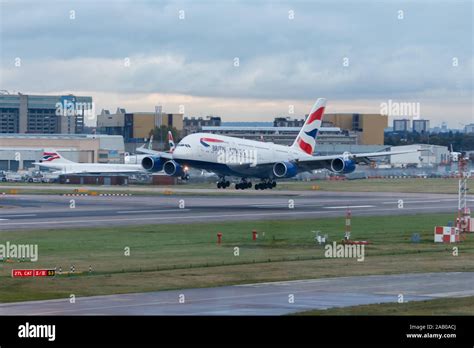
In 2013, Qantas reshaped its European strategy through a partnership with Emirates, shifting the stopover hub from Singapore to Dubai. The Melbourne route became Melbourne–Dubai–London, maintaining the A380 presence on both services.
That dual-superjumbo era ended in March 2018, when Qantas last scheduled two daily A380 arrivals at Heathrow. Since then, the airline has operated a single flagship service from Sydney.
A One-Day Event With Strategic Value
While the additional Sydney–London A380 flight is only a one-time occurrence, it highlights the fascinating interplay between commercial aviation economics and operational logistics. Airlines must constantly balance aircraft utilization, maintenance schedules, passenger demand, and regulatory constraints.
In this case, Qantas has transformed a routine aircraft repositioning trip into a revenue-generating long-haul service, while simultaneously helping travelers reach Europe during a period of heightened demand.
The result is a rare moment when Sydney briefly sends two giant Airbus A380s toward London in the same day, a small but intriguing reminder of the superjumbo’s enduring role in global aviation.