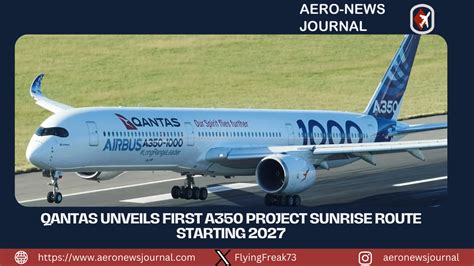
Qantas is preparing to change the geography of air travel. With Project Sunrise, the Australian flag carrier is moving beyond traditional long-haul operations and entering a category once considered commercially unrealistic: regular 20 to 22-hour nonstop flights linking Australia directly with Europe and North America. What once required stopovers in Asia or the Middle East is about to become a single seamless journey.
The concept is bold but highly strategic. Australia has always faced the tyranny of distance. Its major cities sit far from the economic centers of Europe and the eastern United States, forcing passengers to accept time-consuming connections. Project Sunrise aims to eliminate that friction. Instead of routing through Singapore, Dubai, Doha, or Los Angeles, travelers from Sydney and Melbourne will board once, settle in, and arrive directly in London or New York.
This is not merely a route launch. It is a structural shift in how airlines think about network planning, aircraft capability, premium demand, and passenger endurance. Qantas is betting that time saved, convenience gained, and premium comfort delivered will outweigh the psychological barrier of spending nearly a full day in the air.
By doing so, the airline is not just launching flights. It is rewriting the rules of ultra-long-haul travel.
The Vision Behind Qantas Project Sunrise
The name Project Sunrise reflects the surreal nature of these journeys. On certain sectors, passengers may witness two sunrises during one trip due to time zones and extended flight duration. It is a poetic branding choice, but it also captures the technological ambition behind the project.
Qantas first explored the concept years ago, studying whether aircraft performance, crew management, fuel economics, and customer willingness could align. The answer appears to be yes. The success of its Perth to London nonstop route, launched in 2018, provided the strongest evidence. Many critics assumed travelers would prefer a break mid-journey. Instead, customers embraced the convenience of avoiding transit hubs.
That lesson mattered. If passengers accepted 17 hours nonstop from Perth to London, then 20-plus hours from Sydney to London became a realistic next step.
Project Sunrise therefore represents the next logical evolution: longer sectors, larger origin markets, stronger premium demand, and a purpose-built aircraft.
The Flagship Routes That Will Redefine Distance
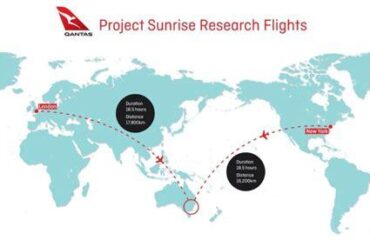
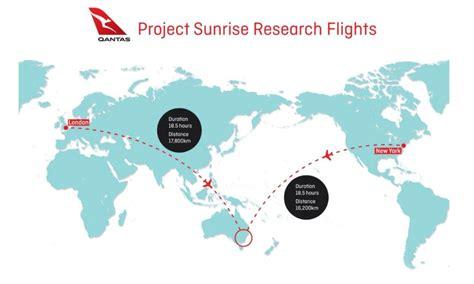
The headline service will be Sydney to London Heathrow, expected to become the world’s longest regular nonstop passenger route. At more than 17,000 kilometers, it surpasses existing record holders by a substantial margin.
Additional planned routes include:
- Melbourne to London
- Sydney to New York JFK
- Melbourne to New York JFK
Even the shortest among them remains longer than many current record-setting services. These are not symbolic routes created for publicity. They connect two of Australia’s biggest business centers with two of the world’s most commercially powerful cities.
That matters because ultra-long-haul flights depend heavily on yield. Routes succeed when they attract corporate travelers, affluent leisure passengers, and customers willing to pay for convenience. London and New York provide exactly that.
The Airbus A350-1000ULR: The Aircraft Making It Possible
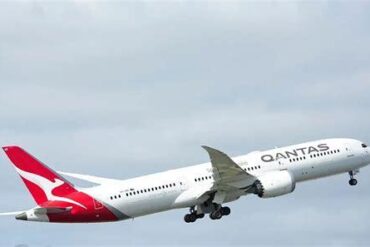
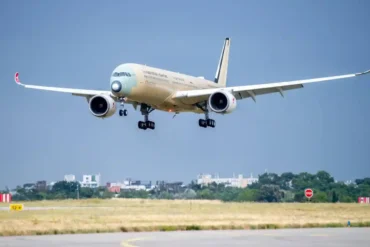
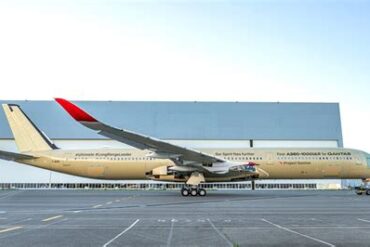
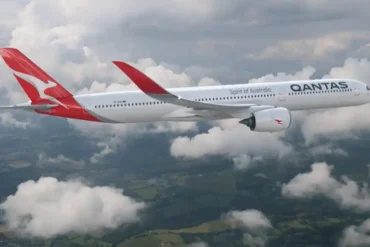
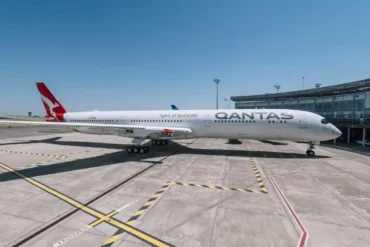
No airline can launch flights of this length using conventional widebody design alone. Qantas needed a specialized aircraft, and Airbus delivered the A350-1000ULR.
This variant builds on the already efficient A350-1000 platform, widely respected for fuel burn, cabin quietness, and long-range performance. But for Project Sunrise, additional modifications were necessary.
Key enhancements include:
- Increased maximum takeoff weight
- Additional fuel management capability
- New rear center fuel tank
- Optimized long-range operational software
- Payload-range performance tailored for extreme sectors
These changes give Qantas the ability to carry passengers, baggage, cargo, and fuel over extraordinary distances while maintaining commercial viability.
The aircraft also benefits from modern composite construction and highly efficient Rolls-Royce engines, both essential when every percentage point of fuel efficiency matters over a 22-hour mission.
Why Cabin Layout Matters More Than Ever
Project Sunrise is not about cramming seats into a flying tube. Quite the opposite.
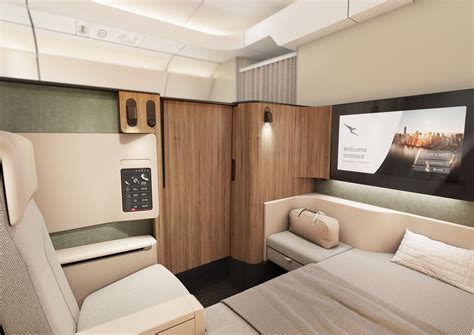
Qantas selected one of the least dense Airbus A350 layouts in the world, with only 238 seats onboard. For comparison, many airlines configure similar aircraft with well above 300 seats.
That reduced density serves several purposes. It lowers weight, improves passenger comfort, increases premium revenue mix, and creates a more humane onboard environment for flights approaching an entire day.
The cabin is expected to include:
- Six First Class suites
- 52 Business Class suites
- 40 Premium Economy seats
- 140 Economy seats
This reveals Qantas’ commercial thesis. Premium cabins will drive profitability, but economy remains essential because Australia generates strong leisure and visiting-friends-and-relatives traffic that cannot be ignored.
Economy Class on a 22-Hour Flight? Surprisingly Smart
Some observers questioned why Qantas would include economy seating on flights this long. The answer is simple: demand diversity.
Unlike Singapore, which serves a smaller local population and can focus more narrowly on premium traffic, Australia produces a broad mix of passengers. Families, tourists, students, expatriates, and price-conscious travelers all need direct access.
Qantas is also avoiding the mistake of making economy punitive. Reports indicate a generous 33-inch seat pitch, significantly better than many global long-haul economy cabins. Large entertainment screens and improved ergonomics are expected to further soften the experience.
For many passengers, the equation is straightforward: endure one longer flight rather than one long flight plus a stressful airport transfer, security checks, gate waits, and disrupted sleep.
That tradeoff is more attractive than critics assume.
The Wellbeing Zone: A New Idea for Long Flights
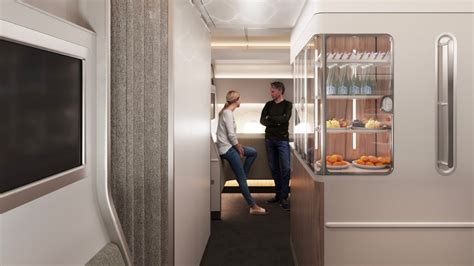
Perhaps the most innovative feature onboard is the Wellbeing Zone, a dedicated space designed for movement, stretching, hydration, and guided wellness content.
This may sound minor until one considers the realities of sitting for 20 hours. Passenger fatigue, stiffness, dehydration, and sleep disruption become major experience factors on ultra-long-haul routes.
The Wellbeing Zone acknowledges a truth airlines long ignored: comfort is not just seat width. It is also circulation, movement, mood, and body management.
Expect future long-haul aircraft across the industry to borrow this concept.
Why Project Sunrise Can Make Money
The biggest misconception about ultra-long-haul flying is that it is purely prestige driven. In reality, airlines do not invest billions for vanity.
Qantas believes Project Sunrise works because of revenue concentration.
Passengers often pay premiums for:
- Saving several hours of total journey time
- Avoiding missed connections
- Eliminating baggage transfer risks
- Reducing jet lag from stop-start travel
- Gaining direct access to central business markets
For a banker traveling Sydney to London, or an executive moving between Melbourne and New York, time is not abstract. Time is money.
When enough travelers share that mindset, yields rise sharply.
Fuel costs are undeniably high, but modern aircraft economics plus premium-heavy cabins can offset that pressure. What matters most is not raw operating cost—it is revenue per seat and total network value.
Lessons From Past Ultra-Long-Haul Winners and Failures
History shows that long routes fail when aircraft are inefficient or markets are weak.
Older attempts using Airbus A340 aircraft often struggled because four-engine jets burned too much fuel. Some routes connected leisure-heavy cities where fares could not cover costs.
Today’s environment is different.
Modern twin-engine aircraft like the A350 and Boeing 787 have dramatically improved economics. Meanwhile, global travelers increasingly value convenience and nonstop access.
Singapore Airlines proved this with nonstop U.S. routes. Qantas proved it with Perth to London. Project Sunrise is the next chapter in the same trend.
Technology created the opportunity. Market behavior validated it.
What Project Sunrise Means for Global Aviation
If successful, Project Sunrise will influence airline strategy worldwide.
Other carriers will study whether cities such as:
- Paris to Australia
- Toronto to Southeast Asia
- U.S. East Coast to South Africa
- Europe to New Zealand
can support similar nonstop models.
Airports may compete harder for premium direct services. Manufacturers may refine future aircraft around wellness and range. Cabin design may prioritize space over density on high-yield sectors.
Most importantly, passengers will reset expectations. Once travelers experience direct flights that remove painful stopovers, tolerance for unnecessary connections may decline.

The Future Starts in 2027
Commercial service is expected to begin in 2027, making Project Sunrise one of the most anticipated airline launches of the decade.
For Qantas, it is more than a fleet addition. It is a statement that geography no longer dictates connectivity the way it once did. Australia’s distance from Europe and North America has shaped travel patterns for generations. Soon, that limitation may feel outdated.
Project Sunrise is not merely about flying farther. It is about making the world functionally smaller.
And when passengers board a nonstop flight from Sydney to London, sleep, wake, stretch, dine, work, and land without ever changing aircraft, they may realize that the age of ultra-long-haul travel has truly arrived.