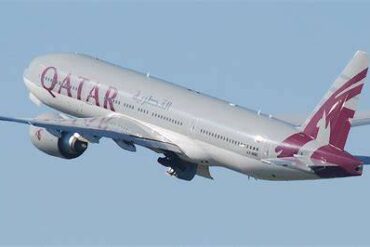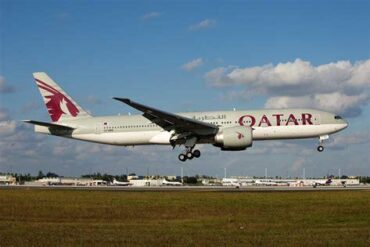
Qatar Airways is pushing deeper into South America with the launch of a new ultra-long-haul triangle route connecting Doha, Bogotá, and Caracas, marking one of the most ambitious network additions in the airline’s recent expansion strategy. Beginning on July 22, the Doha-based carrier will operate the service twice weekly using the Boeing 777-200LR, an aircraft specifically designed for some of the world’s longest commercial flights.
The new operation is more than just another destination launch. It represents a strategic breakthrough into underserved long-haul markets between the Gulf region and northern South America. The route will also make Qatar Airways the first Middle Eastern airline to serve Venezuela, while simultaneously becoming the only Gulf carrier operating a nonstop link between the Middle East and South America.
The scale of the operation is enormous. The nonstop sector from Doha Hamad International Airport to Bogotá El Dorado International Airport stretches approximately 8,261 miles (13,291 kilometers), placing it among the airline’s longest routes globally. For Qatar Airways, a carrier already famous for connecting distant city pairs across continents, this latest addition reinforces its growing focus on ultra-long-haul connectivity.

Qatar Airways Builds A Strategic Triangle Route Across Colombia And Venezuela
Rather than operating separate services, Qatar Airways has opted for a triangle routing structure. Flights will depart Doha and fly nonstop to Bogotá before continuing onward to Caracas. The return flight will then operate directly from Caracas back to Doha.
The schedule has been carefully designed around transit connectivity through Hamad International Airport, allowing passengers from South America to connect efficiently to destinations throughout Asia, the Middle East, and Oceania. Markets expected to benefit strongly include Tokyo, Seoul, Beijing, Sydney, Melbourne, Dubai, and Beirut.
The flight schedule currently includes departures from Doha every Wednesday and Sunday. Flight QR783 leaves Doha at 8:15 AM and arrives in Bogotá at 4:30 PM after a journey lasting roughly 16 hours and 35 minutes. After a short stop, the same aircraft continues to Caracas, arriving in Venezuela after an additional two-hour segment.
The return leg, operating as QR784, departs Caracas late in the evening and arrives back in Doha the following day after approximately 14 hours and 15 minutes in the air. Combined, the service creates one of the most operationally demanding routes in Qatar Airways’ network.
Bogotá Emerges As A New Gulf Aviation Gateway
For Bogotá, the arrival of Qatar Airways is a major milestone in the airport’s international development. El Dorado International Airport has increasingly positioned itself as a leading Latin American hub, but nonstop connections to the Gulf region have remained extremely limited.
Currently, Emirates serves Bogotá via Miami from Dubai, while Turkish Airlines operates flights from Istanbul to both Bogotá and Caracas. Qatar Airways changes the competitive landscape by offering a direct Gulf-to-Colombia service without an intermediate stop in North America.
This distinction matters significantly for passengers. Avoiding a US transit stop eliminates visa complications for many travelers while reducing overall travel times between South America and destinations across Asia and the Middle East.
The route also creates new opportunities for trade, tourism, and business travel between Colombia, Venezuela, and Qatar. Cargo demand is expected to play an important role as well, particularly for perishables, pharmaceuticals, and high-value exports moving between Latin America and Asian markets.

One Of Qatar Airways’ Longest Flights Ever
The Doha–Bogotá sector immediately becomes one of the airline’s headline ultra-long-haul services. At 8,261 miles, it ranks behind only a handful of Qatar Airways routes in total distance.
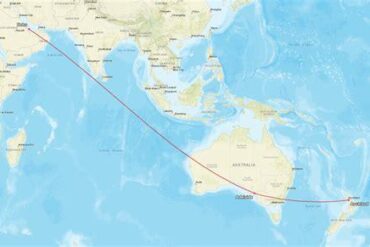
The carrier’s current longest nonstop route remains the flight between Doha and Auckland, which spans roughly 9,051 miles. However, temporary operational adjustments affecting the Auckland service could briefly elevate Bogotá into the position of Qatar Airways’ second-longest nonstop route.
Among Qatar Airways’ flights to the Americas, only Los Angeles exceeds Bogotá in distance. The Doha–Los Angeles route covers approximately 8,306 miles, while San Francisco, Houston, and Dallas/Fort Worth follow closely behind.
These enormous route lengths demonstrate how modern long-range aircraft have transformed global aviation. The Boeing 777-200LR, despite being an older design compared to newer Airbus A350 variants, remains one of the most capable ultra-long-haul aircraft ever produced. Its range and payload capabilities make routes such as Bogotá operationally viable.
Expanding Qatar Airways’ Presence Across The Americas
The addition of Bogotá and Caracas increases Qatar Airways’ footprint in the Americas to 16 destinations. The airline already maintains a strong North American network, including services to major US gateways such as New York JFK, Los Angeles, Chicago, Miami, Dallas/Fort Worth, Seattle, Houston, Boston, Atlanta, San Francisco, and Washington Dulles.
In Canada, the airline serves both Toronto and Montreal, while São Paulo remains its longstanding South American destination. Qatar Airways first entered the Brazilian market in 2010, and the success of São Paulo likely helped shape confidence in expanding further across the continent.
The Bogotá–Caracas launch reflects a broader industry trend in which Gulf carriers increasingly target underserved long-haul markets beyond traditional mega-cities. Rather than focusing exclusively on Europe or major Asian hubs, airlines such as Qatar Airways are pursuing routes that connect secondary global regions directly through their home hubs.
A High-Risk Yet Potentially Transformational Route
Ultra-long-haul routes are notoriously difficult to operate profitably. Fuel costs, crew scheduling complexities, and fluctuating passenger demand create significant operational pressure. Yet Qatar Airways has repeatedly shown a willingness to enter challenging markets where competitors hesitate to expand.
The Bogotá–Caracas route carries geopolitical and economic risks, particularly regarding Venezuela’s aviation market. However, it also provides Qatar Airways with a unique first-mover advantage in a region where nonstop Gulf connectivity remains rare.
If demand develops as expected, the service could reshape travel patterns between South America and Asia while strengthening Doha’s role as one of the world’s most important intercontinental transit hubs. For aviation enthusiasts, the launch also adds another remarkable ultra-long-haul flight to an industry increasingly defined by endurance, efficiency, and global reach.