Qatar Airways is preparing to enter one of the most unconventional long-haul markets in modern aviation with the launch of a new ultra-long-haul service linking Doha, Bogotá, and Caracas. Scheduled to begin on July 22, the route instantly becomes one of the airline’s most ambitious operations, stretching deep into northern South America with flight times exceeding 20 hours.
The announcement arrived with remarkably little lead time. For an airline known for carefully planned network growth, unveiling a new intercontinental route barely two months before launch signals urgency, strategic experimentation, or perhaps broader geopolitical priorities beyond commercial aviation alone. Either way, the new service places Qatar Airways into Colombia and Venezuela for the first time, significantly expanding its footprint in Latin America.
Until now, São Paulo stood as the carrier’s sole South American destination, having remained on the network since 2010. The addition of Bogotá and Caracas transforms Qatar Airways from a limited regional participant into a far more serious player connecting South America with the Gulf, South Asia, and beyond.
The routing itself is highly unusual. Initial operations will reportedly begin with a Doha–Caracas–Bogotá–Doha sequence before transitioning to a more operationally logical Doha–Bogotá–Caracas–Doha pattern after the first flight.
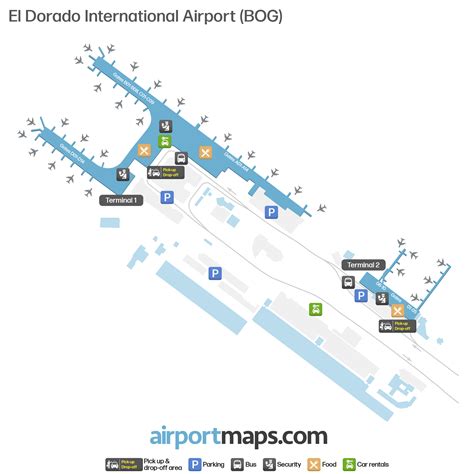
The adjustment matters because Bogotá’s El Dorado International Airport sits at an elevation of more than 8,600 feet above sea level. High-altitude airports create substantial performance penalties for heavily loaded aircraft, especially on ultra-long-haul sectors requiring enormous fuel loads. By positioning Bogotá before Caracas on the outbound journey, Qatar Airways can optimize takeoff performance for the long return sector to Doha.
Even for a carrier experienced in operating marathon flights, the numbers are extraordinary. The Doha-to-Bogotá segment alone is blocked at up to 16 hours and 35 minutes, immediately becoming one of the airline’s longest nonstop sectors. Combined with the onward connection to Caracas and associated ground time, total journey duration to Venezuela reaches 20 hours and 10 minutes.
That places the service among the longest passenger operations in the world.
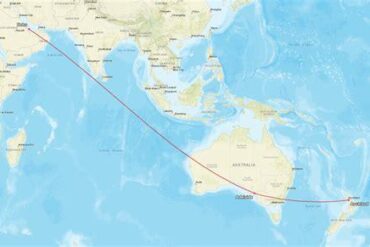
Currently, Qatar Airways’ temporary Doha–Adelaide–Auckland routing edges slightly ahead at 20 hours and 15 minutes due to operational diversions linked to regional airspace restrictions. Once nonstop Auckland operations resume later in the year, however, the Bogotá–Caracas service is expected to become the carrier’s longest scheduled passenger operation.
Qatar Airways Deploys Boeing 777-200LR With QSuite Cabins
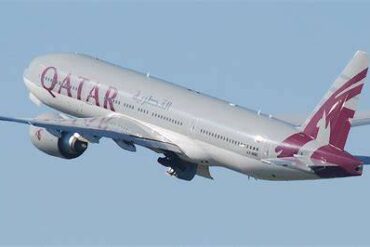
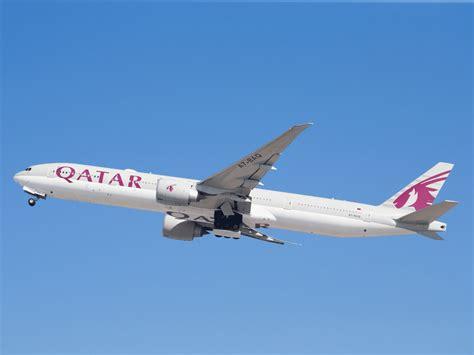
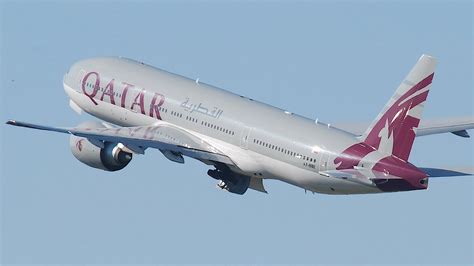
To operate the demanding route, Qatar Airways will deploy its Boeing 777-200LR fleet, one of the few aircraft types specifically engineered for ultra-long-range missions. Configured with either 272 or 276 seats depending on layout, the aircraft combines substantial passenger capacity with the fuel efficiency required for sectors approaching 17 hours.
Passengers on the route will receive the airline’s flagship QSuite business-class product along with Starlink connectivity, reinforcing Qatar Airways’ intention to market the flights as premium long-haul experiences rather than niche regional experiments.
Still, the schedule reveals cautious expectations. The flights will operate only twice weekly, a surprisingly low frequency for a major intercontinental launch.
Industry observers immediately noticed the unusual structure. Limited frequencies often indicate uncertain demand forecasts or strategic state-level priorities. According to aviation sources cited anonymously in industry reporting, the route may carry political and diplomatic significance beyond simple commercial profitability.
That speculation is understandable given the complexity of the market.

Why Bogotá And Caracas Matter To Qatar Airways
At first glance, demand between northern South America and the Gulf region appears relatively modest. Booking data suggests roughly 146,000 annual passengers travel between Bogotá or Caracas and regions including the Middle East, South Asia, Central Asia, and Eastern or Southern Africa. Spread across an entire year, that equates to approximately 400 passengers daily.
For comparison, many successful long-haul markets generate several times that figure.
Competition already exists as well. Turkish Airlines has built strong connectivity into both Bogotá and Caracas through Istanbul, while Emirates reaches Bogotá via Miami. Both carriers possess established regional recognition and extensive global networks capable of siphoning premium traffic.
Yet Qatar Airways appears to be targeting highly specific passenger flows rather than mass-market tourism.
Among the largest traffic markets are Bogotá–Dubai, Caracas–Beirut, Bogotá–Delhi, Bogotá–Mumbai, and Bogotá–Karachi. Particularly significant is Venezuela’s large Lebanese diaspora community, estimated at more than 750,000 people of Lebanese descent or citizenship. That demographic creates a potentially valuable stream of family, business, and cultural travel traffic connecting Caracas with Beirut through Doha.
The route also opens additional cargo possibilities. Bogotá remains one of the world’s major flower-export hubs, while Qatar Airways Cargo continues expanding aggressively across long-haul freight markets. High-yield cargo can often determine the viability of ultra-long-haul passenger operations where passenger demand alone appears thin.
A Strategic Expansion Beyond Traditional Aviation Logic
What makes the new service fascinating is how aggressively it challenges conventional airline network planning. Most carriers prioritize frequency, strong local demand, and operational simplicity. Qatar Airways instead appears willing to embrace complexity, long stage lengths, and relatively thin passenger flows in pursuit of broader strategic positioning.
The Doha-based airline has repeatedly demonstrated that it views network reach as a geopolitical advantage as much as a commercial one. Serving underconnected markets strengthens diplomatic ties, increases soft power influence, and positions Doha as a truly global transfer hub linking regions often ignored by competitors.
The Bogotá and Caracas launch perfectly reflects that philosophy. The flights may not initially rival Qatar Airways’ flagship routes to London, Bangkok, or New York in terms of volume, but they dramatically extend the airline’s global map into underserved territory.
For aviation enthusiasts, the route is equally compelling because it combines nearly every challenge associated with modern ultra-long-haul flying: extreme distance, high-altitude operations, niche traffic flows, geopolitical considerations, and limited frequency economics.
In an era when airlines increasingly focus on efficiency and predictability, Qatar Airways is once again betting that global ambition still matters.