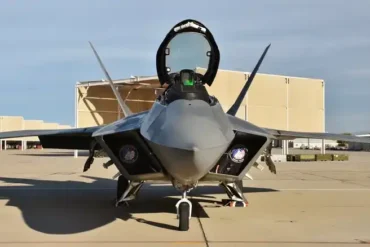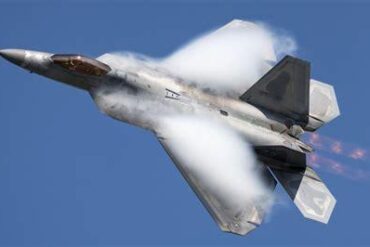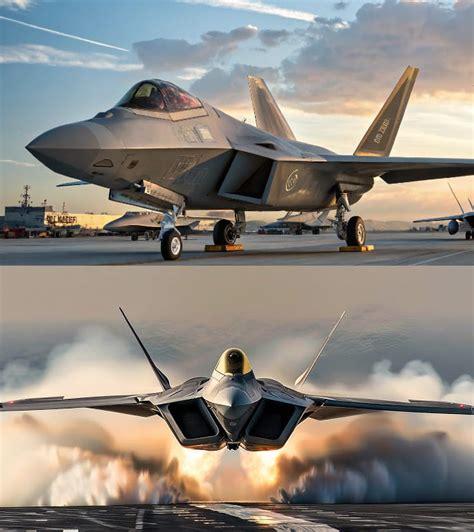
The Lockheed Martin F-22 Raptor has long stood as the undisputed symbol of air superiority, a machine engineered with a singular obsession: invisibility. For decades, its design philosophy revolved around one ruthless advantage—if you cannot be seen, you cannot be killed. But modern warfare has a way of rewriting even the most successful doctrines. Today, the Raptor is undergoing a transformation that quietly signals a profound shift in how air combat is fought.
The U.S. Air Force’s latest modernization effort—often dubbed “Raptor 2.0”—is not about preserving the past. It is about adapting to a battlespace where stealth alone no longer guarantees dominance. With a $90.34 million investment in FY2026, the upgrades introduce stealthy external fuel tanks, Infrared Search and Track (IRST) systems, and a helmet-mounted display, reshaping the aircraft into something far more versatile—and arguably more dangerous.
This evolution reflects a stark reality: the future of air combat is not defined by invisibility alone, but by who sees first, shoots first, and stays longest.
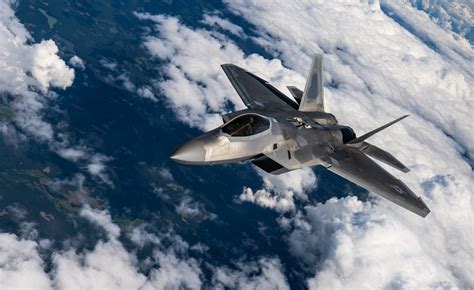
The End of Pure Stealth Doctrine
The original F-22 was a masterpiece of Cold War thinking refined for post-Cold War dominance. Every curve, every panel, every system was optimized to minimize radar cross-section. External stores were avoided. Fuel was carried internally. Even minor protrusions were treated as threats to survivability.
But the battlefield has evolved into a multi-domain detection environment. Advanced adversaries such as China’s Chengdu J-20 and Russia’s Sukhoi Su-57 are no longer blind to stealth. Instead, they operate within integrated sensor networks that combine radar, infrared tracking, and data from satellites and drones. In this environment, relying solely on radar invisibility is like whispering in a room full of people wearing microphones—you might still be heard.
The shift underway is subtle but decisive. The F-22 is no longer being optimized to be perfectly unseen. Instead, it is being reshaped to become exceptionally aware. That distinction changes everything.
Raptor 2.0: A Fighter Built for Distance and Endurance
One of the most significant limitations of the original F-22 was its range. Designed with European and Middle Eastern theaters in mind, it operated under the assumption that airbases would always be relatively close. That assumption collapses in the vast expanse of the Indo-Pacific, where distances stretch into thousands of miles and aerial refueling becomes both essential and vulnerable.
Enter the Low-Drag Tank and Pylon (LDTP) system—a deceptively simple upgrade with massive implications.
Traditional external fuel tanks are a stealth aircraft’s worst enemy. They dramatically increase radar signature, forcing pilots to jettison them before entering contested airspace. This creates a painful trade-off: range or survivability, but not both.
The LDTP system rewrites that equation. These new tanks are carefully shaped to preserve low observability, allowing the F-22 to retain external fuel deep into contested zones. The result is an aircraft that can fly farther, loiter longer, and fight deeper without sacrificing its stealth edge entirely.
This isn’t just a technical improvement—it’s a strategic unlock. The upgraded Raptor can now:
- Escort bombers across vast Pacific distances
- Maintain extended combat air patrols
- Reduce dependence on vulnerable tanker aircraft
- Operate from more distant and secure bases
Range, once a weakness, is becoming one of the Raptor’s defining strengths.
Passive Detection: Hunting Without Being Seen
If stealth defined the first era of the F-22, passive detection defines the second.
The integration of Infrared Search and Track (IRST) pods marks a fundamental shift in how the aircraft engages threats. Unlike radar, which broadcasts energy and risks revealing position, IRST systems operate silently, detecting heat signatures emitted by aircraft engines, exhaust plumes, and aerodynamic friction.
This matters enormously in a world filled with stealth fighters. While radar signatures can be minimized, heat cannot be hidden completely. Even the most advanced stealth aircraft still glow—faintly, but detectably—against the cold backdrop of the sky.
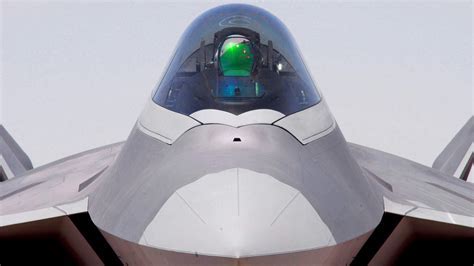
With IRST, the F-22 gains the ability to:
- Detect stealth aircraft without emitting signals
- Track targets without alerting them
- Operate in electromagnetically contested environments
- Maintain tactical surprise deep into engagements
The implications are profound. Air combat becomes less about who is invisible and more about who is quietly watching. In such a scenario, the aircraft that can observe without announcing itself holds a decisive advantage.
The Raptor, once designed to evade detection, is now evolving into a stealth hunter—capable of finding adversaries who believed themselves hidden.
Information Dominance Over Raw Invisibility
Modern air combat is no longer a duel between isolated fighters. It is a networked ecosystem, where aircraft, satellites, drones, and ground systems share data in real time. Victory depends less on individual platform performance and more on information superiority.
The upgraded F-22 is being repositioned as a central node in this network, not just a lone predator. Its avionics refresh enhances its ability to:
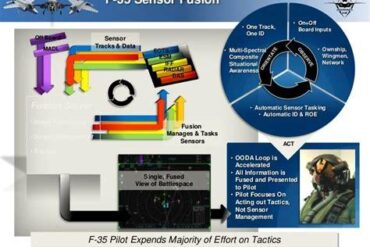
- Fuse data from multiple sensors
- Share targeting information across platforms
- Coordinate with F-35s, drones, and airborne warning systems
- Build a comprehensive battlespace picture
This shift reflects a new reality: the pilot who understands the battlefield first wins long before missiles are fired.
Rather than being optimized for solo stealth penetration, the Raptor is becoming a collaborative intelligence platform—a role that aligns perfectly with the emerging doctrine of distributed, network-centric warfare.
The Helmet-Mounted Display: A Quiet Revolution in the Cockpit
For all its technological brilliance, the F-22 had one glaring omission: a modern helmet-mounted display (HMD). While other fighters evolved toward pilot-centric interfaces, the Raptor remained anchored in a more traditional cockpit paradigm.
That is finally changing.
The new HMD transforms how pilots interact with the aircraft. Instead of glancing down at instruments, they can now see targeting data, threat alerts, and navigation cues projected directly onto their visor. The effect is immediate and powerful: situational awareness becomes intuitive rather than procedural.
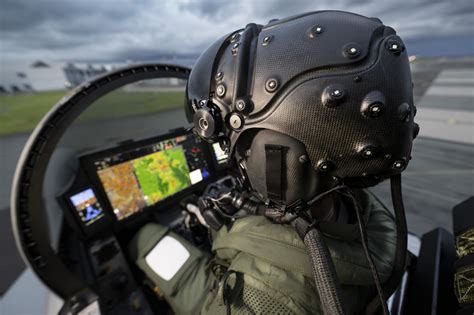
In high-speed engagements where seconds matter, this upgrade delivers tangible advantages:
- Faster target acquisition and engagement
- Reduced pilot workload
- Improved performance in close-range dogfights
- Seamless integration with advanced missile systems
It’s not flashy in the way new weapons or engines are, but in practice, this may be one of the most impactful upgrades. In modern combat, the edge often belongs to the pilot who can process information fastest without being overwhelmed.
A Calculated Trade-Off: Stealth vs. Flexibility
Perhaps the most controversial aspect of the upgrade is the willingness to accept a slight increase in radar visibility. For a platform built on stealth purity, this is almost heretical.
But it is also strategically rational.
Absolute stealth comes with constraints—limited fuel, restricted payload configurations, and reduced flexibility. By relaxing these constraints slightly, the F-22 gains range, endurance, and sensor capability that dramatically enhance real-world effectiveness.
This is not abandonment of stealth. It is prioritization.
The Air Force is effectively acknowledging that:
- Perfect invisibility is no longer achievable
- Detection technologies are diversifying beyond radar
- Operational success depends on adaptability, not purity
The upgraded Raptor embodies a more nuanced philosophy: be stealthy enough to survive, but capable enough to dominate.
Indo-Pacific Realities Driving the Transformation
Geography has a way of forcing innovation. The Indo-Pacific theater presents challenges unlike any other:
- Vast distances between bases
- Limited forward operating locations
- Increased reliance on long-range operations
- Sophisticated adversary defenses
In this environment, an aircraft optimized for short-range stealth penetration becomes strategically constrained. The Raptor’s upgrades directly address these realities, ensuring it can project power across enormous distances while remaining combat-effective.
The emphasis on range and passive detection is not theoretical—it is tailored for the exact conditions where future conflicts are most likely to occur.
Bridging the Gap to Sixth-Generation Air Combat
The F-22’s transformation is not happening in isolation. It is part of a broader transition toward the Next Generation Air Dominance (NGAD) program, expected to define the sixth generation of fighter aircraft.
Until that future arrives, the Raptor must serve as a bridge platform—one that connects legacy strengths with emerging capabilities.
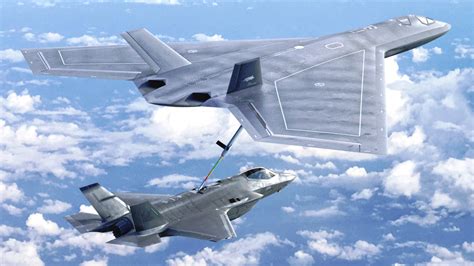
In this bridging role, the upgraded F-22 will:
- Operate alongside F-35s and autonomous drones
- Act as a sensor and command node
- Extend the reach and effectiveness of networked forces
- Provide air superiority in contested environments
It is no longer just a fighter. It is becoming part of a system of systems, where its value lies as much in what it sees and shares as in what it shoots.
The Future of Air Superiority Is Already Here
The evolution of the F-22 tells a larger story about the future of warfare. The age of single-metric dominance—whether speed, stealth, or firepower—is over. In its place emerges a more complex equation:
Range + Awareness + Connectivity + Adaptability = Victory
The Raptor’s upgrades reflect this equation with striking clarity. By embracing passive detection, extended range, and network integration, it is transforming from a pure stealth icon into a multidimensional combat platform.
This transformation is not a compromise. It is an upgrade in philosophy.
The aircraft that once ruled the skies by being unseen is now preparing to rule them by seeing everything—quietly, patiently, and decisively.