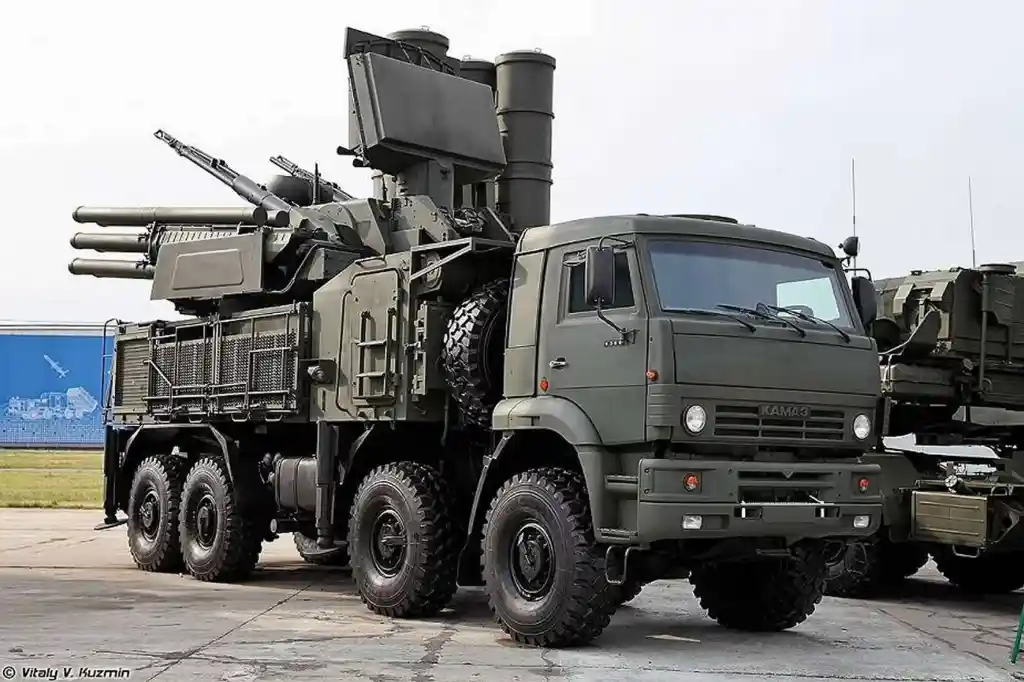
Russia has moved decisively to reinforce its point-defense architecture with the delivery of new standard and short-range interceptor missiles for the Pantsir air defense system, enabling a dramatic increase in ready-to-fire capacity from 12 to as many as 48 missiles per launcher. The upgrade, executed by Rostec’s High Precision Systems holding for the Russian Ministry of Defense, reflects a battlefield reality defined less by sporadic aircraft incursions and more by persistent, layered attacks involving drone swarms, loitering munitions, cruise missiles, and precision-guided weapons.
This expanded loadout is not a cosmetic enhancement. It is a structural response to saturation warfare, where low-cost unmanned aerial vehicles (UAVs) are deployed in large numbers to overwhelm defensive systems, exhaust interceptor inventories, and create exploitable gaps for higher-value strikes. By quad-packing short-range interceptors into standard launcher positions, Pantsir units can now sustain significantly longer engagement cycles without immediate resupply, strengthening Russia’s inner defensive ring around critical assets.
The Pantsir system has long served as the close-in shield for higher-tier air defense platforms such as the S-300 and S-400. Its role is to intercept “leakers”—targets that penetrate outer defensive layers—and to protect command posts, airfields, logistics hubs, and strategic infrastructure. With the 48-missile configuration, that mission is evolving from limited-duration point defense into sustained counter-swarm operations under high operational tempo.
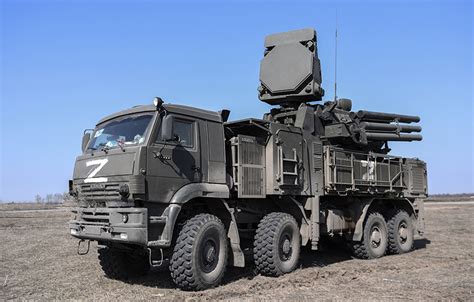
Quad-Packed Interceptors Redefine Magazine Depth
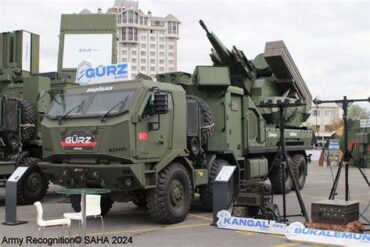
The technical foundation of this enhancement lies in packaging rather than a radical redesign. A conventional Pantsir combat vehicle carries 12 ready-to-launch missile canisters. Under the new configuration, each standard canister slot can accommodate a quad-pack module of short-range interceptor missiles. This allows up to four smaller missiles to occupy the physical space of one full-sized round.
The result is a maximum ready load of 48 missiles per vehicle when configured entirely with mini-interceptors. In practice, operators can mix standard 57E6-series missiles with quad-packed short-range interceptors depending on the anticipated threat profile. This modularity provides tactical flexibility that was previously constrained by limited onboard magazine depth.
For a system operating in environments characterized by repeated UAV incursions, this matters enormously. Saturation attacks are not defined by individual missile quality but by quantity and timing. When dozens of low-RCS (radar cross-section) targets approach in waves, a 12-round magazine can be depleted in minutes. A 48-round loadout transforms the endurance equation.
The 57E6 Series: Retaining Reach Against High-Performance Threats
The backbone of Pantsir’s intercept capability remains the 57E6 series missile family. These two-stage, command-guided surface-to-air missiles are optimized for short-to-medium range engagements without relying on onboard seekers. Guidance is achieved through radar tracking and command updates from the launcher vehicle, allowing precise control during the engagement phase.
Published specifications for the Pantsir-S1M configuration indicate that the baseline 57E6-E offers an engagement range from approximately 1.2 kilometers to 20 kilometers, with altitude coverage from about 15 meters up to 15 kilometers. The improved 57E6M-E variant extends engagement range to roughly 30 kilometers and altitude to 18 kilometers. With missile velocities reaching up to 1,700 meters per second and a maximum target speed engagement threshold near 1,000 meters per second, these interceptors are designed to counter cruise missiles, guided bombs, and various tactical air-launched munitions.
These missiles are not primarily intended for mass drone engagements. They are higher-performance interceptors suited to faster, higher-altitude, or more maneuverable threats. In the layered air defense model, they serve as the outer edge of Pantsir’s engagement envelope within its assigned protective bubble.
TKB-1055 Mini-Interceptors: Engineering for the Drone Belt
The introduction of the TKB-1055 short-range interceptor, also associated with the 19Ya6 designation, marks a deliberate shift toward cost-effective drone suppression. Designed explicitly for small, low-altitude UAVs and loitering munitions, this mini-missile operates within a tighter engagement envelope—approximately 0.5 to 7 kilometers in range and up to 5 kilometers in altitude.
This envelope aligns precisely with the zone where drone swarms become tactically dangerous. Small UAVs often fly low to reduce radar visibility and exploit terrain masking. They approach in clusters, forcing defenders into rapid engagement decisions. In such scenarios, economic sustainability becomes as critical as kinetic performance. Firing a large, high-performance missile at every small drone is inefficient and strategically wasteful.
The mini-interceptor addresses that imbalance. It enables Pantsir crews to reserve full-size 57E6-series missiles for more demanding targets while deploying lower-cost rounds against dense UAV formations. This layered ammunition strategy enhances both survivability and long-term operational viability.
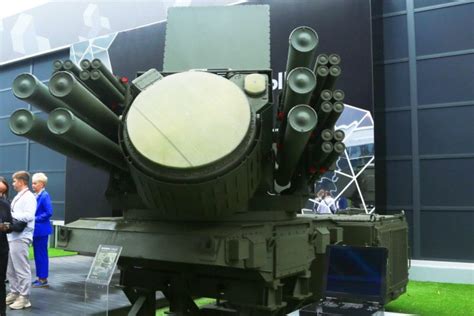
Fire-Control Architecture and Engagement Dynamics
Pantsir’s effectiveness does not rely solely on missile quantity. Its integrated fire-control architecture includes a search and acquisition radar, a tracking and engagement radar, and an electro-optical channel. The acquisition radar reportedly detects and tracks up to 40 targets simultaneously, while the multifunction engagement radar can track and engage up to four targets at once, guiding multiple missiles concurrently.
The 48-missile configuration does not inherently increase the number of simultaneous engagements. Instead, it multiplies the number of available engagement cycles before reload becomes necessary. Under swarm conditions, this distinction is critical. The limiting factor in saturation scenarios is often magazine depletion rather than radar tracking capacity.
The electro-optical channel adds resilience under electronic warfare conditions, allowing engagements when radar emissions are degraded or contested. In a battlespace increasingly defined by electronic countermeasures, multi-sensor redundancy enhances operational continuity.
Strategic Implications for Layered Air Defense
Russia’s deployment of quad-packed Pantsir loadouts signals a broader adaptation to contemporary warfare trends. Persistent UAV harassment has targeted infrastructure and rear-area logistics nodes, compelling air defense units to operate continuously rather than episodically. The shift from aircraft-centric threats to drone-centric saturation challenges demands systems capable of absorbing repeated low-cost attacks without rapid exhaustion.
Within Russia’s layered architecture, Pantsir serves as the inner defensive ring beneath long-range systems like the S-400. By increasing magazine depth, the system strengthens the resilience of that inner layer. It allows defended assets—air defense batteries, command centers, airfields—to maintain protective coverage during extended periods of pressure.
Systems equipped with 30 mm autocannons retain a final protective layer inside roughly four kilometers, where reaction time is measured in seconds. However, missiles remain the preferred solution for maneuvering or crossing targets at extended ranges, particularly when precision and interception geometry are critical.
The doctrinal evolution is clear. Pantsir is being repositioned from a limited-duration point-defense asset into a high-density counter-drone and counter-precision-guided munition node. Industrial delivery of mini-interceptors indicates that this is not a prototype capability but an operationalized supply-chain adjustment aligned with wartime lessons.
In modern air defense, resilience is measured not only in range and speed but in sustained readiness under stress. By expanding Pantsir’s ready-to-fire capacity to 48 missiles, Russia has altered the calculus of inner-layer defense against drone swarm battlefield saturation, reinforcing its capacity to endure prolonged, high-volume engagements within a contested airspace.