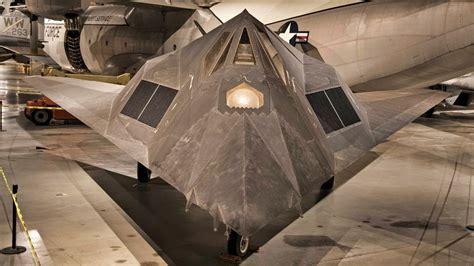
In the shadows of the Cold War, amid the fierce technological rivalry between the United States and the Soviet Union, a paradox unfolded—the birth of America’s first stealth aircraft, the F-117 Nighthawk, was powered by the mathematics of a Soviet scientist. Pyotr Ufimtsev, a relatively unknown physicist in the USSR, inadvertently laid the foundation for an aviation revolution that would go on to cement U.S. air superiority for decades. This is the remarkable story of how Soviet science became the backbone of American stealth technology.
The Paradox of Superiority: America’s Stealth Supremacy Rooted in Soviet Science
Today, the United States stands as the unmatched leader in stealth aircraft technology, having developed four cutting-edge stealth platforms—the F-117 Nighthawk, B-2 Spirit, F-22 Raptor, and F-35 Lightning II. These aircraft have not only reshaped modern warfare but have also proven themselves in battlefields across Iraq, Kosovo, Afghanistan, and beyond.
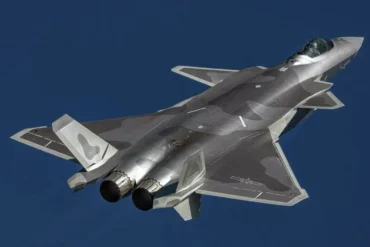
In stark contrast, Russia’s Su-57 Felon, officially commissioned only in 2020, has struggled to earn the same reputation. China’s J-20 and J-35A remain largely untested. Yet, few know that the seeds of stealth warfare were first planted not in American laboratories, but in the published equations of a Soviet physicist who was never aiming to design aircraft.
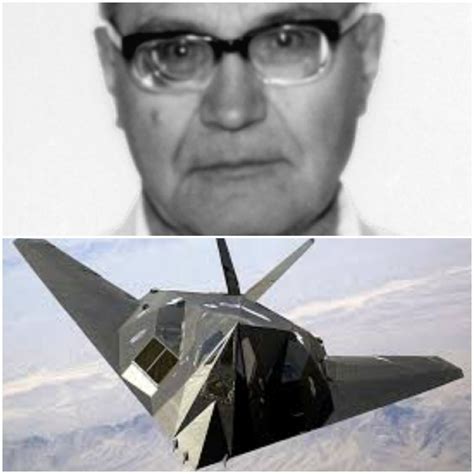
The Man Behind the Equation: Pyotr Ufimtsev and the Method of Edge Waves
In the 1960s, Pyotr Yakovlevich Ufimtsev was immersed in the theoretical world of electromagnetic wave diffraction. His primary focus: understanding how radar waves scatter when they encounter different surfaces—particularly flat and angular ones. His findings were compiled in a paper titled “Method of Edge Waves in the Physical Theory of Diffraction,” which was published under the assumption that it had no direct military value.
The Soviet authorities allowed its dissemination, unaware that they were essentially open-sourcing the holy grail of radar evasion. What Ufimtsev had unwittingly created was the mathematical framework for reducing radar cross-sections (RCS)—a critical component in developing stealth technology.
His work would have remained obscure had it not been for an engineer at Lockheed’s famed Skunk Works, Denys Overholser, who recognized the immense potential buried in Ufimtsev’s equations. Overholser realized that these complex mathematical models could predict how radar waves bounce off differently shaped aircraft surfaces. This understanding would become central to Lockheed’s emerging stealth project.
Lockheed’s Skunk Works: Breathing Life into Soviet Equations
In 1974, DARPA initiated Project Harvey, named after the invisible rabbit in the movie Harvey, reflecting its goal to develop aircraft that could be effectively “invisible” to radar. Lockheed’s Skunk Works, already known for pushing the boundaries of aerospace design, won the contract under the code name “Have Blue.”
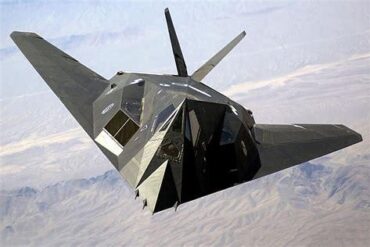
The Have Blue team, led by the legendary Ben Rich, went against every prevailing design doctrine. Instead of prioritizing aerodynamics, speed, or agility, the focus was absolute stealth. The design featured no curved surfaces, only sharply angled panels that could deflect radar waves in directions away from their source—a direct application of Ufimtsev’s mathematical theories.
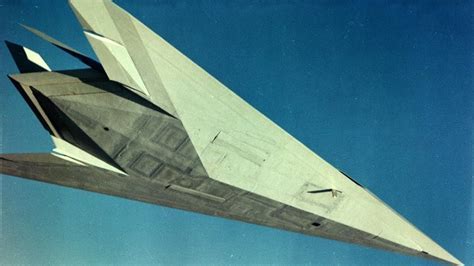
The resulting prototype resembled a jagged, alien-like craft. It was the first manmade object purpose-built to defeat radar detection, and though both prototypes crashed in separate incidents, they proved beyond doubt that radar invisibility was achievable.
The Birth of the F-117 Nighthawk: Invisibility Takes Flight
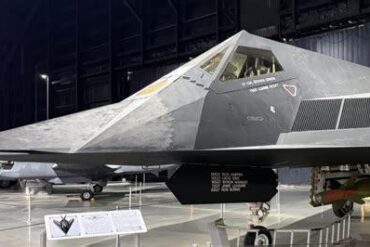
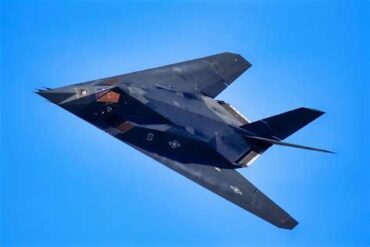
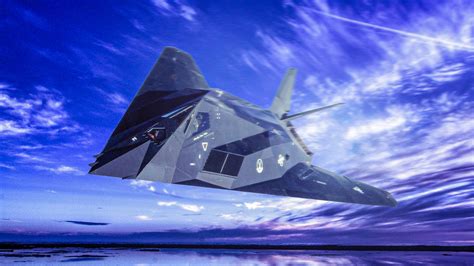
From the ashes of Have Blue rose the F-117 Nighthawk, the world’s first operational stealth aircraft. It was unlike anything that had flown before—a polygonal, faceted jet painted pitch black, designed to evade enemy detection rather than engage in traditional dogfights. Its weapons were stored internally, its engines buried deep in the fuselage to minimize heat signature, and it flew strictly at subsonic speeds to reduce infrared trails.
The aircraft’s first flight occurred in 1981, and by 1983 it was officially commissioned into the U.S. Air Force. Yet it remained hidden from the public eye. For five years, the Nighthawk flew only at night from a remote Nevada airbase, its existence concealed not just from enemies, but from the American public.
Stealth on the Battlefield: Operational Dominance in Global Conflicts
The F-117 first saw combat in 1989 during Operation Just Cause in Panama, targeting strategic command centers. But its moment of global debut came during the 1991 Gulf War, where it flew over 1,200 sorties without a single loss, neutralizing heavily defended targets in Baghdad with impunity.
Later, in Kosovo in 1999, the aircraft made headlines again—not for its success, but for its vulnerability. One F-117 was shot down by a Soviet-made SA-3 Goa missile. The incident, however, did not tarnish its legacy but underscored the risks even the most advanced technology faces in war. It remains the only stealth aircraft ever downed in combat.
The F-117 went on to serve in Afghanistan and Iraq, proving the value of stealth across multiple theaters of war. Even after its official retirement in 2008, the aircraft never fully disappeared.
Retirement in Name Only: The Ghost of the Nighthawk Still Flies
Despite its retirement, 45 F-117s have been preserved in flyable or regeneratable condition. These aircraft are still used today for experimental research, radar signature testing, and adversary training missions. In 2025, two F-117s were spotted refueling mid-air off the California coast, a quiet testament to their enduring value.
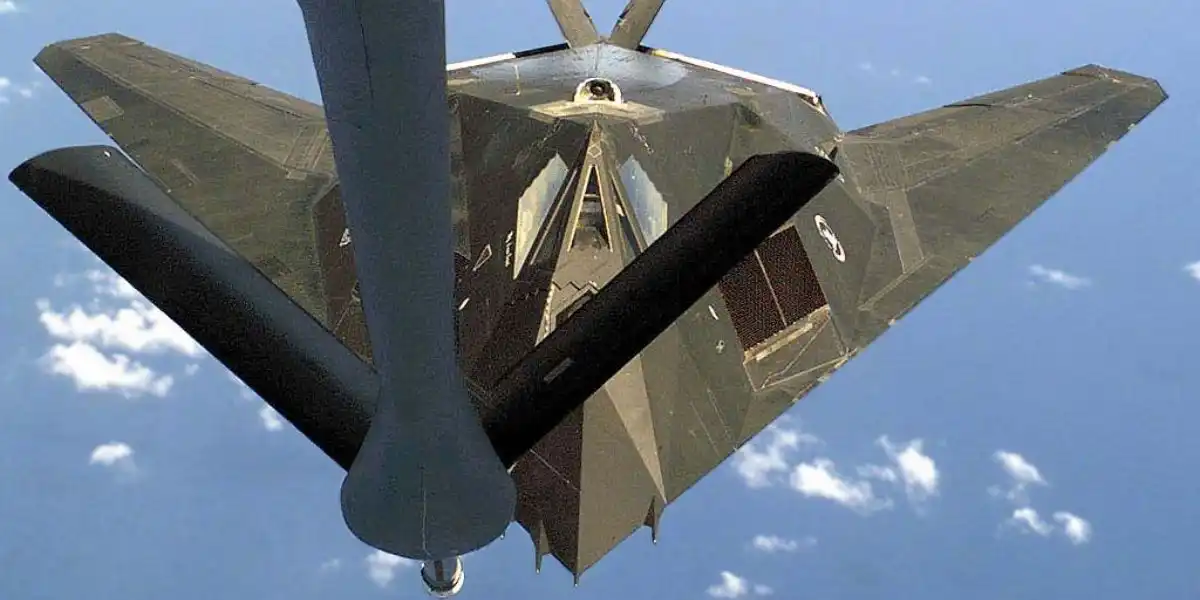
Officially, the Nighthawk won’t be permanently grounded until 2034 at the earliest, marking a career that spans over five decades—an incredible run for a jet whose creators prioritized stealth over longevity.
Legacy Beyond Design: Ufimtsev’s Equations and the Rise of Stealth Generations
The influence of Ufimtsev’s work did not end with the F-117. His theories formed the bedrock of subsequent stealth developments, from the B-2 Spirit bomber with its flying wing configuration, to the air-dominance F-22 Raptor, and the multirole F-35 Lightning II.
Each of these aircraft represents an evolution, applying more advanced materials and computational models. Yet the central principle—control over radar signature through shape and material—remains grounded in Ufimtsev’s equations.
Ironies of Innovation: A Soviet Mind Behind America’s Edge
The geopolitical irony of a Russian scientist enabling America’s military dominance is profound. Ufimtsev never defected, nor did he work for a Western institution. His only “crime” was publishing brilliant theoretical physics, which his own country dismissed. Meanwhile, the United States turned those theories into a weapon that redefined aerial warfare.
In an era when nations guard their intellectual property and research with unmatched vigilance, the story of Ufimtsev is a stark reminder of how open science can sometimes catalyze the most unexpected revolutions.
The United States remains the only country to successfully deploy stealth aircraft in multiple combat zones with proven effectiveness. As new platforms like the B-21 Raider and NGAD F-47 take shape, the lineage that began with Have Blue continues. And at the root of it all is a quiet physicist from the Soviet Union, whose formulas traveled farther than any jet he ever imagined.