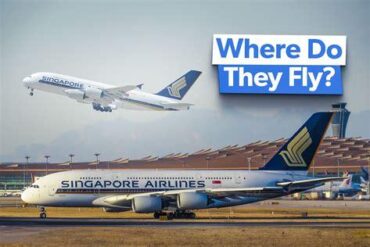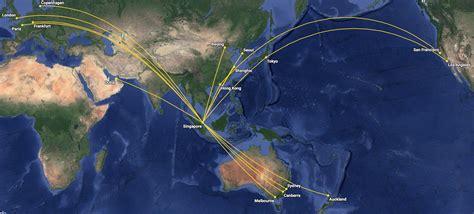
Singapore Airlines continues to demonstrate why it remains one of the world’s most respected long-haul airlines, and its Boeing 777-300ER fleet still occupies a crucial position within that strategy. Although the airline now relies heavily on newer Airbus aircraft, the 22 Boeing 777-300ERs continue serving some of the carrier’s most prestigious international markets. Despite representing only around 15% of the passenger fleet, these aircraft remain indispensable thanks to their premium-heavy cabin configuration, operational flexibility, and ability to efficiently connect multiple continents on a single journey. During the second half of 2026, the aircraft will operate 11 of the airline’s longest scheduled routes, including one remarkable itinerary stretching beyond 24 hours from departure to arrival.
Unlike many network analyses that focus exclusively on nonstop flying, these routes also include scheduled one-stop services whose total block time includes taxiing, flight duration, and normal operational buffers. The result is an impressive picture of how Singapore Airlines continues maximizing the versatility of its flagship twin-engine aircraft across Europe, North America, Oceania, and the Middle East.
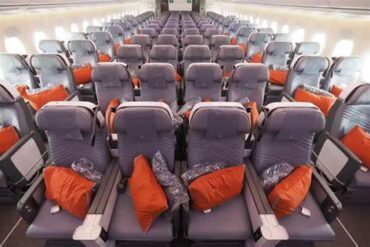
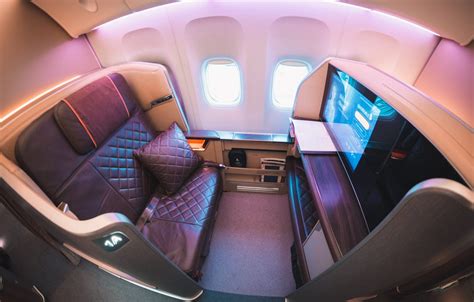
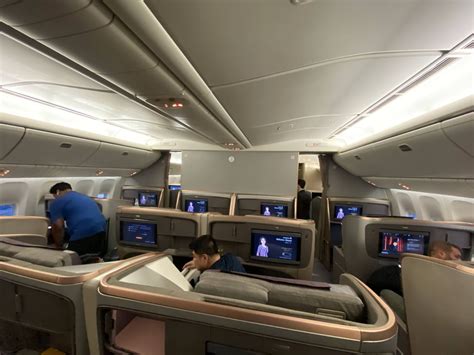
Every Singapore Airlines 777-300ER offers an intentionally premium cabin. Each aircraft accommodates only 264 passengers, featuring four First Class suites, 48 Business Class seats, 28 Premium Economy seats, and 184 Economy Class seats. It is also the airline’s only twin-engine passenger aircraft equipped with an international First Class cabin, allowing premium travelers to enjoy flagship service even on routes where the Airbus A380 does not operate.
Singapore Airlines Operates A 24-Hour Boeing 777 Passenger Journey
The airline’s longest scheduled Boeing 777-300ER operation is far more than simply a long-haul flight. It is effectively an intercontinental network linking Asia, Europe, and North America through a single aircraft rotation.
The route operates from Singapore Changi Airport to New York John F. Kennedy International Airport via Frankfurt Airport, reaching a scheduled block time of up to 24 hours and 20 minutes. While passengers traveling between Singapore and New York increasingly choose the airline’s nonstop Airbus A350-900ULR service, the Frankfurt routing remains strategically important because Singapore Airlines enjoys valuable fifth-freedom traffic rights between Germany and the United States. This allows the carrier to sell tickets solely between Frankfurt and New York while simultaneously carrying passengers continuing to Singapore.
The Frankfurt-New York operation has become one of the airline’s most enduring international services. According to U.S. Department of Transportation records, Singapore Airlines has maintained the route since 1992, transporting more than 5.5 million passengers over three decades. Aircraft have evolved considerably throughout that period, beginning with the iconic Boeing 747-400, later transitioning to the Airbus A380, briefly using the Airbus A350-900 during the pandemic, and ultimately settling on today’s Boeing 777-300ER from 2023 onward.
Los Angeles Via Tokyo Remains One Of Aviation’s Classic Long-Haul Routes
Ranking second is another legendary fifth-freedom operation connecting Los Angeles International Airport with Singapore via Tokyo Narita Airport. Scheduled at up to 20 hours and 35 minutes, this daily service has existed for decades and continues serving passengers traveling between Japan, the United States, and Southeast Asia.
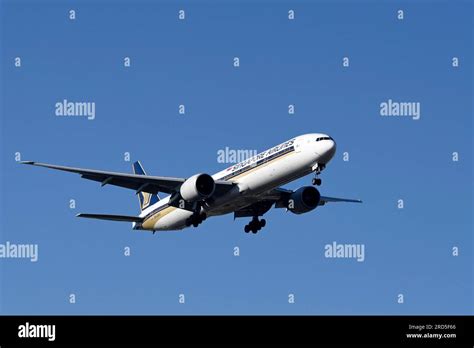
Like the Frankfurt-New York sector, the Narita-Los Angeles segment benefits from fifth-freedom rights that strengthen network economics while providing travelers with additional premium travel choices across the Pacific. Previous generations experienced this journey aboard the Boeing 747-400 before the Airbus A380 assumed the role, eventually handing operations to today’s efficient 777-300ER fleet.
After these exceptionally long one-stop services, the network transitions to traditional nonstop ultra-long-haul flying. London Heathrow ranks third at up to 14 hours and 25 minutes, followed closely by Paris Charles de Gaulle at 14 hours and 15 minutes. Amsterdam Schiphol completes the top five with flights scheduled for as long as 13 hours and 50 minutes, illustrating the enormous European footprint maintained by the aircraft.
Europe Continues To Dominate The Boeing 777-300ER Network
Europe remains one of Singapore Airlines’ strongest premium markets, and the Boeing 777-300ER plays a major role in supporting that demand. Following London, Paris, and Amsterdam, Frankfurt appears again as the sixth-longest route with a scheduled block time reaching 13 hours and 45 minutes before continuing onward to New York.
Zurich Airport follows closely at approximately 13 hours and 30 minutes, reflecting sustained premium demand between Switzerland and Singapore. The route has experienced several fleet transitions over recent years. While the Airbus A380 previously served Zurich, operational adjustments eventually shifted daily services back to the Boeing 777-300ER, where its smaller capacity better aligns with current market conditions while preserving premium cabin availability.
Australia, New Zealand And Dubai Complete The Longest Route Portfolio
The remaining routes demonstrate the remarkable versatility of the aircraft across the Asia-Pacific region. Auckland ranks eighth with flights lasting up to 10 hours and 50 minutes, while return services from Sydney and Melbourne require approximately 8 hours and 25 minutes and 8 hours, respectively. These markets consistently generate strong premium demand from both corporate travelers and leisure passengers.
The final entry belongs to Dubai, scheduled for up to 7 hours and 45 minutes. Although geopolitical tensions temporarily suspended operations because of regional security concerns involving Iran, services are expected to resume once operational conditions allow. Before the disruption, the Airbus A380 had been scheduled to replace the Boeing 777-300ER on the route, but revised planning keeps the twin-engine aircraft operating daily instead.
Together, these 11 longest Boeing 777-300ER routes showcase how Singapore Airlines continues extracting exceptional value from an aircraft that remains central to its premium long-haul strategy. Whether operating marathon 24-hour itineraries across three continents or connecting major financial centers throughout Europe and Oceania, the Boeing 777-300ER continues delivering the combination of range, passenger comfort, and operational efficiency that has made it one of commercial aviation’s most successful widebody aircraft. Even as newer aircraft gradually assume larger roles within the fleet, the triple seven remains an essential pillar supporting one of the world’s most sophisticated global airline networks.