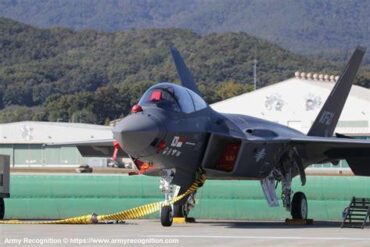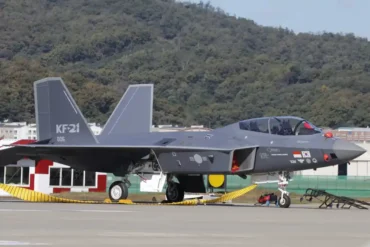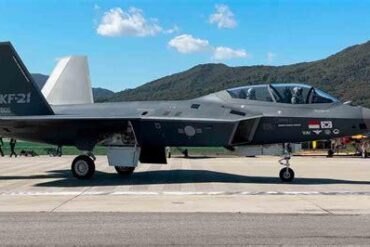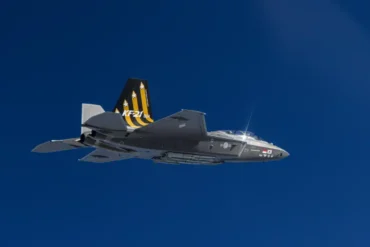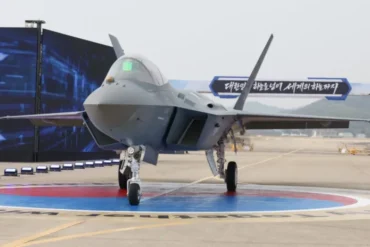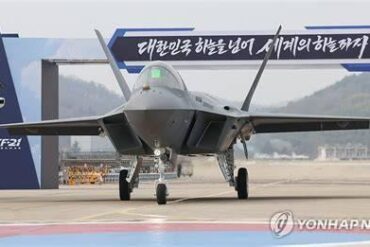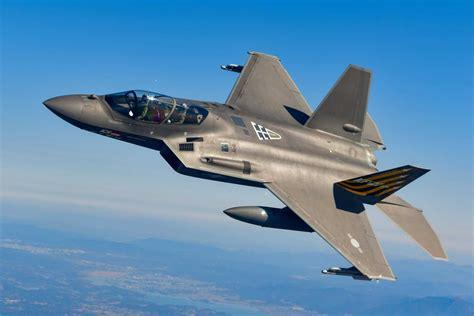
South Korea has crossed a decisive threshold in its quest for aerospace self-reliance with the KF-21 Boramae fighter jet officially cleared to enter frontline service after the successful completion of its development flight-test program. The announcement confirms that the country’s first domestically designed multirole combat aircraft is no longer an experimental ambition but a fully validated weapons system ready to be fielded by the Republic of Korea Air Force (ROKAF) at a moment of intensifying regional security pressure.
The milestone was confirmed by the Defense Acquisition Program Administration (DAPA) on January 13, 2026, following the completion of all planned test objectives. Over a period of 42 months, the KF-21 accumulated roughly 1,600 sorties and passed more than 13,000 individual test conditions without a single flight accident. In modern fighter development, where compressed schedules and software-heavy systems often introduce elevated risk, such a record is exceptional and immediately places the Boramae among the most disciplined and carefully managed combat aircraft programs of its generation.
Launched in 2015 to replace the ROKAF’s aging F-4 Phantom II and F-5 Tiger fleets, the KF-21 program was designed to give South Korea strategic autonomy in combat aviation while maintaining close interoperability with U.S. and allied systems. The completion of development testing now allows the aircraft to transition from prototype status into serial production, positioning it as a central pillar of Seoul’s future airpower architecture.
The achievement also carries symbolic weight. It signals that South Korea has joined the small group of nations capable of independently designing, integrating, testing, and certifying a high-performance supersonic fighter—an accomplishment that reshapes both its military posture and its standing within the global defense industry.
From Prototype to Proven Fighter: Inside the KF-21 Test Campaign
The KF-21 Boramae’s path to operational clearance has been defined by methodical expansion of performance boundaries rather than headline-grabbing stunts. Six prototypes—four single-seat and two twin-seat aircraft—were used to progressively validate aerodynamics, propulsion, avionics, and mission systems under increasingly demanding conditions. The final development sortie was flown on January 12, 2026, over waters off Sacheon, closing one of the most comprehensive flight-test programs ever conducted by a new Asian fighter.
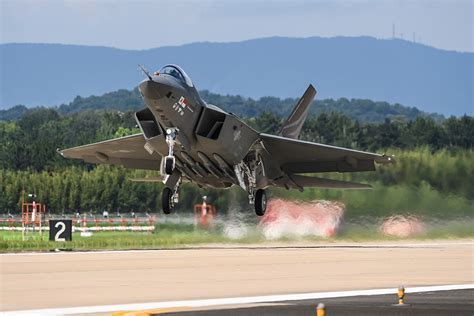
Test activities were distributed across multiple bases, including Sacheon and Seosan, to maximize sortie generation and simulate operational diversity. For the first time in a Korean fighter development program, aerial refuelling was integrated into flight testing, allowing engineers to evaluate endurance, fuel management, and long-duration mission profiles that reflect real-world combat scenarios. This capability is essential for extended air patrols and coalition operations beyond the Korean Peninsula.
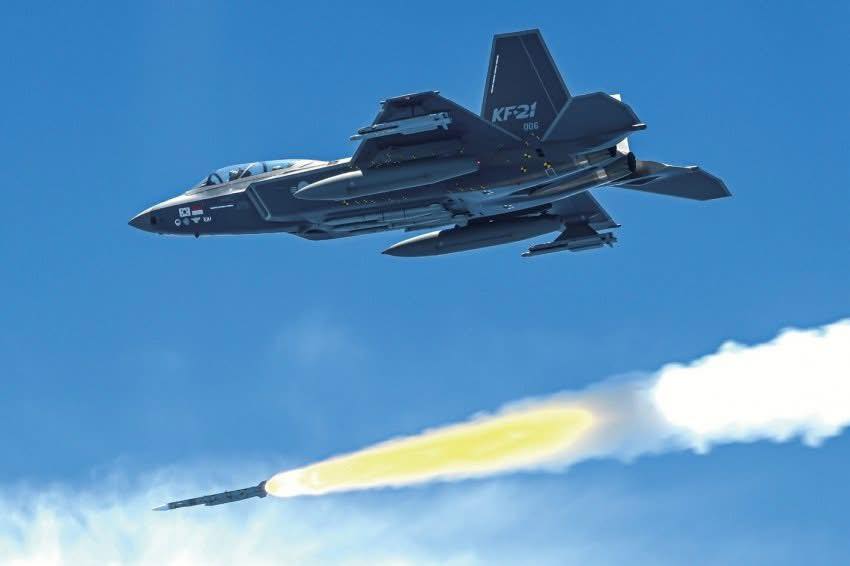
Weapons trials formed a critical part of the campaign. The KF-21 successfully demonstrated external carriage and separation of air-to-air missiles, validating structural integrity and flight stability across a range of speeds and altitudes. High-risk tests—including extreme-angle recovery and complex weapons-release envelopes—were completed without incident, reinforcing confidence in the aircraft’s handling qualities and digital flight-control laws.
The ability to conclude development testing two months ahead of schedule further underscores the maturity of the program’s systems engineering and risk management. For DAPA and the ROKAF, this translates directly into accelerated force regeneration at a time when regional air activity continues to rise.
A 4.5-Generation Design Built for Growth and Flexibility
The KF-21 Boramae is classified as a 4.5-generation multirole fighter, deliberately positioned between upgraded fourth-generation platforms and fifth-generation stealth aircraft such as the F-35. This design philosophy balances affordability, performance, and survivability, allowing South Korea to field a numerically significant fleet without the prohibitive costs associated with all-stealth forces.
Powered by two General Electric F414 turbofan engines, the aircraft is designed to reach speeds approaching Mach 1.8, operate at altitudes of roughly 50,000 feet, and sustain high sortie rates under demanding operational tempos. Its twin-engine configuration enhances survivability over maritime and mountainous terrain, a key consideration for Korean geography.
Central to the KF-21’s combat capability is its domestically developed AESA radar, produced by Hanwha Systems. The radar enables long-range detection, multi-target tracking, and simultaneous engagement of airborne, land, and maritime threats. Integrated with advanced mission computers and sensor fusion software, it provides pilots with a coherent, real-time battlespace picture—a defining feature of modern air combat.
While the initial Block I configuration prioritizes air superiority and air defense, the airframe has been engineered with substantial growth margins. Planned Block II upgrades will expand swing-role capabilities, including precision air-to-ground and maritime strike missions, while accommodating additional low-observable refinements. The open-architecture avionics design allows new sensors, weapons, and electronic warfare systems to be integrated without costly structural redesigns.
Strategic Independence Through Indigenous Technology
Beyond performance metrics, the KF-21 represents a strategic shift in how South Korea approaches national defense. During development, export restrictions forced domestic industry to independently create technologies that would previously have been imported, including radar, electronic warfare components, and electro-optical targeting systems. This challenge ultimately strengthened the country’s aerospace ecosystem.
By mastering these technologies at home, South Korea has reduced long-term dependence on foreign suppliers and gained greater freedom in weapons integration and export policy. The KF-21 is designed to accommodate both European missiles such as Meteor and IRIS-T and future indigenous munitions, giving Seoul flexibility rarely enjoyed by operators of foreign-designed fighters.
Cost efficiency is another decisive factor. Compared to fifth-generation platforms, the Boramae is expected to offer lower acquisition and operating costs, enabling sustained readiness and high sortie availability. This allows the ROKAF to deploy F-35A stealth fighters selectively for missions requiring extreme low observability, while relying on the KF-21 for the bulk of air defense and strike operations.
The program’s accident-free development record further strengthens confidence among policymakers and potential export customers, signaling a design that has reached operational maturity without being rushed into service.
Transforming the ROKAF’s Force Structure
The entry of the KF-21 into frontline service will significantly reshape South Korea’s air combat posture. The aircraft is intended to replace legacy fighters that have reached the limits of economical operation, while complementing modernized F-15K and F-16 fleets and stealthy F-35As.
DAPA plans to finalize system development in the first half of 2026, with mass-produced aircraft deliveries beginning in the second half of the year. The roadmap calls for 40 Block I fighters in service by 2028, expanding to approximately 120 aircraft by 2032. This scale of deployment will provide South Korea with a dense, resilient airpower layer capable of responding rapidly to incursions and crises.
Operationally, the KF-21 enhances air policing, quick-reaction alert missions, and coalition interoperability. Its sensor suite and data-link capabilities allow seamless integration with allied assets, reinforcing combined deterrence across the Korean Peninsula and beyond.
Export Potential and Regional Influence
The geopolitical impact of the KF-21 extends well beyond national defense. By fielding an indigenous multirole fighter, South Korea positions itself as a credible alternative supplier in a market traditionally dominated by the United States, Europe, Russia, and China.
Indonesia is exploring a revised plan to acquire 16 KF-21 Block II aircraft, potentially revitalizing its role in the program, while Malaysia and the Philippines have opened discussions with Korea Aerospace Industries regarding future procurement. For middle-power air forces seeking modern capability without full reliance on major powers, the Boramae offers an attractive balance of performance, cost, and political flexibility.
Successful exports would reinforce South Korea’s broader strategy of leveraging defense manufacturing as a tool of diplomacy and economic growth. Shared platforms create long-term training, maintenance, and interoperability ties, embedding Korean systems within regional security networks.
From National Ambition to Operational Reality
With development flight testing complete, the KF-21 Boramae now enters its most consequential phase: operational service. Its true measure will be defined not by test metrics alone but by reliability on the flight line, adaptability to evolving threats, and the confidence it inspires among pilots and planners.
The program’s disciplined execution—delivered ahead of schedule and without accidents—provides a strong foundation for success. As the aircraft transitions into squadron service and export negotiations mature, the KF-21 stands poised to become more than a replacement for aging jets. It is emerging as a cornerstone of South Korea’s deterrence strategy, a symbol of technological sovereignty, and a new factor in the balance of airpower across the Indo-Pacific.