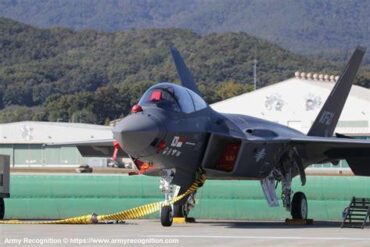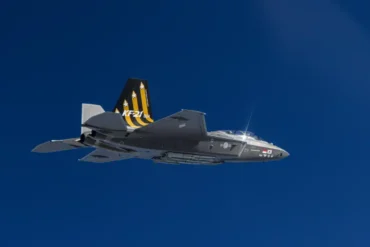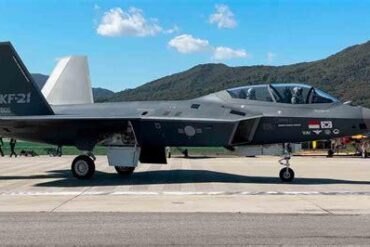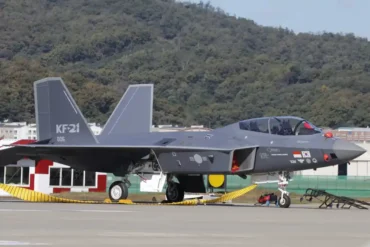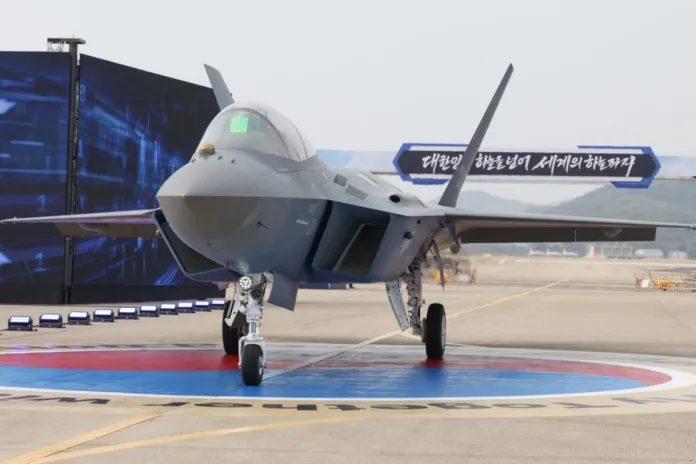
South Korea’s defense industry has reached a defining inflection point with the rollout of the KF-21 Boramae, a fighter jet that is rapidly reshaping the competitive landscape of modern airpower. Developed by Korea Aerospace Industries (KAI), this advanced multirole aircraft represents not just technological maturity, but a strategic declaration—South Korea is no longer a follower in aerospace innovation; it is now a serious contender.
The unveiling of the first mass-produced KF-21 marks the culmination of decades of ambition, investment, and engineering discipline. From its conceptual roots in the early 2000s to its astonishingly fast transition from prototype to production, the Boramae program has achieved what many nations struggle to accomplish: speed, scale, and sophistication—all at once.
What makes this achievement particularly striking is the context. While global competitors continue to wrestle with delays, cost overruns, and technical bottlenecks, South Korea has executed a near-flawless development trajectory. The KF-21 doesn’t merely enter the stage—it arrives ahead of schedule, ahead of expectations, and arguably ahead of its class.
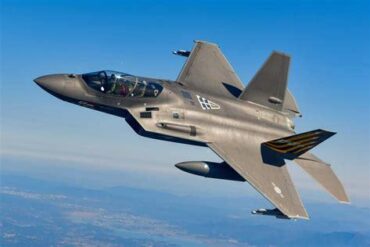
South Korea has officially rolled out the first mass-production KF-21 Boramae fighter jet, marking a major milestone for its domestic combat aircraft program.
Built by Korea Aerospace Industries (KAI), the KF-21 is a 4.5-generation twin-engine multirole fighter designed to… pic.twitter.com/bVqR0UF9VM
— Clash Report (@clashreport) March 25, 2026
A 25-Year Vision Realized: From Concept to Combat-Ready Platform
The KF-21 Boramae program traces its origins to a bold vision articulated in 2001—to develop a domestically produced fighter jet capable of securing national airspace without dependence on foreign platforms. That vision evolved into a structured development program by 2016, supported by both domestic innovation and strategic technology transfers.
What followed was an engineering sprint rarely seen in the aerospace sector. The first prototype emerged in 2021, followed by a successful maiden flight in 2022. Less than five years later, the first series-produced aircraft rolled out—an achievement that stands in stark contrast to traditional fighter development timelines, which often stretch beyond a decade.
This accelerated progress reflects a deeply integrated industrial ecosystem. South Korea’s defense sector has refined its ability to deliver cutting-edge systems with efficiency, balancing innovation with manufacturability. The KF-21 is not just a technological success; it is a systems-engineering triumph.
Why the KF-21 Is Being Called “4.9-Generation”
Officially classified as a 4.5-generation fighter, the KF-21 Boramae is already pushing beyond conventional definitions. Its capabilities blur the line between fourth- and fifth-generation platforms, prompting some experts—and even program leadership—to describe it as a “4.9-generation” aircraft.
This characterization is not marketing hype; it is grounded in tangible performance attributes:
- Advanced AESA radar for superior situational awareness
- Reduced radar cross-section design for partial stealth
- Integrated avionics architecture enabling sensor fusion
- High payload flexibility with multiple external hardpoints
- Twin-engine configuration for enhanced survivability and thrust
Unlike legacy 4.5-generation fighters such as Rafale or Eurofighter Typhoon, the KF-21 has been designed with future upgrades in mind from the outset. Its architecture is modular, scalable, and ready to absorb next-generation technologies without requiring fundamental redesigns.
The Stealth Evolution: Block Upgrades and the Path to Fifth Generation
One of the most compelling aspects of the KF-21 program is its phased development strategy. Rather than attempting to leap directly into full fifth-generation capabilities, South Korea has adopted a block upgrade approach—each iteration bringing the aircraft closer to true stealth dominance.
The current configuration lacks internal weapons bays, a defining feature of fifth-generation fighters. However, future variants—particularly the anticipated Block III (KF-21EX)—are expected to incorporate:
- Internal weapon carriage for reduced radar signature
- Enhanced stealth coatings and airframe shaping
- Indigenous engine development
- Integration with unmanned “loyal wingman” drones
- Advanced electronic warfare and AI-assisted systems
This evolutionary pathway is both pragmatic and strategic. It allows South Korea to field a highly capable platform today while continuously enhancing its capabilities without incurring the risks associated with all-at-once development.
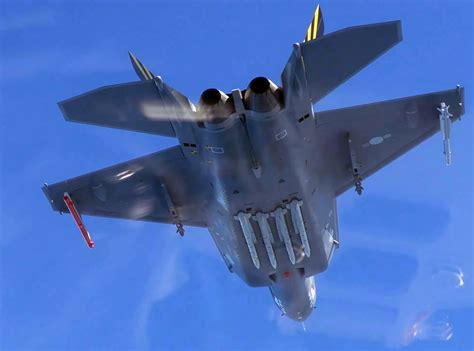
Speed as a Strategic Advantage: Outpacing Global Rivals
Perhaps the most astonishing element of the KF-21 story is its pace. From first flight to production rollout in under five years, it has dramatically outperformed historical benchmarks.
To put this into perspective, consider comparable programs:
- The F-35 program took approximately 11 years from prototype flight to production rollout
- Russia’s Su-57 required around a decade to reach a similar milestone
In contrast, the KF-21 has compressed this timeline by more than half. This speed is not merely an engineering achievement—it is a strategic advantage. In modern defense markets, timing can be as critical as capability.
While India’s AMCA program remains in early development stages and Turkey’s KAAN is still progressing through prototype testing, South Korea has already crossed into serial production. This positions the KF-21 as the most mature next-generation fighter among emerging aerospace powers.
Export Ambitions: A Fighter Built for the Global Market
South Korea’s ambitions for the KF-21 extend far beyond domestic deployment. The aircraft has been designed from the outset with export competitiveness in mind—balancing performance with affordability.
Several nations have already expressed interest, including:
- United Arab Emirates
- Saudi Arabia
- Philippines
- Poland
These countries are seeking alternatives to expensive Western platforms and politically constrained supply chains. The KF-21 offers a compelling proposition: near-fifth-generation capabilities at a significantly lower cost, coupled with flexible partnership opportunities.
South Korea’s growing reputation as a reliable defense exporter further strengthens this appeal. Over the past decade, the country has steadily increased its share of the global arms market, leveraging its ability to deliver advanced systems بسرعة and at competitive prices.
Strategic Impact: Strengthening South Korea’s Airpower Doctrine
For the Republic of Korea Air Force (ROKAF), the KF-21 represents more than a new aircraft—it is a cornerstone of national defense strategy. The platform is expected to complement existing F-35A assets, creating a layered airpower structure that combines stealth, versatility, and numerical strength.
This integration is critical in the context of regional security dynamics. The Korean Peninsula remains one of the most heavily militarized regions in the world, and air superiority is a निर्णायक factor in any potential conflict scenario.
The KF-21 enhances South Korea’s three-axis defense system, which focuses on:
- Preemptive strike capabilities
- Missile defense
- Retaliatory response mechanisms
By providing a domestically controlled, highly capable fighter platform, the Boramae reduces reliance on foreign systems and ensures operational sovereignty.
KF-21 vs AMCA and KAAN: A Clear Lead—For Now
In the broader context of next-generation fighter development, the KF-21 currently holds a decisive lead over its closest peers.
India’s AMCA program, while ambitious, is still navigating early-stage development challenges. With its first flight projected for the late 2020s and induction timelines extending into the mid-2030s, it remains years away from operational reality.
Turkey’s KAAN program has made more visible progress, achieving prototype rollout and initial flight testing. However, serial production is not expected until at least 2028, and even that timeline carries uncertainty.
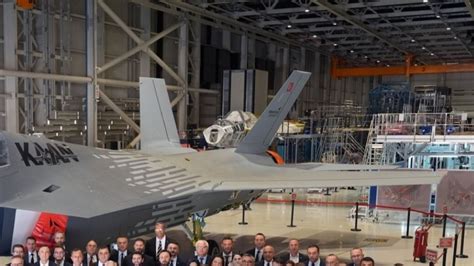
In contrast, the KF-21 is already transitioning into operational deployment. This temporal advantage could prove decisive in securing export contracts and establishing market dominance before competitors fully mature.
A New Aerospace Power Emerges
The KF-21 Boramae is more than a fighter jet—it is a symbol of transformation. It reflects South Korea’s evolution from a technology importer to an innovation leader, capable of designing, developing, and producing world-class defense systems.
This transformation has been underpinned by consistent policy support, strategic partnerships, and a relentless focus on execution. The result is an aerospace ecosystem that can compete with established powers on both capability and cost.
As future upgrades bring the KF-21 closer to full fifth-generation status, its significance will only grow. It has the potential to join the ranks of elite fighter programs, reshaping not just regional balances of power, but the global defense industry itself.
Conclusion: The Fighter That Changed the Timeline
The KF-21 Boramae has done something rare in modern defense development—it has changed expectations. By delivering advanced capabilities on an accelerated timeline, it has forced competitors to rethink their own programs and timelines.
Its blend of performance, affordability, and upgrade potential makes it one of the most compelling fighter platforms of its generation. And with each new block upgrade, it moves closer to redefining what a “fifth-generation” fighter truly means.
In a world where air superiority remains a cornerstone of military power, the KF-21 is not just keeping pace—it is setting it.