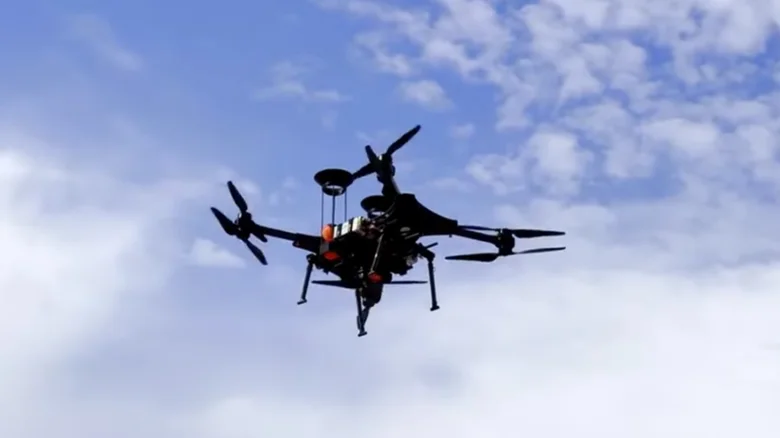
The United States faces a wildfire crisis defined by scale, speed, and unpredictability. Millions of acres of forested land, shifting climate patterns, and prolonged dry seasons have combined to make destructive fires a recurring national emergency. In 2023 alone, more than 56,000 wildfires were recorded across the country, followed by nearly 65,000 incidents in 2024, a grim escalation that underscores how rapidly conditions are deteriorating. Against this backdrop, a student-built drone system is emerging as a powerful new tool that could fundamentally reshape how early wildfire response is handled in America.
Wildfires are not only dangerous because of their intensity, but because of how quickly they grow beyond control. In remote or mountainous terrain, fire crews often need precious minutes or even hours to reach the ignition point. By the time engines, helicopters, and ground teams arrive, a small spark can already have transformed into an unstoppable front. The promise of drone-based intervention lies in speed, precision, and automation, qualities that traditional firefighting methods struggle to match in the opening moments of a blaze.
Drones have already proven their value in search-and-rescue operations, disaster assessment, and emergency surveillance. Their ability to launch within seconds and travel directly to a location without terrain constraints makes them uniquely suited to wildfire detection and containment. Building on this advantage, a team of students in California is now pushing the technology further, integrating artificial intelligence, autonomous navigation, and targeted fire suppression into a single coordinated system designed to act before fires spiral out of control.
A Smart Detection Network Designed for Immediate Action
At the heart of this innovation is a network of fire-detection towers currently operating in Orange County, California. These towers, developed by Sensory AI, continuously scan vast landscapes for the earliest indicators of wildfire ignition. According to Sensory AI founder Ryan Honary, the system is trained to recognize three critical wildfire signatures: smoke, heat plumes, and visible flame. When any combination of these indicators appears, the system can identify a fire within moments of ignition.
What elevates this project beyond conventional monitoring is what happens next. Instead of merely alerting emergency services, the detection system transmits precise coordinates directly to a specially equipped firefighting drone. This automated handoff removes delays caused by human verification and dispatch procedures, allowing the drone to launch almost instantly after a fire is detected.
This integration of detection and response represents a shift toward proactive firefighting, where technology intervenes at the earliest possible stage. The project is also part of the $3.5 million XPrize Wildfire Challenge, an international competition aimed at accelerating breakthrough solutions for wildfire prevention and suppression, with finals scheduled for June 2026.
How the Firefighting Drone Responds in Real Time
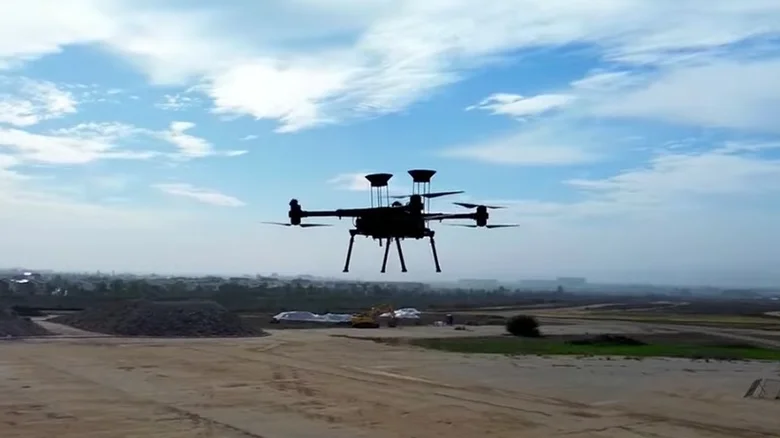
Once airborne, the drone navigates autonomously to the fire’s coordinates using GPS guidance and onboard sensors. Daniel Kim, Vice President of Valley Christian Schools, explains that when the drone reaches the site, it adjusts its position and releases a targeted payload designed to suppress or slow the fire’s spread. This payload may include water, fire retardant, or specialized extinguishing agents depending on the scenario.
The goal is not to replace firefighters, but to buy time. By knocking down flames or cooling hotspots early, the drone can prevent a small ignition from becoming a fast-moving wildfire. Even when it cannot extinguish a fire completely, it can significantly reduce intensity, making subsequent ground and aerial suppression safer and more effective.
Working Alongside Firefighters, Not Replacing Them
Fire officials emphasize that this technology is designed to complement, not supplant, traditional firefighting forces. Kevin Fetterman (Ret.), Division Chief of the Orange County Fire Authority, describes a future where drones launch simultaneously with fire engines and aircraft. While crews are still en route, drones could already be on scene, deploying extinguishing agents and providing live intelligence.
This coordinated response could be transformative. Firefighters would arrive to a partially contained situation rather than an uncontrolled inferno, reducing risk to personnel and improving overall containment success. The first-response window, often the most decisive factor in wildfire outcomes, is where drones offer their greatest advantage.
Lessons from Recent Catastrophic Fires
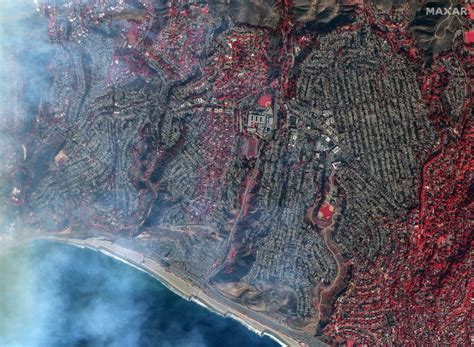
The urgency of faster intervention is underscored by events like the Eaton and Palisades fires that swept through Los Angeles in January 2025. Over nearly four weeks, those fires burned approximately 37,000 acres across 45 square miles, destroying homes, wildlife habitats, and critical infrastructure. Fires of this magnitude demonstrate how quickly initial delays can cascade into long-term devastation.
As ABC News meteorologist Ginger Zee noted, many fires ignite in areas without easy road access. While firefighters may need hours to navigate rugged terrain, a drone can reach the same location in seconds. That difference can determine whether a fire becomes a headline or a footnote.
Heavy-Lift Drones Redefining Fire Suppression Capabilities
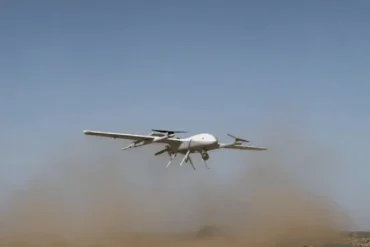
Contrary to the common image of drones as small, lightweight devices, modern firefighting drones can be substantial machines. Kaizen Aerospace, the company behind the drones used in this project, manufactures models of varying sizes tailored to different emergency scenarios. One of their largest firefighting drones measures 13 feet in length and can carry payloads of up to 1,000 pounds, enabling it to deliver significant volumes of water or retardant with pinpoint accuracy.
These capabilities open the door to safer firefighting strategies that reduce the need to place human crews directly in harm’s way during the most volatile stages of a blaze. Combined with real-time data feeds and wildfire tracking tools, drone technology represents a decisive step toward smarter, faster, and more resilient wildfire management.
As climate pressures intensify, solutions like this student-built drone may prove essential in protecting lives, landscapes, and communities across the United States.