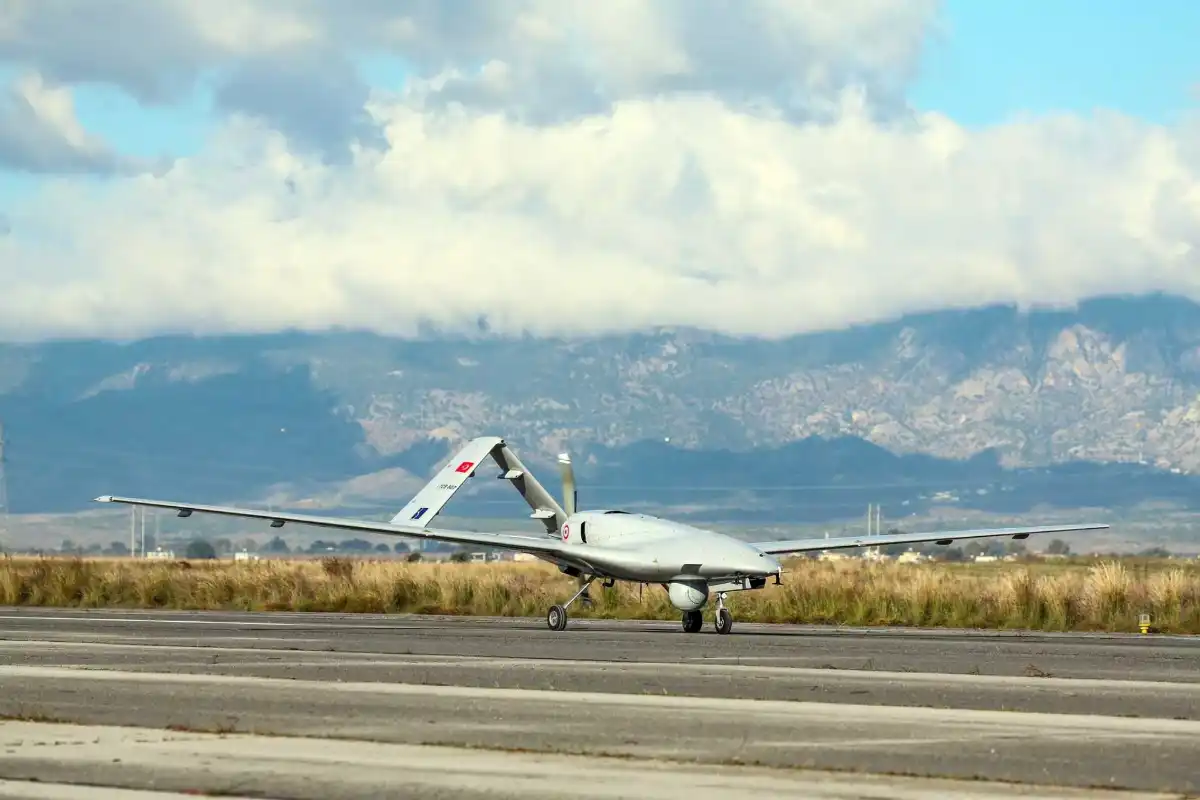
The possibility that the Syrian Arab Army could soon receive Turkish-made Bayraktar TB2 unmanned aerial vehicles has emerged as one of the most intriguing defense stories in the region, reflecting how rapidly Middle Eastern security dynamics are evolving after years of entrenched hostility. Although the claim remains unconfirmed, it has already triggered intense scrutiny because of what it implies politically, militarily, and symbolically for Ankara and Damascus.
Reports citing a senior Syrian military official suggest that the Turkish government is at least considering the transfer or sale of a limited number of TB2 drones. Even without formal confirmation, the mere circulation of such information signals that bilateral relations have entered a new and pragmatic phase. Only a few years ago, Turkish drones were actively employed against Syrian government forces; today, those same systems are being discussed as potential assets for Syria’s post-Assad military reconstruction.
This development must be understood against the backdrop of Syria’s profound transformation since the collapse of the Assad government and the establishment of transitional authorities. For Damascus, rebuilding the armed forces is no longer about projecting power abroad but about restoring internal stability, territorial control, and basic deterrence. For Ankara, engagement with the new Syrian leadership serves strategic interests tied to border security, refugee management, and regional influence.
A Dramatic Shift in Syrian–Turkish Military Relations
The idea of Turkish drones supporting Syrian forces would have been inconceivable during the height of the civil war. Relations between Ankara and Damascus were defined by open confrontation, proxy conflict, and competing security agendas. That paradigm began to erode after the fall of Assad, when both sides reassessed their priorities under new political realities.
In August 2025, Türkiye and Syria’s transitional authorities signed a memorandum of understanding on military cooperation, laying the groundwork for structured engagement. The agreement reportedly covers training programs, logistical assistance, advisory support, and the selective supply of military equipment. Since then, Syrian soldiers have begun attending courses in Turkish military facilities, while cadets have been admitted to Turkish academies across land, air, and naval disciplines. Turkish officers, in turn, have provided guidance on command organization, logistics reform, and force regeneration.
Within this framework, drones stand out as a particularly sensitive yet potentially transformative capability. Unlike heavy armor or combat aircraft, unmanned systems can be introduced in small numbers, scaled gradually, and tailored to defensive and surveillance missions. This makes them politically easier to justify while still delivering tangible operational benefits.
Why the Bayraktar TB2 Matters to Syria
For the Syrian Arab Armed Forces, the attraction of the Bayraktar TB2 lies less in its strike capability and more in its ability to deliver persistent intelligence, surveillance, and reconnaissance. After more than a decade of war, Syria’s military remains large on paper but fragmented in readiness, training, and equipment quality.
Ground forces continue to rely heavily on aging Soviet-era platforms such as T-55, T-62, and T-72 tanks, BMP infantry fighting vehicles, and a diverse mix of artillery systems. While manpower remains substantial, unit effectiveness varies sharply by region and mission. The air force, once a cornerstone of Syrian military power, now operates with reduced aircraft availability, constrained maintenance capacity, and limited pilot training cycles.
In this context, even a small fleet of TB2s could dramatically enhance situational awareness. Persistent drone coverage would allow Syrian commanders to monitor sensitive regions, track armed group movements, and secure borders and infrastructure with far greater efficiency than manned aircraft or ground patrols alone. Precision strike options, while secondary, would offer a limited but valuable tool against isolated threats.
Current Syrian Military Priorities and Constraints
Today’s Syrian forces are focused overwhelmingly on internal security missions rather than conventional warfare. Units are deployed to secure major cities, highways, border crossings, and strategic assets such as power plants and energy facilities. In contested or politically sensitive areas, the emphasis is on monitoring rival armed factions and preventing infiltration rather than launching offensive operations.
Air assets are used sparingly, primarily for reconnaissance or occasional strikes when conditions permit. Air defense units concentrate on protecting key sites instead of attempting nationwide coverage. These operational patterns reflect limited resources, logistical strain, and a deliberate preference for intelligence-driven, defensive postures.
Within this environment, drones like the TB2 align well with Syria’s needs. They offer endurance, flexibility, and relatively low operating costs compared to manned aircraft. Crucially, they also fit a doctrine centered on control and monitoring, not deep-strike campaigns.
Political Sensitivities Surrounding a Drone Transfer
Despite the operational logic, the political implications of a TB2 transfer are complex. Turkish drones became globally known through their combat use in Syria, Libya, Nagorno-Karabakh, and Ukraine, often against forces aligned with or supported by Damascus in earlier phases of the conflict. Any sale to Syria would therefore represent a symbolic reversal that cannot be overlooked.
Such a move would also imply ongoing Turkish involvement in training, maintenance, and technical support. Unmanned systems depend on secure communications, ground control stations, and software updates, all of which require sustained cooperation. This raises questions about oversight mechanisms, rules of use, and the extent to which Ankara would retain influence over how the drones are employed.
The absence of details on quantities, timelines, or contractual terms suggests that, if the idea is real, it may begin as a highly constrained and carefully managed step. Rather than signaling a full military alliance, it would point to cautious experimentation within a broader, interest-based relationship.
The Bayraktar TB2: Design, Evolution, and Capabilities
Developed by Baykar in the early 2010s, the Bayraktar TB2 was part of Türkiye’s drive to reduce reliance on foreign unmanned systems and establish an independent armed drone capability. The aircraft conducted its first flight in 2014 and soon entered service with Turkish forces, initially in an ISR role before being cleared for armed missions.
Production expanded steadily, with more than 600 units manufactured, driven by both domestic demand and exports. Operational experience, coupled with export restrictions on foreign components, led Baykar to introduce locally produced subsystems and incremental upgrades, including improved avionics and satellite communications in later variants.
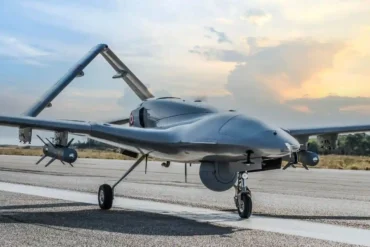
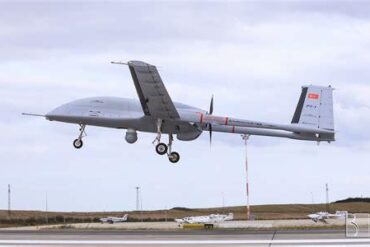
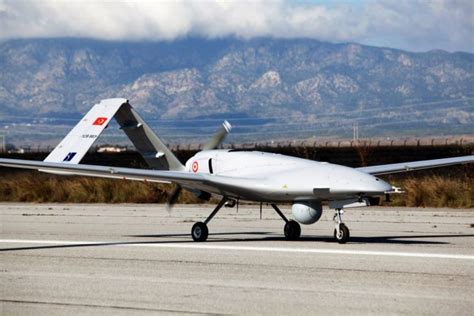
Technically, the TB2 is a medium-altitude long-endurance UAV optimized for persistence rather than speed. It features a wingspan of approximately 12 meters, a length of 6.5 meters, and a maximum takeoff weight of around 700 kilograms. A rear-mounted propeller driven by a single internal combustion engine provides efficient cruise performance, while the twin-boom tail and high-aspect-ratio wing ensure stable flight at medium altitudes.
Operational Performance and Limitations
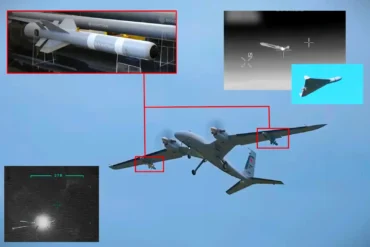
The TB2’s endurance can exceed 24 hours, depending on payload and mission profile, allowing continuous monitoring of areas of interest. With a payload capacity of roughly 150 kilograms, it typically carries electro-optical and infrared sensors alongside lightweight laser-guided munitions such as MAM-C and MAM-L.
Operational altitude usually ranges between 18,000 and 25,000 feet. Line-of-sight data links support operations over several hundred kilometers, while satellite communications-equipped versions extend that reach significantly. However, survivability depends heavily on the threat environment. The TB2 performs best in permissive or moderately contested airspace, where opposing air defenses and electronic warfare capabilities are limited.
For Syria, this profile is both a strength and a constraint. The country’s airspace threats are uneven, making careful deployment and tactics essential. Used judiciously, TB2s could deliver high value without exposing Syria to unacceptable losses.
Strategic Implications for the Region
If confirmed, the introduction of Turkish drones into Syrian service would carry regional implications beyond their immediate military utility. It would underscore Türkiye’s emergence as the most influential external partner in Syria’s military rebuilding, eclipsing other actors through institutional engagement rather than large-scale deployments.
At the same time, it would signal to neighboring states that Damascus is pursuing a pragmatic, diversified approach to security cooperation. Rather than relying exclusively on legacy partners or Cold War-era systems, Syria appears willing to integrate modern capabilities from regional players where interests align.
Whether this reported consideration evolves into a concrete transfer or fades as speculation, it reflects a deeper truth: Syrian–Turkish relations are no longer defined solely by past enmity. In a region shaped by shifting alliances and hard security calculations, even the idea of a Bayraktar TB2 flying under Syrian colors marks a notable turning point—one that merits close attention as the balance of cooperation and caution continues to evolve.