Residents of Tucson, Arizona were jolted awake on the night of June 17, 2025, as low-flying helicopters thundered through the dark skies over their quiet neighborhoods. Among them, one aircraft stood out — a gray-painted Mi-17 “Hip”, a Russian-built helicopter flying in formation with American Bell 407s. The sudden aerial activity, involving bright lights, sirens, and simulated combat noise, left locals alarmed and confused. Later revelations confirmed the helicopters were part of a highly classified U.S. military training exercise — a scenario that ignited fresh debate over transparency, foreign technology integration, and covert defense operations on American soil.
A Russian Aircraft in the Arizona Desert: The Mi-17 Makes a Surprise Appearance
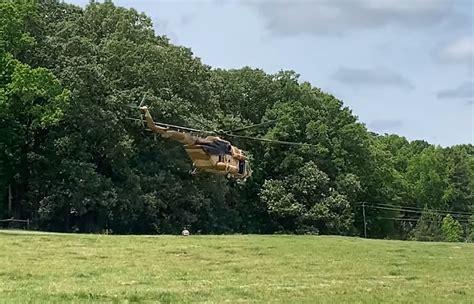
The Mil Mi-17, a versatile Russian-designed utility helicopter, is not a common sight in American airspace — especially not over suburban Tucson. Yet video clips uploaded to Instagram late that night unmistakably showed the aircraft maneuvering close to rooftops near an abandoned school building, its distinctive rotor configuration and silhouette making it instantly recognizable to aviation watchers.
While initial online speculation ranged from UFO theories to drug cartel involvement, the truth emerged quickly: the Mi-17 was flying under U.S. military command, taking part in a covert urban warfare exercise designed to simulate high-risk operations in hostile or unfamiliar environments.
The Pima County Sheriff’s Department later confirmed that the helicopters were affiliated with the U.S. military, though even local law enforcement admitted to being left in the dark. Sheriff Chris Nanos, speaking to local media outlet KOLD News 13, said: “The only thing I knew was that there was a lot of noise, flash bangs, helicopters, personnel, lights, sirens — that type of stuff.”
Secretive Army Aviation Unit Suspected: The Role of the Aviation Technology Office
Defense analysts were quick to weigh in. A detailed report by The War Zone (TWZ), a publication known for deep-diving into military aviation, pointed to strong evidence linking the Tucson operation to the Aviation Technology Office (ATO) — one of the most secretive Army aviation units in the U.S. military apparatus.
Based out of Felker Army Airfield in Virginia, ATO is believed to focus on black operations support, clandestine mission rehearsals, and experimental aviation technologies. Its aircraft often differ markedly from their conventional military counterparts, featuring advanced modifications, such as:
- Reinforced ballistic armor
- Infrared and radar-absorbing coatings
- Unusual sensor and antenna arrays
- Custom avionics and navigation systems
The Mi-17 spotted in Tucson bore several of these enhancements, aligning with Mi-17s previously observed in other ATO-linked missions, such as a 2021 emergency landing in North Carolina involving a similarly modified helicopter.
Public Caught Off Guard: Backlash Over Lack of Notification
Despite the military’s focus on realism in training, the absence of public notification sparked widespread concern. Social media platforms quickly filled with videos and testimonials from startled residents, many of whom feared an actual attack or law enforcement crisis was unfolding.
The abandoned school — later identified as a decommissioned local facility repurposed for tactical drills — had been approved weeks in advance for military use, with the Sheriff’s SWAT unit reportedly involved in its selection. However, no effort was made to inform nearby residents or even the wider Pima County law enforcement body.
Sheriff Nanos expressed regret, stating: “This was on us. We could easily have said, use our location [elsewhere] at 10 p.m. I don’t understand what the thinking was there.”
He further pledged better coordination for future drills, emphasizing that trust between military forces and the local population hinges on communication and transparency.
Why the U.S. Uses Russian-Built Helicopters
Though it may seem paradoxical, the U.S. military has a long history of operating and maintaining Russian-designed aircraft — especially the Mi-17 platform, known for its rugged reliability and adaptability in austere environments.
Originally developed in the Soviet Union as an export-oriented derivative of the Mi-8, the Mi-17 is widely used across Asia, Africa, Latin America, and Eastern Europe. This global footprint makes it a valuable tool for training exercises where American forces simulate operations in regions where such aircraft are prevalent.
The CIA, U.S. Army Special Forces, and Department of Defense have all used Mi-17s in various missions, especially in Afghanistan, where they trained and equipped local forces to fly and maintain the type.
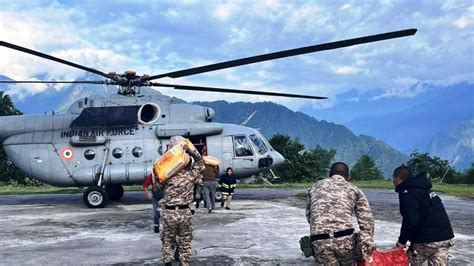
Incorporating Mi-17s into stateside drills allows American troops to train with platforms they may encounter or need to use during joint operations, extraction missions, or humanitarian efforts in allied or contested territories.
Bell 407s: A Familiar Companion in Clandestine Aviation
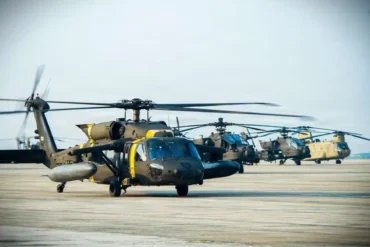
Flying alongside the Mi-17 that night were three Bell 407 helicopters, light utility aircraft frequently employed by both civil authorities and covert military units. Their speed, maneuverability, and ease of modification make them ideal for low-visibility infiltration and extraction missions, often in environments where more conspicuous platforms would be inappropriate.
ATO is known to operate Bell 407s as part of its fleet, often outfitting them with:
- Quiet rotor systems for stealth operations
- Enhanced surveillance payloads
- Night vision-compatible cockpit lighting
When seen in tandem with an Mi-17, the 407s likely serve escort, surveillance, or insertion roles, adding to the realism and tactical depth of the training scenario.
Operational Implications: What This Means for U.S. Defense Strategy
This episode, while dramatic, reflects a broader evolution in U.S. military doctrine: the increasing reliance on urban warfare training, realistic roleplay, and interoperability with non-NATO platforms.
In an age where military engagement can span traditional battlefields, crumbling cityscapes, and digitally saturated civilian zones, American forces must be prepared for everything from joint operations with foreign partners to counter-insurgency efforts in hostile environments. Training with foreign aircraft and repurposed domestic structures mirrors the complexity of real-world missions far more effectively than sterile base exercises.
The Tucson exercise, therefore, underscores two key trends:
- Deepening secrecy in military preparedness, as operations increasingly occur outside public view, even on U.S. soil.
- Strategic integration of foreign technology to bolster mission realism, especially in anticipation of conflict zones where U.S. troops may find themselves relying on local infrastructure or allied support.
Conclusion: The Thin Line Between Realism and Public Trust
While the need for highly realistic, dynamic military exercises is clear, the Tucson incident illustrates the delicate balance between secrecy and civilian assurance. Surprise night drills using foreign-built helicopters over populated American towns invite scrutiny, and the lack of public warning can erode the credibility and trust necessary for defense initiatives to succeed domestically.
That said, the use of an Mi-17 by U.S. forces is far from unprecedented. It is, instead, a window into how modern militaries train for tomorrow’s wars — not just through advanced weapons or hardware, but by adopting tools, techniques, and scenarios that reflect the complex global environments in which they may be deployed.
As the dust settles over Tucson and analysts dissect the event, one thing is certain: this was no accident. It was a calculated demonstration of readiness, made visible only by the keen eyes and smartphones of those who happened to look up when the roar of rotor blades shattered the silence of a summer night.