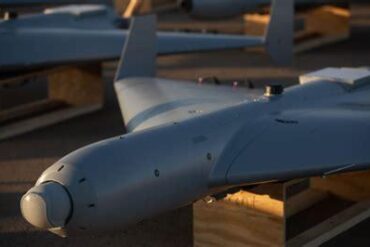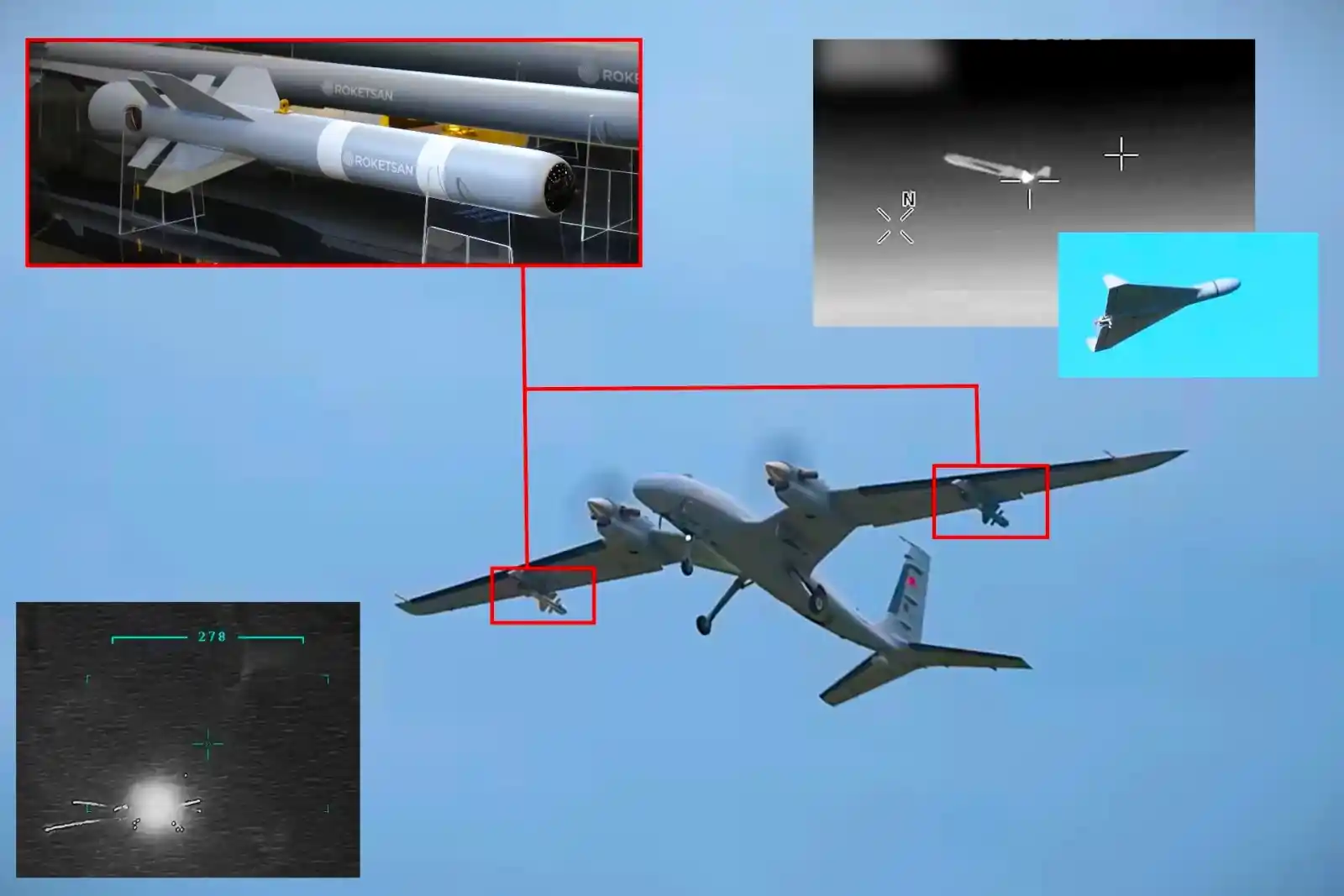
Türkiye has crossed a decisive threshold in unmanned warfare. In a landmark demonstration over the Black Sea, the Bayraktar AKINCI unmanned combat aerial vehicle (UCAV) achieved its first confirmed air-to-air kill, destroying a Shahed-type target drone using the turbojet-powered EREN loitering munition. Conducted near Sinop and publicly confirmed on 21 February 2026, the test signals more than a technical milestone. It marks the emergence of a new operational logic in air defense—one in which long-endurance unmanned aircraft do not merely observe or strike ground targets, but actively hunt hostile drones in contested airspace.
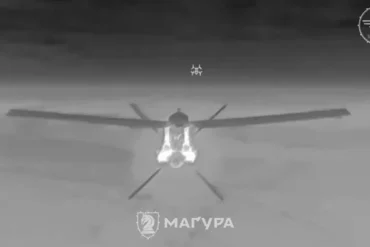
The engagement occurred after AKINCI departed from Baykar’s Flight Training and Test Center in Çorlu and proceeded toward a designated test area over the Black Sea. A target UAV, launched from the coast near Sinop, climbed to its assigned altitude and profile. Once within parameters, AKINCI released a single EREN munition. The weapon accelerated under turbojet power, navigated toward the moving target, locked on using its seeker system, and executed a direct hit. The intercept was clean, kinetic, and decisive. No supporting fighter aircraft or ground-based radar was required to complete the kill chain.
This matters because it compresses detection, tracking, decision, and engagement into a single unmanned platform. Instead of depending on a distributed network of radars, fighters, and surface-to-air missile batteries, AKINCI demonstrated a self-contained capability: find the threat, classify it, launch, and destroy. In an era defined by mass-produced kamikaze drones and low-cost aerial threats, that autonomy alters both tactics and economics.
The AKINCI Platform: From Strike Drone to Aerial Interceptor
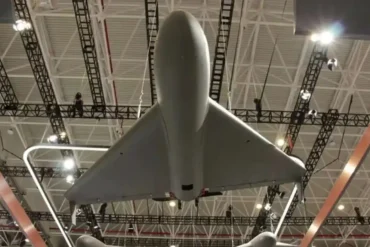
The Bayraktar AKINCI was conceived as a high-altitude, long-endurance combat drone with significant payload and multirole flexibility. With a maximum take-off weight of roughly six tons and a payload capacity exceeding 1,500 kilograms, it operates in a different class from lighter tactical drones. Twin turboprop engines sustain endurance beyond 24 hours, while eight external hardpoints allow simultaneous carriage of precision-guided bombs, cruise missiles, and specialized munitions.
What transforms AKINCI from a strike asset into an interceptor is its sensor suite. Equipped with satellite communications, electronic warfare systems, and most notably the MURAD active electronically scanned array (AESA) radar, the platform can detect and track aerial targets at substantial ranges. An AESA radar electronically steers its beam rather than mechanically rotating an antenna. This allows rapid target updates, multi-mode operation, and simultaneous tracking of multiple objects.
Testing of the MURAD 100-A variant has indicated detection ranges on the order of 160 kilometers under optimal conditions, along with synthetic aperture radar (SAR) and ground moving target indication (GMTI) modes. In practical terms, AKINCI can surveil airspace for slow, small radar cross-section threats while also scanning the surface below. It is not merely flying with a camera; it is patrolling with a sophisticated, network-ready sensor architecture.
When paired with an onboard effector like EREN, the UCAV becomes a persistent aerial picket. It can remain aloft for hours, watching corridors, coastlines, or critical infrastructure approaches. Once a threat emerges, it does not need to call for help. It can prosecute the engagement itself.
EREN: A Turbojet Loitering Munition Redefining Intercept Dynamics
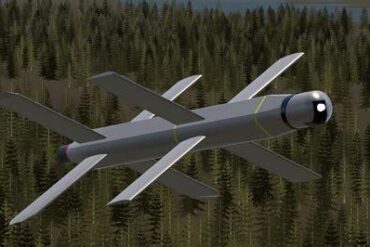
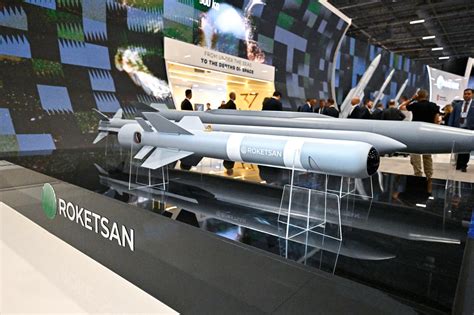
The EREN loitering munition, developed by Roketsan, sits at the intersection of drone and missile technology. Weighing approximately 35 kilograms and measuring about two meters in length, it is powered by a turbojet engine rather than a propeller. That propulsion choice is significant. Turbojet thrust enables higher dash speeds and more dynamic engagement envelopes than electrically powered or piston-driven loitering drones.
EREN combines GNSS/INS mid-course navigation with an imaging infrared (IIR) seeker in the terminal phase. An imaging infrared seeker does more than detect heat; it forms a thermal image of the target area, enabling pattern recognition and discrimination. That capacity allows operators to confirm targets, abort if necessary, and re-engage if conditions shift. In a dense environment filled with decoys or civilian clutter, such flexibility is not a luxury. It is essential.
With a range exceeding 100 kilometers and endurance above 15 minutes in the target area, EREN can be launched from standoff distance. Once near the threat, it loiters, searches, and then commits to a high-speed terminal dive. Earlier tests validated its performance against static maritime targets. The Black Sea intercept proved it can handle a dynamic, airborne adversary.
The Shahed-Type Threat and the Economics of Defense
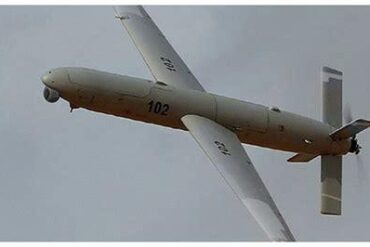
The choice of target—a Shahed-type UAV profile—was no accident. Iranian-designed Shahed-series drones, and their derivatives, have reshaped modern conflict. Cheap, numerous, and relatively simple, they are used to saturate defenses and exhaust high-end interceptors. In recent conflicts, defenders have often expended surface-to-air missiles costing hundreds of thousands or even millions of dollars to destroy drones whose production costs are a fraction of that.
This mismatch creates an unsustainable cost-exchange ratio. Defense planners face a stark arithmetic problem: fire too many expensive interceptors, and the budget collapses; fire too few, and infrastructure burns.
A UCAV armed with loitering interceptors shifts that balance. AKINCI can remain airborne at operational altitude, outside many short- and medium-range air defense envelopes. Instead of launching a million-dollar missile from the ground, it can dispatch a comparatively lower-cost turbojet munition optimized for small, low-speed aerial targets. The platform is reusable, persistent, and mobile. The economics begin to tilt back toward the defender.
Operational Concept: A Mobile Counter-UAS Bubble
When a high-altitude, long-endurance drone carries multiple EREN munitions, it effectively projects a mobile counter-UAS bubble. Operating around 30,000 feet, AKINCI can patrol maritime choke points, border regions, or forward-deployed force areas. Its radar detects incoming drones. Its electro-optical systems verify them. EREN is released from outside the threat’s lethal range and closes the distance at speed.
Because AKINCI features eight hardpoints, it can carry several interceptors while retaining air-to-ground munitions. That duality matters. After neutralizing incoming drones, the same aircraft could strike launch sites, logistics nodes, or command posts linked to the attack. The sensor-to-shooter loop remains compressed, and reaction time is minimized.
From a doctrinal standpoint, this integrates seamlessly into layered air defense. Ground-based systems like Patriot, SAMP/T, or NASAMS provide medium- and long-range coverage. Manned fighters remain available for high-end threats such as crewed aircraft or advanced cruise missiles. AKINCI fills the space in between, persistently screening for lower-cost aerial threats that would otherwise drain high-value resources.
NATO Implications and Strategic Signaling
Türkiye’s demonstration arrives at a sensitive geopolitical moment. The Black Sea region has become a focal point of drone and missile activity. NATO’s eastern flank faces recurring aerial threats ranging from loitering munitions to cruise missiles. By fielding an indigenous AESA-equipped UCAV with air-to-air intercept capability, Türkiye strengthens not only its own air defense but potentially that of the broader Alliance.
Baykar has already established itself as a leading exporter of armed UAVs. Systems such as the TB2 and AKINCI operate in multiple allied inventories. The addition of EREN as a multi-domain effector expands that export portfolio into the counter-drone domain. For NATO planners, the concept of deploying AKINCI detachments to provide round-the-clock counter-UAS coverage over vulnerable corridors becomes operationally plausible.
Instead of tying up high-performance fighters in defensive patrols against slow, small UAVs, air forces could leverage persistent unmanned patrols. Fighter aircraft would then focus on high-threat missions requiring speed, maneuverability, and complex human judgment. In resource-constrained environments, such role specialization increases overall resilience.
Sovereign Integration and Industrial Momentum
A subtle but crucial aspect of this milestone lies in industrial sovereignty. AKINCI, MURAD AESA radar, and EREN are domestically developed systems. Integration occurred within a national industrial ecosystem rather than through fragmented foreign sourcing. That vertical coherence accelerates iteration cycles. When a sensor update is needed, or a seeker algorithm refined, domestic collaboration reduces friction.
The February 2026 intercept is therefore not an isolated stunt. It represents the culmination of incremental integration: airframe, propulsion, radar, guidance, and software converging into a cohesive combat capability. Türkiye has moved beyond replicating existing concepts. It is now shaping new ones.
A Glimpse of the Future Air Defense Architecture
The Black Sea intercept signals a broader evolution in how air defense may be structured in the coming decade. Traditional hierarchies—ground radar detects, command center assigns, fighter intercepts—are giving way to distributed, autonomous nodes. A HALE UCAV equipped with its own radar and armed with turbojet interceptors exemplifies that shift.
In future conflicts defined by swarms and saturation, persistence will matter as much as speed. Endurance becomes a weapon. The ability to loiter, watch, and selectively strike is not glamorous, but it is strategically potent. AKINCI’s first confirmed air-to-air kill using EREN demonstrates that unmanned platforms are no longer confined to supporting roles. They can defend airspace directly.
Türkiye has effectively converted a long-endurance strike drone into a drone hunter. The message is clear: air defense in the age of mass-produced UAVs will not rely solely on expensive missiles and manned jets. It will depend on adaptable, networked, and economically sustainable systems capable of meeting low-cost threats on their own terms.