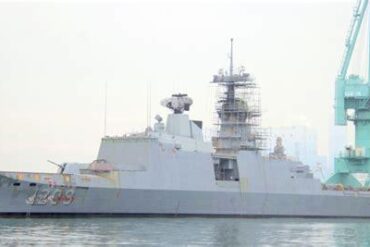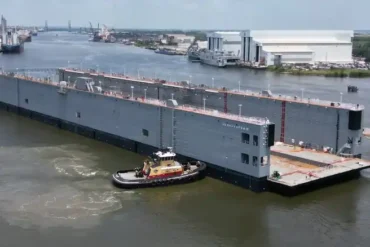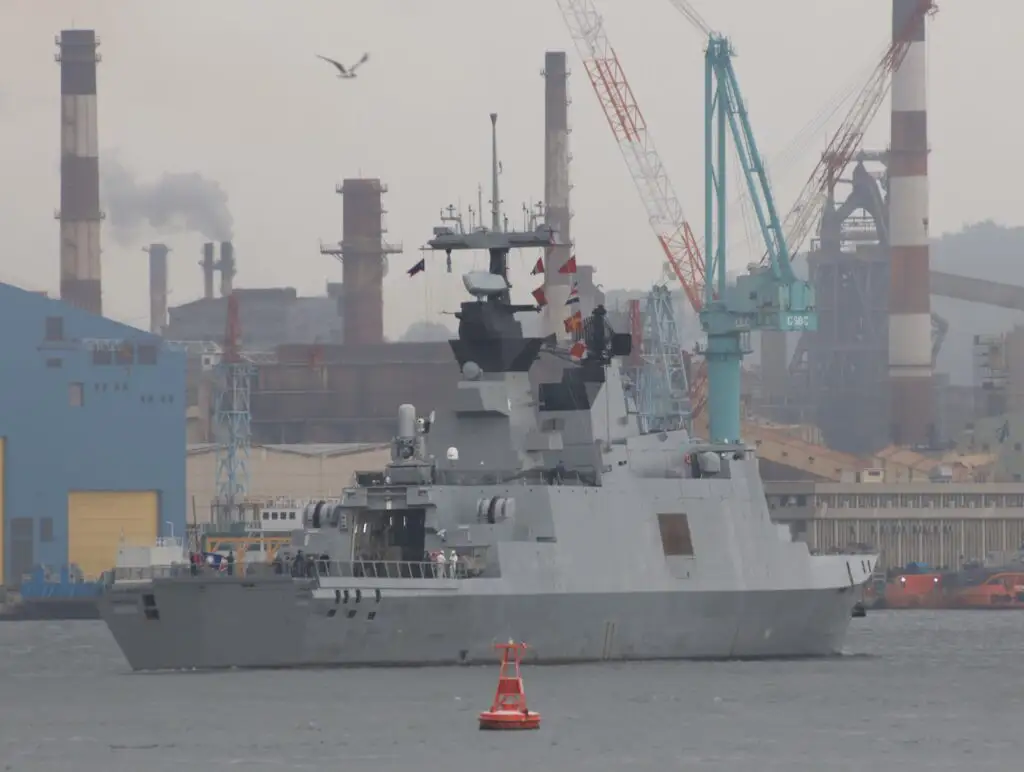
The Republic of China Navy has taken another visible step in reshaping its surface combatant force as the Kang Ding-class frigate Kang Ding (PFG-1202) entered a CSBC Corporation Taiwan dry dock in Kaohsiung in early January 2026. This movement is not a routine maintenance evolution, but part of a fleetwide combat system performance improvement program designed to fundamentally alter how these aging yet strategically vital frigates defend themselves and the waters around Taiwan. With air and missile threats growing more complex across the Taiwan Strait, the refit signals a deliberate shift from legacy point-defense thinking toward layered, medium-range air defense anchored in indigenous technology.
The docking of Kang Ding follows closely behind the completion of modernization work on sister ship Chen De (PFG-1208), the first vessel to receive the full upgrade package. Together, these two milestones suggest that the program has moved beyond experimentation and into sustained execution. Rather than refitting ships one at a time with long operational gaps, the navy is now clearly managing overlapping upgrade and testing cycles to preserve fleet availability while accelerating modernization momentum.
From the outside, Kang Ding already showed unmistakable signs of transformation even before entering the dock. Structural changes around the main mast and aft sensor platforms revealed that this refit would go far beyond cosmetic updates or incremental electronics swaps. The ship is being re-engineered to serve as a credible air-defense escort, correcting limitations that have followed the class since its controversial birth in the 1990s.
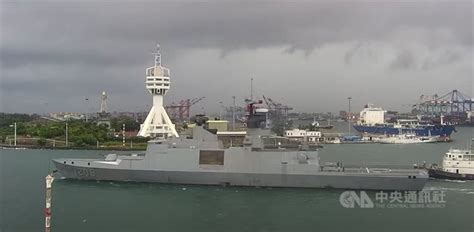
A Strategic Modernization Anchored in Missile Power
The most consequential change awaiting Kang Ding lies in the complete replacement of its legacy RIM-72C Sea Chaparral launcher. For decades, this system defined the ship’s air-defense envelope, offering an engagement range of barely 3 to 4 kilometers. Against modern anti-ship missiles, sea-skimming aircraft, and saturation attacks, such reach was dangerously short. Its removal marks the end of a stopgap solution inherited from political constraints rather than naval doctrine.
In its place, the frigate will receive the Hua Yang vertical launch system (VLS), an eight-cell module capable of quad-packing Sea Sword II (TC-2N) surface-to-air missiles. This configuration allows each Kang Ding-class frigate to carry up to 32 ready-to-fire interceptors, a dramatic increase in both defensive depth and tactical flexibility. Instead of firing a single missile at a time and waiting for reload opportunities, the ship can now engage multiple airborne threats in rapid succession.
The Sea Sword II itself represents a generational leap. With an engagement range commonly cited at around 30 kilometers, the missile pushes the frigate’s defensive reach far beyond point defense and into true area coverage. Its active radar guidance allows for mid-course updates and autonomous terminal homing, reducing reliance on continuous ship-based illumination and increasing resilience in contested electromagnetic environments. For a navy facing dense electronic warfare scenarios, this matters as much as raw range.
Radar Transformation: Seeing Farther, Seeing Smarter
Missiles alone do not win air-defense battles; sensors decide what gets shot at and when. The modernization program recognizes this reality by replacing the Kang Ding-class’s outdated radar suite with the Type 997 Artisan three-dimensional radar. Even before docking, the partial removal of the Hai Shen G (Triton-G) low-altitude radar structure on Kang Ding made clear that a major sensor overhaul was underway.
The outgoing radars, including the DRBV-26D Jupiter II, were products of a different era. As two-dimensional systems, they struggled with altitude discrimination, clutter rejection, and high-density target tracking. In modern threat environments filled with unmanned aerial vehicles, decoys, and sea-skimming missiles, those weaknesses translate directly into delayed reactions and reduced interception chances.
Artisan changes the equation. As a fully 3D air-search radar, it provides accurate range, bearing, and altitude data while tracking hundreds of air and surface targets simultaneously. Its instrumented range is often cited at over 200 kilometers, but its real value lies in rapid track updates and strong resistance to electronic interference. This radar was designed to operate in cluttered littoral environments, exactly the conditions that define Taiwan’s surrounding seas.
The integration of Artisan with the Sea Sword II missile creates a sensor-shooter loop that simply did not exist on the Kang Ding-class before. Detection, classification, engagement, and kill assessment can now occur within a single, coherent combat system architecture rather than through loosely coupled subsystems.
Combat System Integration and Indigenous Engineering
Behind the visible hardware changes lies a quieter but equally complex effort: combat management system integration. The Kang Ding-class is based on the French La Fayette-class design, and its original architecture was never intended to host Taiwan’s indigenous missile and sensor suite at this scale. Bridging that gap requires extensive software development, interface engineering, and system testing.
The modernization program, valued at approximately NT$43.1599 billion, covers all six ships in the class and runs through 2030. It includes not only missiles and radars, but also upgraded electro-optical sensors, revised command-and-control consoles, and new data-processing hardware. The goal is to ensure that French-origin hulls and propulsion systems can seamlessly operate with Taiwanese-developed weapons without performance bottlenecks or reliability compromises.
Chen De’s ongoing transition into live-fire verification with the Sea Sword II is a critical proving phase. These trials are intended to confirm that radar tracking, fire control, and missile guidance function as a unified whole under real sea conditions. Kang Ding entering dry dock while Chen De moves toward at-sea testing highlights a deliberate sequencing strategy: lessons learned from one ship feed directly into the next.
From Political Constraints to Operational Reality
To understand the significance of this upgrade, it is necessary to revisit the origins of the Kang Ding-class. Conceived under Taiwan’s Kuang Hua naval modernization program in the late 1980s and early 1990s, the ships were intended to replace aging surface combatants and strengthen anti-submarine and escort capabilities. Taiwan selected a derivative of the La Fayette design for its reduced radar signature and endurance, finalizing a contract in 1991.
However, political restrictions reshaped the final configuration. Several planned French weapons and sensors, including medium-range surface-to-air missiles, were withheld. As a result, the ships entered service with a patchwork of U.S.-supplied and domestic systems, leaving air defense as their most glaring weakness. The Sea Chaparral launcher, while better than nothing, was never meant to be a primary defense against modern threats.
Despite these limitations, all six frigates commissioned between 1996 and 1998 and have served continuously for nearly three decades. They have performed escort duties, anti-submarine warfare, and maritime security missions, often operating in environments where their air-defense shortcomings were mitigated by allied coverage or careful tasking. The current modernization finally aligns their defensive capabilities with their operational responsibilities.
Kang Ding: The Lead Ship Reimagined
As the lead ship of the class, Kang Ding (PFG-1202) carries symbolic and practical weight. Commissioned in MayZY? Wait ensure accuracy: commissioned May 1996. Homeported at Zuoying Naval Base, the frigate has accumulated decades of patrols and exercises across the Western Pacific. With a standard displacement of around 3,200 tonnes and a full-load displacement of approximately 3,800 tonnes, it remains a capable platform in terms of endurance and seakeeping.
Powered by four SEMT Pielstick diesel engines driving two shafts, Kang Ding can reach speeds of about 25 knots and range roughly 4,000 nautical miles at cruising speed. Its original armament included Hsiung Feng II anti-ship missiles, a 76 mm OTO Melara gun, 40 mm Bofors guns, a Phalanx CIWS, torpedo tubes, and support for an S-70C(M) helicopter. What it lacked was depth in air defense.
This refit does not turn Kang Ding into an area-defense destroyer, but it does transform the ship into a credible medium-range air-defense escort. In fleet operations, that distinction matters. Escorts that can defend themselves and contribute to group air defense free higher-end assets to focus on offensive or command roles.
Fleet-Level Impact and Operational Balance
The Taiwanese Navy plans to refit the six frigates sequentially, generally at a rate of one ship per year, carefully balancing modernization with readiness. This approach avoids creating capability gaps while steadily raising the baseline performance of the surface fleet. By the end of the decade, the Kang Ding-class will no longer be defined by what it lacks, but by how effectively it integrates into a layered naval defense network.
At a strategic level, the upgrade reflects a broader emphasis on indigenous defense solutions. The Hua Yang VLS and Sea Sword II missile are domestic systems, reducing dependence on foreign suppliers and political uncertainty. Coupled with imported but proven sensors like Artisan, the result is a hybrid architecture optimized for Taiwan’s specific threat environment.
The image of Kang Ding resting in dry dock is therefore more than a snapshot of maintenance. It represents a pivot from inherited compromise toward deliberate capability. Steel is being cut, radars replaced, and missiles integrated not as symbolic gestures, but as practical responses to evolving maritime and aerial threats. When Kang Ding emerges from the yard, it will sail not as a relic of constrained procurement, but as a modernized combatant shaped for the realities of 21st-century naval warfare.