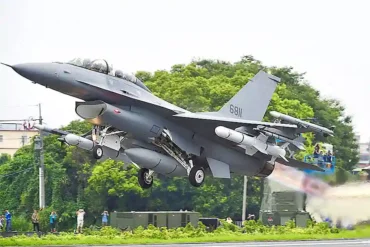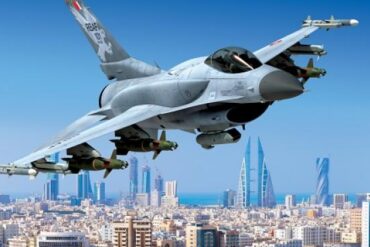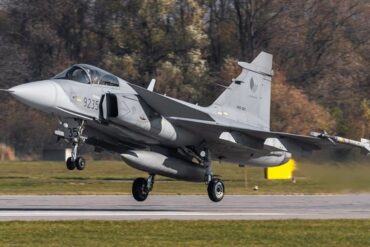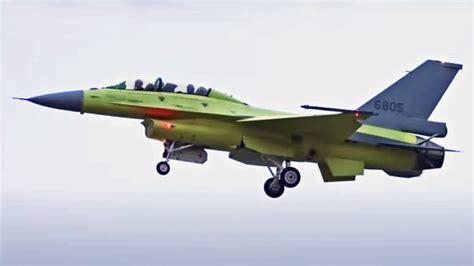
Taiwan is preparing to begin test flights of its new F-16V Viper fighters this month, a long-awaited turning point in the island’s effort to modernize its air force while China’s J-20 stealth armada grows at unprecedented speed. The advancement comes as military planners in Taipei race to field a force capable of surviving the increasingly dense web of People’s Liberation Army Air Force (PLAAF) incursions into the island’s air defense identification zone.
Taiwanese Air Force Chief of Staff Lee Ching-jan confirmed during a December 1 parliamentary briefing that test flights would begin sooner than planned, with 54 of the 66 F-16Vs already advancing through assembly—an increase from 50 in October. This progress reflects intensified work by Lockheed Martin, which has shifted to two 20-hour shifts every weekday to mitigate software integration issues and global supply chain stress.
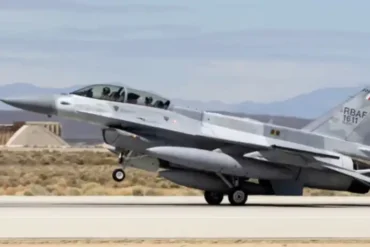
The original $8 billion acquisition, approved by Washington in 2019, aimed for deliveries beginning in 2026. But delays tied to manpower shortages and component bottlenecks—affecting other buyers such as Bahrain, Slovakia, and Bulgaria—have forced Taiwan to revise expectations. Only about 10 jets are expected to complete testing by late 2025.
Current projections suggest the first aircraft will arrive via trans-Pacific ferry flights in early 2026, supported by U.S. aerial refueling tankers. The full batch is now expected to enter service between 2027 and early 2028, pushing Taiwan to extend the operational life of its Mirage 2000 fleet while awaiting the new Vipers.
Reinforcing a Unified Viper Fleet
Once delivered, the new aircraft will join Taiwan’s 141 upgraded F-16A/Bs, all modernized under the $4.5 billion Peace Phoenix Rising program completed in 2023. Together, the fleet will form more than 200 advanced F-16Vs, primarily concentrated at Chiashan Air Base under the 7th Tactical Fighter Wing.
These deployments aim to strengthen Taiwan’s readiness for air defense, maritime patrol, and joint operations, particularly as PLAAF patrols test response times and operational stamina.
F-16V: A 4.5-Generation Workhorse with Modern Teeth
The F-16V represents a significant leap over Taiwan’s legacy platforms, centered on the AN/APG-83 SABR AESA radar, which dramatically enhances detection ranges, resistance to jamming, and the ability to track low-observable threats such as cruise missiles.
Pilots gain additional advantages from a new center pedestal display, helmet-mounted cueing system, Link 16 datalink, precision GPS, and a modular mission computer that simplifies future upgrades. Structural improvements—including reinforced wings, fuselage, and landing gear—extend the aircraft’s service life to about 12,000 flight hours, a 50% increase over earlier Falcons.
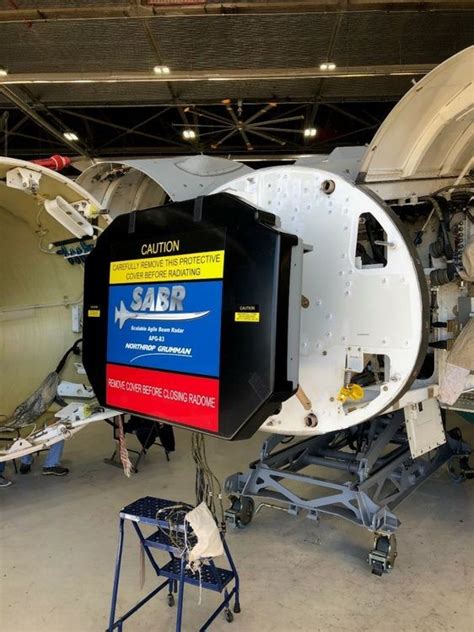
Powered by the F110-GE-129 engine generating 29,000 pounds of thrust, the jet carries up to 17,000 pounds of ordnance on nine hardpoints. Its weapons suite includes AGM-84 Harpoon anti-ship missiles, AGM-154 JSOW, AGM-88 HARM, and potentially the AGM-158 JASSM, which would sharply expand its long-range strike reach.
Facing Down a Fifth-Generation Juggernaut
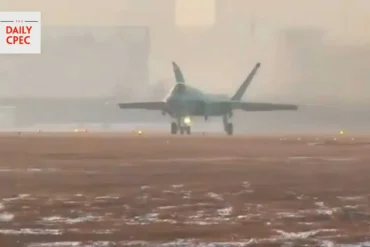
Despite these upgrades, Taiwan faces an increasingly unbalanced matchup. China has now deployed more than 300 J-20 Mighty Dragons, each fitted with WS-15 engines capable of sustained supersonic cruise. With a low radar cross-section and access to PL-15 long-range missiles exceeding 200 km, the J-20 gives PLAAF units a first-look, first-shot advantage.
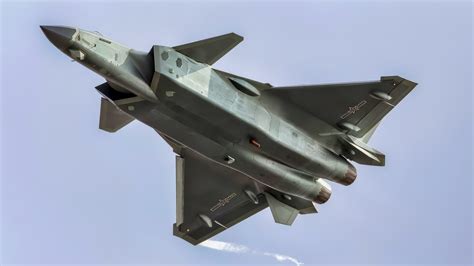
The recent debut of China’s second fifth-generation fighter, the J-35A, has reinforced this momentum. Further ahead lie sixth-generation prototypes—the tailless J-36 and the twin-engine J-50—both flight-tested since late 2024 and showing features such as thrust-vectoring and diverterless supersonic inlets.
Analysts expect China to field its first next-generation fighters by the mid-2030s, possibly ahead of the U.S. Air Force’s Next Generation Air Dominance (NGAD) timeline.
A Contest of Detection and Survival
The J-20’s stealth profile presents a direct challenge to Taiwan’s fighters, which risk detection by KJ-500 airborne early warning aircraft guiding long-range missile strikes. A Chinese pilot’s unverified claim in 2024 of stealth overflights over Taiwan underscores the vulnerability.
To offset this challenge, the U.S. approved a $500 million sale of Legion Pod infrared search and track (IRST) systems in 2023, followed by a $345 million contract in 2024. These pods allow F-16Vs to passively detect heat signatures from stealth aircraft—potentially identifying a J-20 from distances beyond 100 km.
Taiwanese officials maintain confidence in their layered defenses, which include Patriot and Sky Bow missile batteries. Still, experts warn the island’s air superiority remains contested as China expands its nearly $300 billion defense budget.
Strategic Urgency Shapes Every Decision
The approaching F-16V test flights represent more than a technical milestone. They symbolize Taiwan’s determination to hold the line against a far larger adversary, to close technological gaps wherever possible, and to ensure that future air battles—if they come—are fought on terms the island can survive.
Progress continues amid delays. Training pipelines, infrastructure upgrades, and joint U.S.–Taiwan planning are unfolding alongside assembly-line acceleration. With each new aircraft entering service, Taipei brings itself one step closer to fielding a modernized air force designed to meet the asymmetric reality of 21st-century air combat.
In the broader contest of deterrence and resolve, the race to bring these cutting-edge Vipers into the sky has never carried more weight.