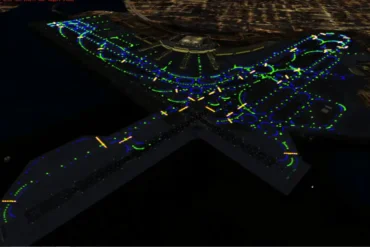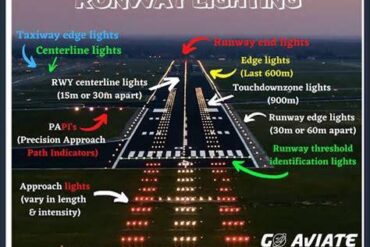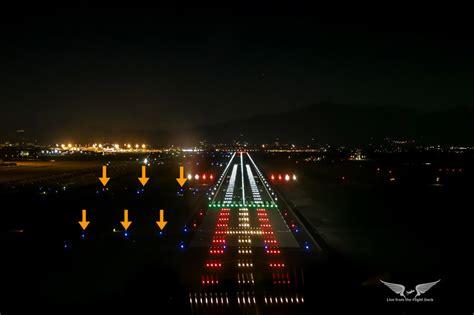
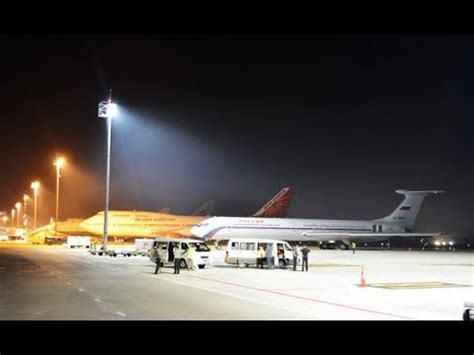
Fly over any airport at night, and you’ll notice something interesting. While the terminal and apron areas are lit up with massive floodlights, and the runway glows like a holiday display, the area in between often looks quite dim. That’s no accident. Taxiway lighting is designed to be less intense than runway lighting, but it’s just as complex and purposeful.
This difference isn’t random — it’s meant to help pilots clearly distinguish where they are. Lighting on the taxiway shows the centerline and edges, helping pilots guide their aircraft safely, especially in low visibility. It’s not only helpful at night. Bad weather can make it tough to see during the day, too.
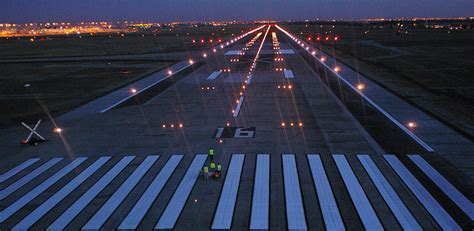
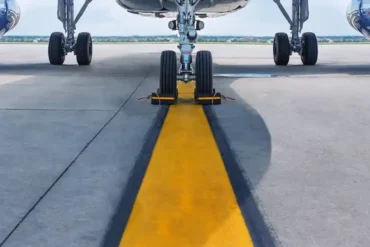
Ramp areas are usually well-lit, but pilots don’t just drive around freely. There are marked taxi routes meant to keep aircraft clear of obstacles like light poles or hangars. In large planes, the cockpit crew can’t see the full wingspan, so staying on the centerline makes sure wingtips and the tail don’t hit anything.
Situational awareness is just as important on the ground as it is in the air. The worst aviation disaster ever actually happened on the ground—in Tenerife, Spain, where two Boeing 747s collided in fog. The Pan Am aircraft couldn’t find the taxiway and remained on the runway. The KLM crew didn’t know the runway was still occupied and began their takeoff. The crash killed 583 people. One root cause was poor visibility and confusion, something today’s taxiway lighting systems aim to fix.
What Types of Lights Are Used?
Taxiway lights can be either LED or incandescent. Older or smaller airports usually use incandescent bulbs. They’re cheaper upfront but don’t last as long and cost more to run. Still, they’ve got a bonus: they give off heat, which can melt snow and improve visibility in cold climates. LEDs don’t do that unless they have built-in heaters, which adds cost and maintenance.
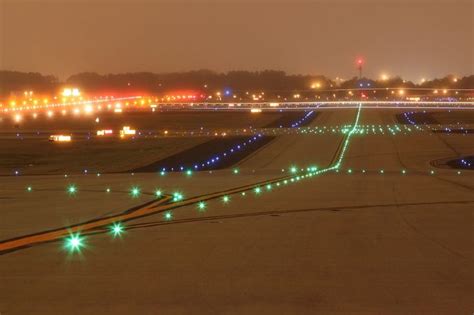
Depending on their role, taxiway lights may shine in one, two, or all directions. Their colors also matter. Like traffic signals, green means go, yellow is caution, and red means stop. Blue and white help tell apart taxiways from runways.
Taxiway Centerline Lights
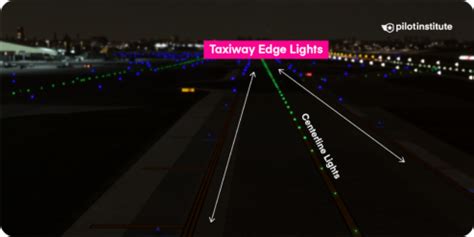
These are the most basic lights on a taxiway. As their name suggests, they trace the painted centerline and glow steady green. They’re bidirectional and help pilots stay aligned, especially in tight or busy areas.
While runways use white lights, some pilots have still confused taxiways for runways, leading to dangerous situations and serious consequences. Misaligning for takeoff or landing can trigger an FAA investigation and possibly a dreaded phone call.
Centerline lights aren’t just for taxiways. You’ll also spot them along ramps, aprons, and even some parts of runways used for taxiing. These lights are usually placed just to the side of the painted centerline—by design. The maximum allowed offset is two feet. That way, when the pilot follows the painted line in clear conditions, the lights don’t bump the nosewheel constantly.
At smaller airports, lights might be placed directly over the painted line. Instructors sometimes challenge their students to hit every light on the way. It’s not just for fun—it helps new pilots learn how their steering lines up with their seating position.
Even though these lights are recessed, they still stick up about an inch. If the plane doesn’t have a good nosewheel shock absorber, you’ll definitely feel it. For light aircraft with simple steering, hitting a centerline light at speed can even throw the aircraft off course.
Taxiway Edge Lights
At night, it’s nearly impossible to tell where the taxiway ends and the surrounding ground begins. Both look pitch black. Yellow edge markings don’t help much unless they’re lit up, and even then, things like water or dust can block them from view.
If a wheel drops off the pavement, the aircraft can get stuck. That’s why edge lights are so important. These blue lights sit along both sides of the taxiway and are carefully spaced—anywhere from 50 to 200 feet apart, based on FAA rules and the specific area.
Unlike some other lighting systems, taxiway edge lights are omnidirectional. They shine in every direction but aren’t super bright, which keeps the airport from looking like a blue light disco.
Why Taxiway Lights Don’t Need to Be Super Bright
When it comes to taxiway lights, blinding brightness isn’t necessary. These lights are mainly for the pilots and ground crews using the taxiways—not for pilots flying overhead. That’s why they’re usually pretty dim and hard to spot from above.
Apron edge lighting works the same way. Sometimes it’s listed separately from taxiway edge lights, but in reality, it’s exactly the same setup. The only twist? In areas where aircraft might roll close to or over the lights—like sharp turns or tight parking spots—the lights are recessed into the pavement to keep them safe from damage. This is especially useful in spots where jet blast from engines could knock over exposed fixtures.
To boost visibility even more, the FAA allows reflectors alongside edge lights. At small airports, these reflectors might even replace actual lights—as long as the centerline is well-lit—which helps cut costs.
Curved Taxiways and Long Aircraft: A Tight Squeeze
Turning a massive plane on the ground isn’t as easy as steering a car. The main landing gear can be dozens of feet behind the cockpit, and the pilots can’t actually see where the wheels are going. This makes sharp turns on taxiways especially tricky.
In the past, pilots used a method called Judgemental Oversteering. They’d keep taxiing straight even if the centerline curved, and only begin turning when they were sure the plane’s wheels would stay within the edges of the turn. The problem? It’s basically a guessing game—and one mistake could cause a wheel to roll off the pavement.
To fix that, modern airports have introduced the Cockpit-over-Centerline design. This means the centerline is purposely offset toward the outside of a turn. Instead of guessing, pilots just follow this specially placed line, which ensures all wheels stay within bounds.
To help with visibility, the inner edge of the curve gets more lights placed closer together. That makes it clear where the taxiway ends, especially during tight turns in low visibility.
What Are Clearance Bar Lights?
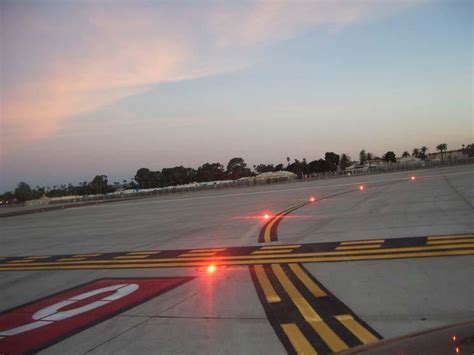
Clearance bars are simple but important. They’re made up of three steady yellow lights set across the taxiway to signal a holding position. These aren’t the same as runway hold points—instead, they’re mainly used when visibility is extremely low or to prevent aircraft from entering an intersection too soon.
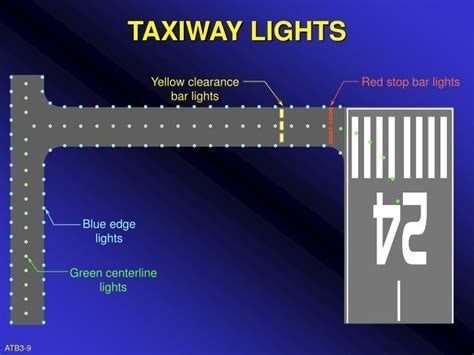
ATC might tell a pilot to taxi and then stop before reaching a certain intersection. That’s where clearance bars come in—they tell pilots, “This is where you stop.”
These lights are always in-pavement, so aircraft can roll over them if cleared. They’re required when visibility drops below 600 feet RVR (Runway Visual Range).
Runway Guard Lights (RGLs): The Flashing Yellow Stop Signs
Runway Guard Lights work just like clearance bars but are placed at a much more critical point—right before the runway hold line. Their job is to grab a pilot’s attention and say, “You’re about to enter a live runway.”
You’ll see these in two styles:
- A row of in-pavement yellow lights.
- Or a pair of elevated flashing yellow lights on either side of the taxiway.
Don’t mix these up with clearance bars — RGLs are always near the runway hold line, while clearance bars aren’t. If the runway isn’t in use, the lights are turned off to avoid confusing pilots.
Stop Bar Lights: The Red Line You Shouldn’t Cross
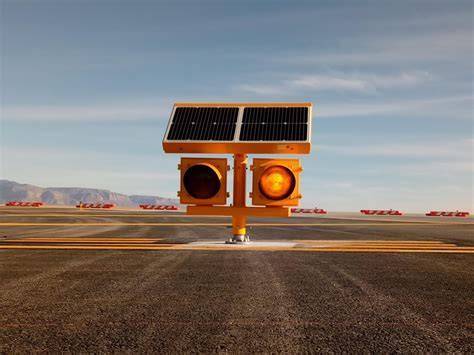
Stop bars are a line of unidirectional red lights across the taxiway just before a runway. These lights send a very clear message: “Stop. Do not enter the runway.”
They’re mostly used in low visibility conditions and help reinforce ATC instructions. The lights are embedded in the pavement, and sometimes raised stop lights are added along the sides to make them more visible from a distance or awkward angles.
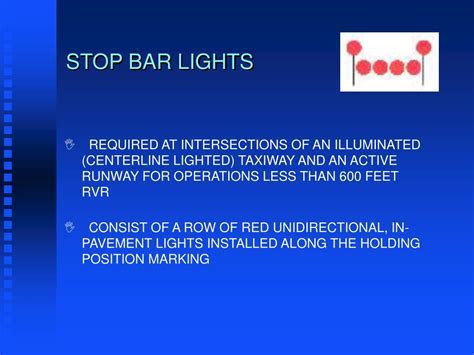
At airports with visibility below 600 feet RVR, these are mandatory. Some stop bars are controlled by ATC, meaning they can turn them off and on based on aircraft movement. Others are automatic (uncontrolled) and switch based on timers or pavement sensors.
Here’s how they work:
- Controlled stop bars are used on busy taxiways.
- As soon as the stop bar turns off, lead-on lights (green) switch on to guide the aircraft onto the runway.
- Once the aircraft moves forward, sensors turn the red stop lights back on for the next aircraft.
Some airports skip the sensors and just use timers to reset everything. Either way, stop bars don’t replace ATC clearance. If the lights turn off by accident, don’t proceed—call ATC. Likewise, if they stay on after you’re cleared to move, don’t cross them until they’re turned off.
Lead-Off Lights: Guiding Planes Off the Runway
So what happens after a plane lands? It needs to exit the runway quickly. That’s where Taxiway Centerline Lead-Off Lights come in. These lights help aircraft transition off the runway safely.
They’re green and yellow alternating lights that show the aircraft is still technically in a critical zone—either on the runway or inside the ILS (Instrument Landing System) critical area.
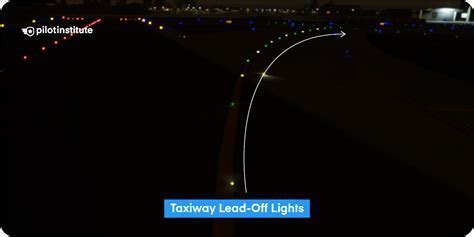
Why does this matter? Because any aircraft or vehicle lingering in this area could interfere with landing aircraft. The longer you stay there, the higher the chance of a go-around for the next plane.
In the worst-case scenario, the next aircraft might not even see you until it’s too late. That’s why vacating the runway quickly and correctly is so important.
In this scenario, the trailing aircraft isn’t moving fast enough to safely take off again, but it’s also going too fast to stop in time. That’s exactly why runway safety has to be taken so seriously.
At the far end of the runway—the departure end—you’ll find the radio transmitters for the Instrument Landing System (ILS). If any aircraft or ground vehicle ends up between these transmitters and an aircraft that’s using the ILS for landing, the system’s signals can get messed up. These interference-prone areas are called ILS critical areas, and air traffic control (ATC) keeps them clear whenever ILS approaches are active.
Taxiway Centerline Lead-On Lights
Taxiway Centerline Lead-On Lights work a lot like the Centerline Lead-Off Lights placed on exit taxiways. But instead of being on the way out, Lead-On Lights are on the way in, mounted on entry taxiways. Their job is the same—letting pilots know when they’re about to enter a runway or ILS critical zone. Basically, don’t hang around there.
These lights can be synced with Stop Bars for clear visual instructions. The same sensors that trigger Stop Bars also work with Lead-On Lights. As soon as an aircraft activates the sensor, the Lead-On Lights for the previous section of the taxi path turn off. This stops the next plane from accidentally trailing it onto the runway.
Lead-On Lights are smart—they’re bidirectional. That means they can act as Lead-Off Lights too, depending on the runway direction.
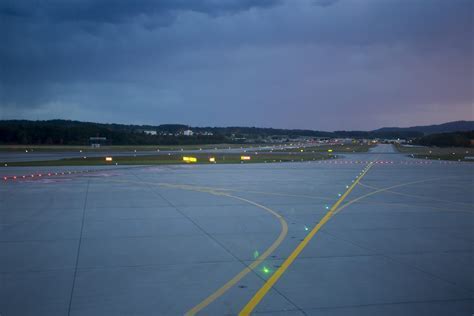
The Runway Status Light System (RWSL) is a newer safety tech rolled out by the FAA. What’s cool is that it works entirely on its own, without ATC input. The system includes two main parts: Runway Entrance Lights (RELs) and Takeoff Hold Lights (THLs). Both use in-pavement red lights to alert pilots and vehicle operators when it’s not safe to enter or cross a runway.
There’s one simple rule for RWSL—if the red lights are on, don’t cross them. Right now, RWSL is live at around twenty large airports like JFK, SFO, and ORD. If it proves effective, more airports will get it.
At places like LAX, you’ll see RWSL lights installed along various runways and taxiways. The system relies on a set of sensors embedded in the pavement. These can detect when an aircraft or vehicle passes over them. And because the system uses multiple sensors, it can also figure out how fast something is moving.
How do these sensors know something’s there? Well, since planes and vehicles are large metal objects, they interfere with magnetic fields when they get close. This disturbance acts as a trigger for the system.
The FAA is also using additional tech like ASDE, Airport Surveillance Radar, and Transponder Multilateration. These help track where aircraft are on the ground. All this data gets merged to make the system more accurate and reliable.
Just a heads-up—RWSL is only meant to add another layer of safety. It doesn’t replace ATC clearance. Pilots still need to follow ATC instructions. And because the lights are directional, the tower usually can’t see them. So if a pilot sees a red light that doesn’t match the ATC clearance, they need to ask for confirmation.
Runway Entrance Lights (RELs)
Runway Entrance Lights are parallel red lights embedded in the taxiway right before a runway. You’ll find one light just before the hold-short line and others spaced evenly up to the runway’s edge. They’re highly directional, so you can only see them when you’re approaching from behind the hold line.
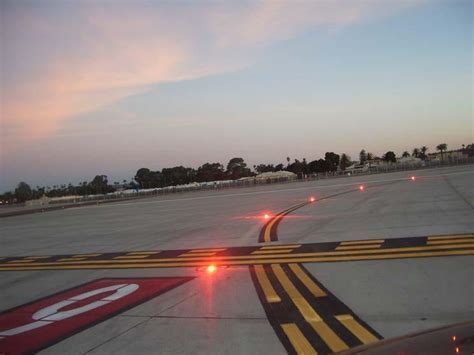
The RELs turn on when a departing aircraft reaches about 30 knots. The lights on all intersecting taxiways light up. Just before the aircraft reaches a crossing taxiway, the system turns those RELs off so the next aircraft doesn’t have to wait longer than necessary.
Once the system confirms the aircraft is airborne, it shuts off all RELs on that runway. It also detects approaching aircraft and lights up the RELs on all intersecting taxiways when the aircraft is within one mile of the runway threshold.
As the landing aircraft moves forward, the system gradually switches off each set of RELs. Once the plane slows to below 85 knots, all RELs more than 30 seconds ahead go dark. When the aircraft is down to 34 knots, all RELs shut off completely. These speed thresholds can be fine-tuned for each runway setup.
If the RELs light up while you’re still taxiing, you should already be holding short. But if ATC clears you to cross and the lights come on, double-check with them. And if you’ve already gone past the hold line when the RELs light up, and you can’t reach ATC due to a busy frequency, you’ll have to make a judgment call—either stop or keep moving—based on your exact position. But do remember, if those lights are on, the runway is likely unsafe.
Takeoff Hold Lights (THLs)
Takeoff Hold Lights are like the runway version of RELs. You’ll see two rows of red lights placed along either side of the runway centerline. They’re also directional, facing the arrival end of the runway, so aircraft lining up to take off or those coming in to land can see them.
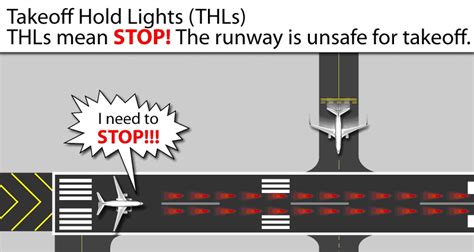
These lights start about 375 feet from the start of the runway and can stretch as far as 1,500 feet. THLs light up whenever an aircraft or ground vehicle is about to cross—or is crossing—the runway, while another aircraft is ready to depart or has just started takeoff.
Just like RELs, THLs turn off shortly before the obstruction is gone to keep things moving efficiently. You might even see them blink on and off multiple times if several vehicles or planes are crossing.
Important note: THLs turning off doesn’t mean you’re cleared for takeoff. That will always come directly from ATC.
If your aircraft starts accelerating for takeoff and the THLs suddenly turn on, you should abort the takeoff—if it’s still safe to do so. Like RELs, any unexpected lighting event means it’s time to contact ATC. If you can’t get through, you’ll need to decide whether it’s safer to keep going or to stop.
How Do Landing Aircraft Know If the Runway Is Clear?
Landing aircraft usually can’t see the THLs clearly until they’re almost on top of the runway threshold because the lights aren’t very bright at a distance. However, the same sensor network used by the RWSL feeds into other safety lighting systems, helping keep everyone informed.
The Final Approach Runway Occupancy Signal (FAROS)
FAROS is an important system designed to alert landing aircraft to potential runway incursions. It operates by flashing the normally steady-burning PAPI (Precision Approach Path Indicator) lights. If you see these lights flashing on your approach, it’s a clear signal to abort your landing attempt and go around to avoid any risks.
How Do Pilots Control Airport Lighting?
At most airports, airport lighting, including taxiway lights, is controlled by ATC (Air Traffic Control). Some lights have automatic photometric sensors that turn them on when daylight fades or during adverse weather. However, manual control is retained by ATC or by the local Flight Service Station (FSS) at uncontrolled airports.
Pilots can request to have lights turned on, even in relatively good weather, and ATC typically complies. Airport lighting usually has multiple intensity settings, with the highest level used in low visibility conditions during the day. On clear nights, the lighting is reduced to avoid ruining pilots’ night vision. This is important because it can take the eyes 20-30 minutes to adjust to darkness after being exposed to bright lights, making any go-arounds more challenging.
Airport Lighting Control at Unmanned Airports
At airports without ATC, a system called PCL (Pilot Controlled Lighting) is often used. Also referred to as ARCAL (Aircraft Radio Control of Aerodrome Lighting), this system allows pilots to activate airport lights remotely via radio. Pilots simply key the aircraft’s microphone while tuned to the designated frequency. The system counts the microphone clicks and turns on the lights at the desired intensity level.
The frequencies used for PCL are listed in the FAA’s Chart Supplement U.S. for public airports. Sectional maps don’t typically include this information, but any instrument approach procedures for the airport will contain lighting data. For most airports, the UNICOM or CTAF (Common Traffic Advisory Frequency) is the standard frequency for PCL activation. At airports with part-time ATC, the tower frequency is used.
Once activated, the lights stay on for a set period (usually 15 minutes) and flash once as the timer nears expiration. This is designed to give pilots a warning before the lights shut off. Pilots can reset the countdown by clicking the mic again or adjusting the light intensity during the countdown.
Types of PCL Systems
There are two main types of PCL systems: Type J and Type K.
- Type K systems allow for adjustable light intensity. To activate, pilots click the mic seven times within five seconds. Once activated, light intensity can be set to low, medium, or high by clicking the mic three, five, or seven times, respectively. The FAA recommends clicking seven times initially to light up all controllable lights at maximum intensity, then adjusting as needed.
- Type J systems, on the other hand, do not have adjustable light intensity. They only require five clicks to turn the lights on.
While the PCL system can add to pilot workload, especially during critical phases of flight, it’s a crucial tool for enabling nighttime operations at small airports that may not have the resources to employ ATC personnel around the clock.
Conclusion
Given the high stakes in aviation, where even a small misunderstanding can result in catastrophic consequences, the FAA is continuously working to enhance systems that improve safety and situational awareness for pilots, ground crews, and ATC. Technologies like RWSL (Runway Status Light System) could have potentially prevented disasters like the Tenerife collision in 1977. These advancements play a vital role in reducing ground collisions and improving overall airport safety.