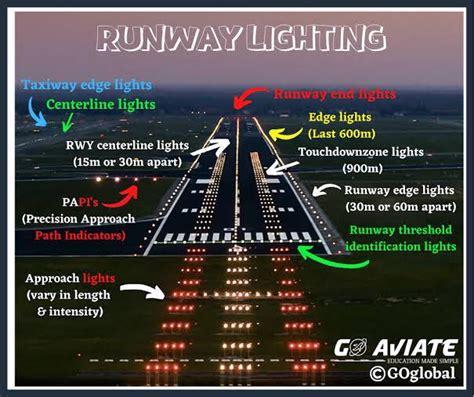
An approach lighting system (ALS) is crucial for safe landings. It consists of lights that guide pilots as they transition from instrument to visual flight. These lights are strategically placed on both sides of the runway’s extended centerline, starting at the landing threshold and extending into the approach zone. The ALS provides essential visual information about runway alignment, height perception, roll guidance, horizon references, and limited distance-to-go data.
The International Civil Aviation Organization (ICAO) defines several types of ALS. First, there’s the simple ALS, designed for non-instrument runways and non-precision approaches. Then we have the precision approach category I lighting system, followed by the more advanced category II lighting system. Generally, ALS configurations consist of a row of lights that stretches from the runway threshold for several hundred meters, accompanied by one or more crossbars.
A simple approach lighting system typically features a row of lights extending at least 420 meters from the runway threshold. This row also includes a crossbar 18 or 30 meters long, positioned 300 meters from the threshold. Lights along the centerline are usually spaced 60 meters apart, though this can be reduced to 30 meters for better guidance.
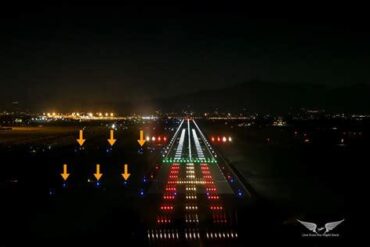
For a CAT I lighting system, the layout includes a row of lights extending 900 meters from the runway threshold, spaced 30 meters apart, with added crossbars. The first 300 meters uses a single light source, the next 300 meters employs two sources, and the final stretch uses three. Crossbars are placed at intervals of 150, 300, 450, 600, and 750 meters, with the 300-meter bar measuring 30 meters in length.
In contrast, a CAT II/III lighting system also extends 900 meters but includes two side rows reaching 270 meters from the threshold. The side rows usually maintain a spacing of 30 meters, which can be increased to 60 meters under specific serviceability conditions. Here, the centerline lights shine white, while the side rows glow red. Crossbars, also white, are positioned at the same intervals as in the CAT I system.
When using barettes instead of individual light sources, they must meet specific length requirements—at least 3 meters for simple ALS and 4 meters for others. In these cases, only one crossbar is installed at 300 meters for CAT I and two for CAT II/III at 150 and 300 meters.